All species › Pigeons and doves › Doves and pigeons › Torresian Imperial Pigeon
Torresian Imperial Pigeon | Ducula spilorrhoa
Bonte muskaatduif | Dúcula Imperial
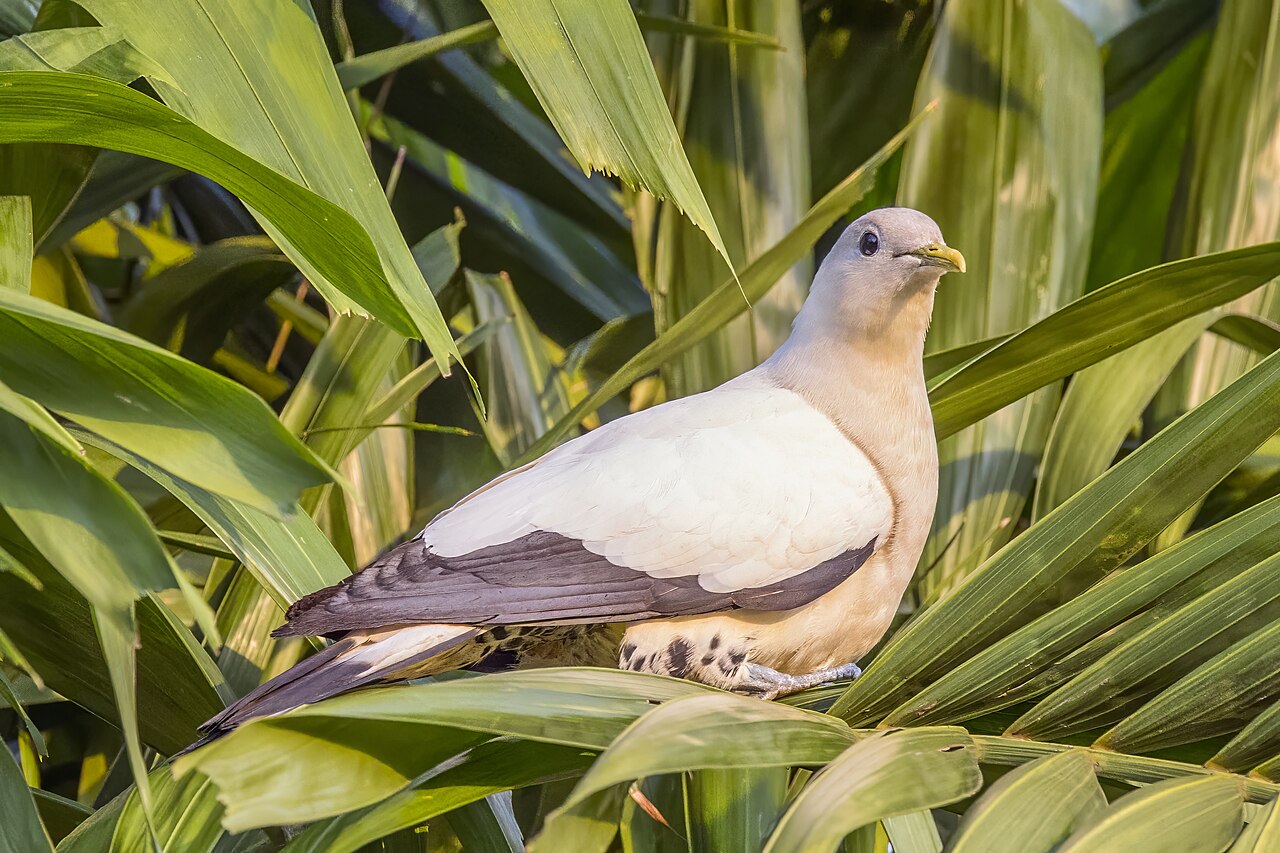
A big cream-white pigeon with black wingtips and a black tail edge that commutes daily between its island roost and the mainland across tropical northern Australia. Soon after dawn and again towards sunset, long strings of white birds cross the sea — for many visitors the first and most startling bird sight of the Queensland coast.
Voice
Deep, low and far-carrying from the canopy: a moaning coo-woo or moo-oop, and a rising up-oooo. In display a bellowing, almost organ-like coo-hoo-hoo or oom-oom-oom that seems to come out of the ground. Over a breeding colony there is a continuous low rumble of hundreds of birds at once, with wing-claps cutting through it.
No freely licensed recording has been found for this species yet; what to listen for is described below.
Identification
About 41 cm and heavily built, a small head on a thick body. The plumage is white to cream, with black primaries, black tips to the secondaries, a black tail edge and black spots and bars on the undertail coverts — that spotted undertail is what the scientific name records. The bill is yellow-green, the legs blue-grey, the eye dark. Birds feeding heavily on figs sometimes stain the head rusty with fruit juice. In flight it is fast and direct, with a strong beat high over the water, often in loose strings of dozens of birds nose to tail.
Confusion species
Collared Imperial Pigeon (Ducula mullerii) is the only other imperial pigeon here and is a vagrant: grey with a white throat and a closed black collar, never mostly white. Topknot Pigeon (Lopholaimus antarcticus) is also bulky and also crosses in flocks, but is grey with a double crest and a red bill. Where the range ends in the south around Mackay and Rockhampton, White-headed Pigeon (Columba leucomela) can mislead: it does have a white head and breast, but a dark slate-black body, and it does not string out over the sea.
Habitat
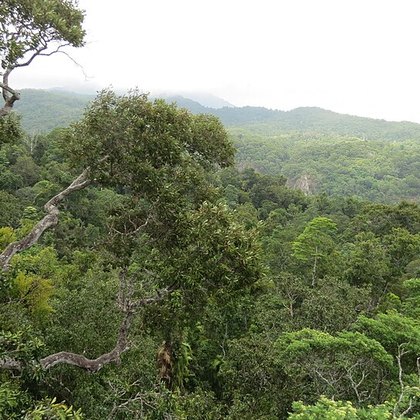
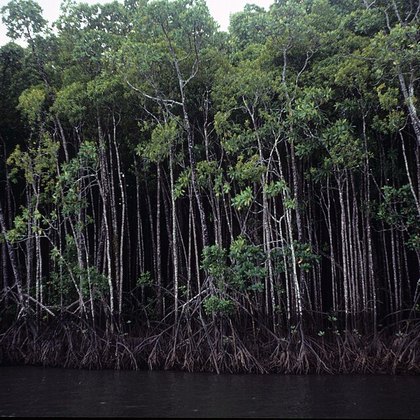
By day it feeds in tropical rainforest, monsoon forest, mangrove and fruiting eucalypt and melaleuca woodland on the mainland; it roosts and breeds in colonies on uninhabited offshore islands, in mangroves, palm fronds and vine tangles. In Cairns something has been added to that: for more than a decade it has also nested in the middle of town, in street trees along the Esplanade and even on TV aerials, streetlights and fittings on power poles.
Where the bird is most often found, arranged by main group and formation.


Range and movements
The tropical northern rim of Australia: the Kimberley in Western Australia, the Top End coast, Cape York and the Torres Strait islands, and the Queensland east coast south to about Rockhampton. It pushes some way inland along the big rivers but avoids the dry interior. Queensland and Northern Territory birds leave for southern New Guinea from February to April and return between August and October; Kimberley birds largely stay, wandering only between islands and coastal woodland.
- Resident
- Breeding (summer)
- dark = core range, pale = thinly spread
Where and when to look
Stand on a headland or beach in the tropics at first light between October and January and look seaward: the flocks leave their island just after sunrise and come back along the same line towards dusk. The Brook Islands off Hinchinbrook and the Low Isles off Port Douglas are the classic colonies. Without a boat, simply walk the Cairns Esplanade, where the nests now hang at eye level above the footpath.
Conservation
Least Concern (LC), with an estimated half a million birds in Australia. That is a recovery rather than a given: through the nineteenth and early twentieth centuries the colonies were shot out by the thousand, for sport and as a supposed pest, until conservationists in north Queensland forced protection through and began annual counts. The fifty-year count series on North Brook Island has trended upward since. Cyclone Yasi wrecked much of that island in 2011; soon afterwards city nesting in Cairns took off, from fewer than 470 nests in 2012–13 to nearly 1,300 in 2020–21.
Scientific name
Ducula spilorrhoa | (Gray, 1858)
George Robert Gray described the species in 1858 in the Proceedings of the Zoological Society of London as Carpophaga spilorrhoa, from Aru Islands material; because it now sits in Ducula, author and year take parentheses. Ducula is formed on Latin dux, ducis, 'leader' — the same root as 'duke', and the reason these pigeons are called imperial pigeons. spilorrhoa is from Greek spilos, 'spot', and orrhos, 'rump', for the black spots on the undertail coverts. It was long treated as a subspecies of Pied Imperial-Pigeon (Ducula bicolor), which is why older guides list it under that name.