All species › Pigeons and doves › Doves and pigeons › Collared Imperial Pigeon
Collared Imperial Pigeon | Ducula mullerii
Zwartkraagmuskaatduif | Dúcula acollarada
The Collared Imperial Pigeon is a vagrant out of New Guinea: a solid grey arboreal pigeon of forty centimetres with a white throat cut off by a closed black band. That collar is so sharp and so complete that one look settles the species. In this region it means a handful of records on the northernmost islands of Torres Strait.

Voice
Deep, booming coos delivered from the crown of a tall tree and felt as a vibration rather than heard as a call — the characteristic sound of the imperial pigeons. Beyond that comes a heavy clatter of wings on take-off. Since only vagrants occur here, the chance of hearing the bird call in this region is vanishingly small.
No freely licensed recording has been found for this species yet; what to listen for is described below.
Identification
A large, heavily built arboreal pigeon of about forty centimetres and some six hundred grams. The upperparts are grey, the underparts grey with a pink wash. Throat and foreneck are white, and below them lies a fully closed black band — the collar the bird is named for, which no other pigeon in this region carries. Head and neck are pale grey, wings and tail darker grey. The bird looks ponderous and usually sits motionless high in a tree.
Confusion species
Torresian Imperial Pigeon (Ducula spilorrhoa) is the only imperial pigeon that is common here and separates at once: clean white with black flight feathers and tail, and no collar at all. A large grey pigeon in the canopy on Cape York is more likely to suggest Topknot Pigeon (Lopholaimus antarcticus), but that bird carries a double crest, has a red bill and a black tail with a pale band, and lacks the white throat and black collar. So a large grey pigeon in Torres Strait needs only one check: a closed black band under a white throat leaves no alternative.
Habitat
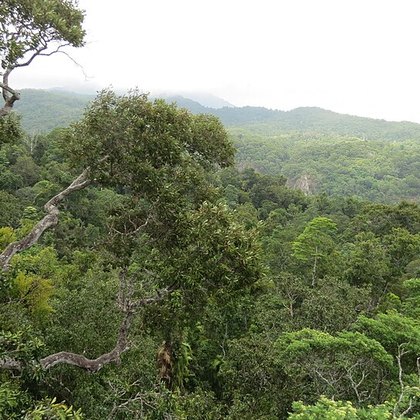
In New Guinea a bird of lowland rainforest, swamp forest, mangrove and the forest strips along rivers, nearly always close to water. It feeds high in the canopy and swallows fruit up to five centimetres across whole; work near Port Moresby recorded Tristiropsis canarioides, ylang-ylang and palm fruits among others, supplemented with insects. The nest is a loose platform of sticks in a tree at the edge of a wetland, with a single egg.
Where the bird is most often found, arranged by main group and formation.


Range and movements
The species belongs to New Guinea — north and south — and the Aru Islands, and occurs within the map window of this guide only as a vagrant. Records concentrate on Boigu and Saibai, the northernmost Australian islands in Torres Strait, which lie a few kilometres off the Papuan coast and where the bird turns up from time to time; further south, on the Australian mainland, it is not established. It amounts to a few dozen records in all, with no settled population and no sign of breeding on the Australian side.
- Breeding (summer)
- dark = core range, pale = thinly spread
Where and when to look
Anyone who wants it in this region has to go to northern Torres Strait, and even there it is a matter of luck: work the tall trees along the shore and the mangrove edge for a large, motionless grey pigeon. Use a scope and look deliberately at the throat, because in backlight the black collar is the only thing that survives. A large white pigeon moving along the coast is Torresian Imperial Pigeon, not this bird.
Conservation
Least Concern (LC), with a population assessed as stable. The species is numerous and widespread in the New Guinea lowlands, and on the Australian side there is nothing to conserve: these are wanderers from a population that lives entirely outside this region. Continuing deforestation and the spread of oil palm across the Papuan lowlands do, however, bear in time on the source of these vagrants.
Scientific name
Ducula mullerii | (Temminck, 1835)
Temminck described the bird in 1835, from material the Dutch Natuurkundige Commissie had collected in southern New Guinea; because the species later moved to Ducula, author and year stand in parentheses. Brian Houghton Hodgson introduced that genus in 1836; the name goes back to Latin dux, genitive ducis, 'leader', which also sounds through the group name imperial pigeon. mullerii honours Salomon Müller, the German-Dutch naturalist who collected for that commission in the archipelago and in New Guinea.