All species › Pigeons and doves › Doves and pigeons › Rock Dove
Rock Dove | Columba livia
Rotsduif | Paloma bravía
The Rock Dove is the pigeon of the station roof and the market square: a medium-sized, thickset pigeon that does not belong in Australia or New Zealand but has long been part of the furniture. Every bird here descends from domestic pigeons brought out on European ships and gone wild, which is why no two are alike — from the blue-grey wild type with its white rump to sooty black, white, red-brown or blotched.

Voice
A soft, rolling, slightly wavering coo with the stress in the middle: coo-rooooo-cu-cu, repeated by the displaying male as he circles and bows with the neck puffed out. Take-off brings a sharp clattering wing-clap — mechanical, not vocal — and alarm a short, strangled grunt.
No freely licensed recording has been found for this species yet; what to listen for is described below.
Identification
A pigeon of just over thirty centimetres with a short neck, a slim blackish bill set off by a conspicuous white cere, red to pink legs and an orange-red eye. The wild type is blue-grey with two black bars across the wing, a white rump that flashes in flight, a black tail band and a green to purple gloss on the neck. In town you also get every intermediate that pigeon breeding has produced, and that mix of plumages within one flock is itself the safest clue, because no native pigeon of this region shows it. In flight the pointed wings, fast beat and hard banking turns are characteristic.
Confusion species
White-headed Pigeon (Columba leucomela) of the eastern forests matches it in build but is darker, with a cream-white head and neck against a glossy black back, and keeps out of the streets. Crested Pigeon (Ocyphaps lophotes) carries a thin upright crest and bronze wing panels. In New Zealand the Kereru (Hemiphaga novaeseelandiae) is far larger and heavier, green-bronze with a sharply cut white waistcoat. The real difficulty is escaped racing and fancy pigeons of the same species: they simply belong to the picture and cannot be separated out.
Habitat
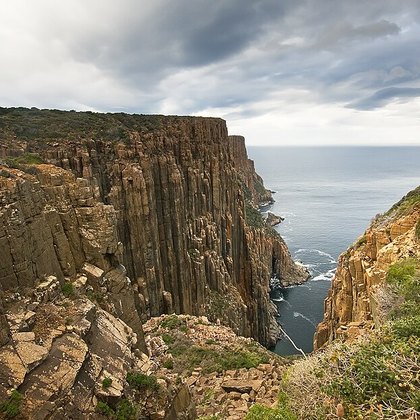
Buildings stand in for the sea cliffs the species nests on in its native range: ledges of warehouses, bridge piers, viaducts, wharf sheds, grain silos and car parks. Feeding is on the ground in shopping streets, squares, parks and road verges, and out of town on cropland and around stock-feed stores. On the coast, natural rock faces and sea cliffs are used as well.
Where the bird is most often found, arranged by main group and formation.



Range and movements
In Australia in virtually every larger town and city, with Darwin the well-known exception; the bird stays tied to built-up land and farmland and does not spread into the interior. In New Zealand from Northland to Southland, densest in cities and on farmland, with few records in the central North Island and along the South Island's West Coast; stray birds have been reported from the Chathams, the Snares and the Antipodes. Domestic pigeons came out with the earliest European ships — the First Fleet carried them in 1788 — and the New Zealand feral birds trace back to nineteenth-century imports for pigeon-keeping and racing.
- Resident
- dark = core range, pale = thinly spread
Where and when to look
Do not look down, look up: the regular roosting and nesting ledges under bridges, on platform canopies and behind the cornices of old warehouses give the colony away. In any flock, pick out the bird that still comes closest to the wild type, and you will see the white rump and the two black wing bars on which the whole worldwide story of the species rests.
Conservation
Least Concern (LC), and in Australia and New Zealand that understates it: here the species is a subject of management rather than protection, because of fouled buildings, losses in grain stores and its part in a few diseases. The real conservation question lies elsewhere: across Europe and western Asia the genuinely wild Rock Dove has in many places been absorbed genetically by interbreeding with feral birds, so the original species is rarer than the street scene suggests.
Scientific name
Columba livia | Gmelin, 1789
Johann Friedrich Gmelin described the species in 1789 in his edition of Systema Naturae as Columba livia; it stayed in that genus, so author and year carry no parentheses. Columba is the Latin word for pigeon, by way of Greek kolumbos 'diver', after the plunging flight. livia comes from medieval Latin livida, 'lead-blue', after the plumage of the wild form. A bird from Fair Isle in Scotland has been designated the neotype.