All species › Pigeons and doves › Doves and pigeons › White-headed Pigeon
White-headed Pigeon | Columba leucomela
Witkopduif | Paloma blanquinegra
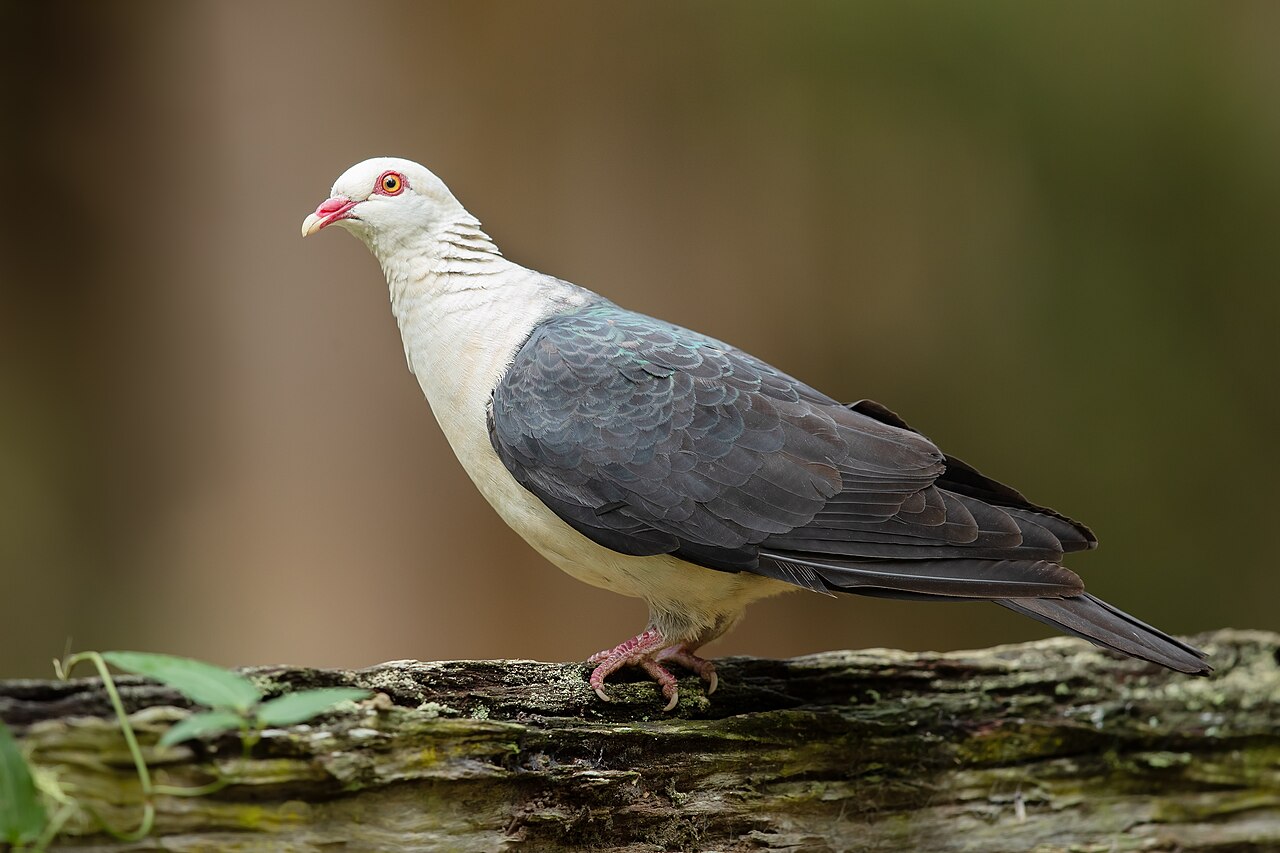
The White-headed Pigeon is the big, two-toned rainforest pigeon of the Australian east coast: head, neck and breast clean white, back, wings and tail slate-grey to black. Once seen it can be mistaken for nothing else. Its recent good fortune it owes largely to a weed — the introduced camphor laurel, which has taken over the cleared coastal country and supplies it with fruit through most of the year.
Voice
A strong, gruff whook!, often followed by a low indrawn uk repeated a few times, and besides that a slow, mournful oom-coo. The sound comes from high in a fruiting tree and does not carry far; usually you hear it only once you are standing beneath the bird. Taking off is noisy in itself: heavy, clattering wingbeats through the foliage.
No freely licensed recording has been found for this species yet; what to listen for is described below.
Identification
A heavy pigeon of 38 to 42 centimetres, forty on average, and well over four hundred grams. Head, neck and breast are white, sometimes with an orange or greyish wash; back, wings and tail are dark slate-grey to black, with a metallic green and purple sheen in the male. Below the white breast the belly is grey. The female is darker and greyer, with less pure white; young birds resemble a dark female. Eye-ring, legs and bill base are pink to dark red, with a pale bill tip. In flight the contrast between white front and black rear reads at long range.
Confusion species
Topknot Pigeon (Lopholaimus antarcticus) shares the same rainforest and is also grey and black, but has a grey head with its characteristic two-part shaggy crest, a black-and-white banded tail tip, and flies in noisy flocks high above the canopy; it never shows a white breast. Torresian Imperial Pigeon (Ducula spilorrhoa) carries the reverse pattern — white body with black flight feathers and tail — and is a bird of the far north and the coast, from Cape York westward. Brown Cuckoo-Dove (Macropygia phasianella) is in the same forest but is uniformly warm brown with a very long tail. Feral Rock Doves (Columba livia) can be pied white and grey, but are smaller, shorter tailed and belong to the town, not the rainforest.
Habitat
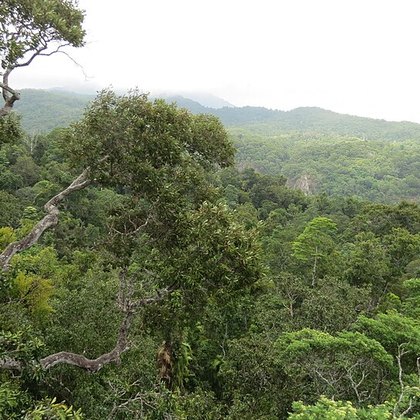
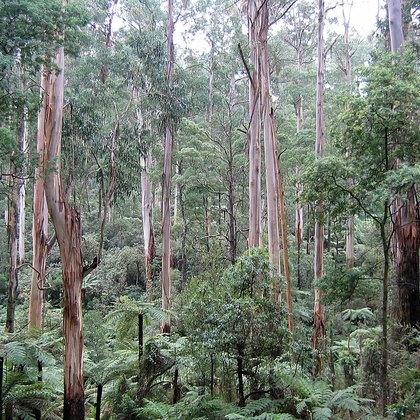
Tall tropical and subtropical rainforest and the remnants of it, wet eucalypt forest with a rainforest understorey, weedy gullies and regrowth, and increasingly street trees and gardens where fruiting trees stand. It feeds in the canopy on fruit and seed, with a strong preference for laurels, flying several kilometres over open country to reach a crop; now and then it comes to the ground.
Where the bird is most often found, arranged by main group and formation.


Range and movements
Australia only, east of the Great Dividing Range, from Cooktown in far north Queensland down the Queensland and New South Wales coast to the south of that state, with an expansion that now reaches into eastern Victoria. It is absent from Western Australia, South Australia, the Northern Territory and Tasmania, and does not occur in New Zealand. Within that area it wanders after fruit, so numbers at any one site can swing sharply from year to year.
- Resident
- dark = core range, pale = thinly spread
Where and when to look
Stand by a fruiting camphor laurel or bangalow palm in a coastal gully and wait; between winter and early spring the birds come in singly or in small parties and then sit quietly in the canopy. What you are looking for is the white front glowing against dark leaves; from the side the sharp line between white breast and black back settles it. Breeding runs from August to December, earlier in the north: a stick platform in dense foliage or a tangle of vines, one egg, twenty days' incubation and twenty-one days in the nest, both parents taking turns.
Conservation
Least Concern (LC), and the world population is increasing. That is a striking reversal: with the clearing of the Big Scrub and the rest of the coastal rainforest the species fell back hard in the nineteenth and early twentieth centuries, then recovered as camphor laurel (Cinnamomum camphora), an Asian weed tree, took over the cleared land and fruited almost year round; privet is taken too. There is a real dilemma in that, because bush regeneration projects that remove camphor laurel have locally pushed the pigeon back again. The work turns out best when it goes together with replanting native rainforest fruit trees.
Scientific name
Columba leucomela | Temminck, 1821
Temminck described the species in 1821 as Columba leucomela, and it has stayed in that genus, so author and year carry no parentheses. Columba is the classical Latin word for a dove or pigeon. leucomela combines Greek leukos, 'white', and melas, 'black' — exactly the bird's two-tone plumage. The type came from New Holland, Australia as it was then called. Its closest relative is the Metallic Pigeon (Columba vitiensis) of the south-west Pacific islands.