All species › Cuckoos › Cuckoos › Pheasant Coucal
Pheasant Coucal | Centropus phasianinus
Fazantspoorkoekoek | Cucal faisán
The Pheasant Coucal is the only cuckoo in the region that builds its own nest and raises its own young: a heavy, short-winged bird that clambers through rank grass with a long, loose tail trailing behind it. Twice a year it changes appearance, from black in the breeding season to streaked rufous outside it, and it is the male that does the incubating.

Voice
The call is a deep, hollow series that first falls and then swells again: oop-oop-oop-oop, usually early in the morning and after rain, and always from dense cover. Pairs call against each other, so the sound seems to come from two directions at once. There is also a metallic tapping note, and a sharp hiss when the bird is disturbed.
No freely licensed recording has been found for this species yet; what to listen for is described below.
Identification
A large ground cuckoo of sixty to seventy-five centimetres, well over half of it tail. In breeding plumage head, neck and underparts are black, against which the rufous, black-barred wings and the long barred tail stand out sharply. Outside the breeding season the whole bird is rufous with cream and black streaking, with a streaked head and a pale brow. The eye is red, the female is clearly larger than the male, and young birds resemble the non-breeding adult but are more washed out.
Confusion species
There is no second coucal in the region, so the confusion starts with the bird itself: the black breeding dress and the streaked plumage outside it are regularly taken for two species. In heavy, low flight with barred wings and a trailing tail it can suggest a Whistling Kite (Haliastur sphenurus), but it seldom flies far before dropping into cover. Running across a track, the hunched carriage and long tail bring a pheasant to mind rather than a cuckoo.
Habitat
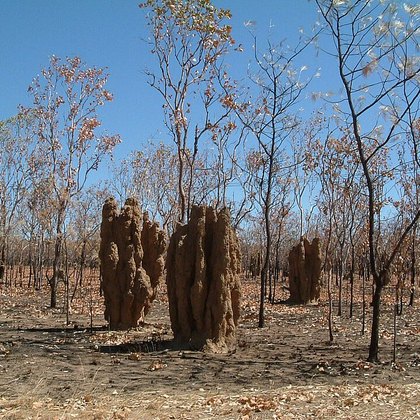
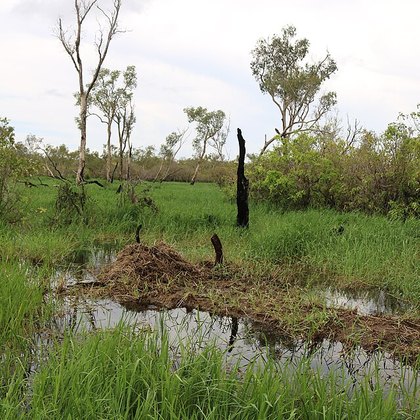
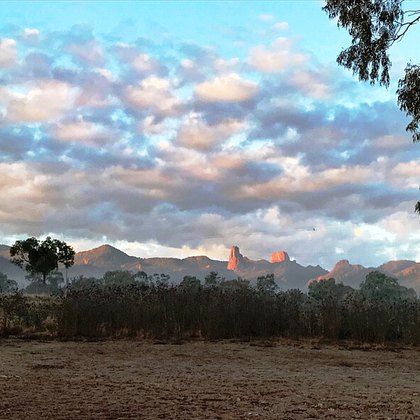
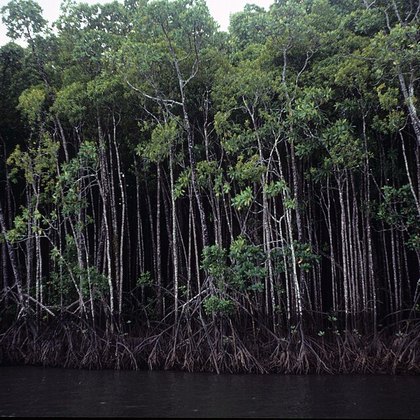
Dense tall grass, reeds, bracken and sedge under open eucalypt woodland and along swamp margins, and in the north the fringe of the mangroves. Rank, weedy ground is its element: lantana, blackberry and sugar cane, and the wide verges of roads and railway lines. It avoids short, open ground, wanting cover within one bound.
Where the bird is most often found, arranged by main group and formation.

Range and movements
From the Pilbara through the Kimberley and the Top End to Cape York, and down the east coast to the south coast of New South Wales; beyond that in New Guinea and Timor. It does not migrate and holds the same ground all year. In the southeast it has spread with the planting of cane and the weedy thickening of river valleys, while in the dry interior it stays tied to permanent water.
- Resident
- dark = core range, pale = thinly spread
Where and when to look
Look for it early in the morning on a track, a fence post or a fallen log, where it takes the first sun while the grass is still wet; at that hour it sits in the open and the call gives it away as well. Drive slowly past cane or a weedy drain and watch for the long tail standing above the grass.
Conservation
The Red List carries it as Least Concern (LC); AviList leaves the category open. It is common throughout its range and profits from weedy farmland and from cane. What goes wrong is local: burning coastal heath in the breeding season and clearing lantana cost nests, and roads take birds because it crosses low and slowly.
Scientific name
Centropus phasianinus | (Latham, 1801)
Latham described the species in 1801 as Cuculus phasianinus; because it was later placed in another genus, author and year stand in parentheses. The genus Centropus was introduced by Illiger in 1811, after Greek kentron, 'spur', and pous, 'foot': the straight, long claw on the hind toe. phasianinus means 'pheasant-like', after the long tail and the way the bird walks. The type came from New Holland; Gould restricted the type locality to New South Wales.