All species › Parrots › Cockatoos › Pink Cockatoo
Pink Cockatoo | Cacatua leadbeateri
Incakaketoe | Cacatúa inca
The Pink Cockatoo is the loveliest of the Australian cockatoos: soft white with a salmon-pink wash over head, neck and underparts, and a long crest that on being raised reveals a hidden band of red and yellow. It belongs to the dry interior, and lives there not in noisy mobs but in pairs and small family parties, widely spaced.

Voice
The call is a plaintive, wavering yodel with a quavering falsetto quality, kwee-yoo-week, far softer and more musical than the screeching of the cockatoos it shares waterholes with. There is also a short, sharp alarm note, and soft throaty muttering between partners at the nest hollow. A pair coming in over the mallee is usually heard before the pink catches the light.
No freely licensed recording has been found for this species yet; what to listen for is described below.
Identification
A medium-sized cockatoo of about 35–40 cm, soft white with a salmon-pink wash strongest on the underparts and underwing; against the light the whole bird looks pink. The crest is long and normally carried flat; only when it is raised does the unmistakable pattern appear — a broad red band, a yellow band behind it, and white tips. The skin around the eye is not blue and not bare but feathered and white, which is the quickest difference from every corella. The bill is short, pale horn and heavy. The female has a broader yellow band in the crest and a red-brown iris, the male a dark brown one.
Confusion species
The three white cockatoos of the interior are the real pitfall. Little Corella (Cacatua sanguinea) is pure white with no pink wash, has a blue-grey bare eye-ring and a short bill, and moves in noisy flocks of hundreds. The two species this guide calls 'Oostelijke langsnavelkaketoe' — Cacatua tenuirostris and Cacatua pastinator — also have a bare blue eye-ring and a greatly elongated upper mandible; C. tenuirostris additionally carries an orange-red crescent across the breast, which the Pink Cockatoo never shows. Sulphur-crested Cockatoo (Cacatua galerita) is larger, pure white and has a narrow sulphur-yellow crest. In flight the pink underwing is the surest mark of the Pink Cockatoo.
Habitat
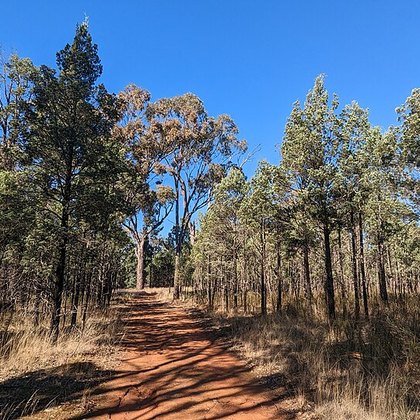
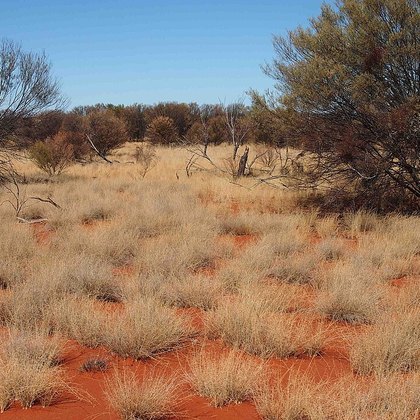
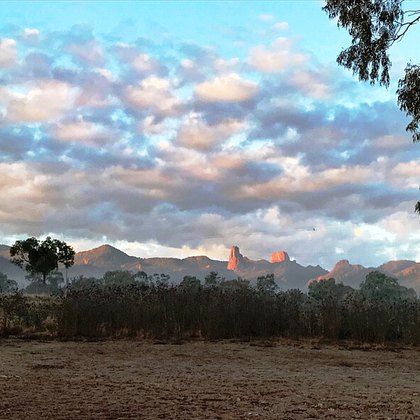
Dry and semi-arid inland woodland: mallee, stands of callitris (native cypress), belah and casuarina, mulga and acacia scrub, and the ribbons of large eucalypts lining the creeks that cross the interior. Those old eucalypts are indispensable, because only they hold hollows of the required size. Pairs nest far apart and will not tolerate a second pair nearby, so the species needs continuous, unfragmented country.
Where the bird is most often found, arranged by main group and formation.


Range and movements
The arid and semi-arid interior of Australia, roughly from the edges of the Western Australian wheatbelt and goldfields east through South Australia, the north-western corner of Victoria (the Murray mallee, Wyperfeld, Hattah-Kulkyne, the Big Desert), western New South Wales and into inland Queensland. It is absent from the north-east and from the coasts. In the south-east the range became badly fragmented during the twentieth century and the bird has gone from much of the farmed country.
- Resident
- dark = core range, pale = thinly spread
Where and when to look
Look for it at first light at a waterhole in the mallee — a dam, a stock trough or a pool along a creek. It comes in as a pair or a small family, stays briefly and leaves again, unlike the Little Corella flocks that hang about for hours. Do not look for the crest, which is usually flat, but for the white feathered surround to the eye and the pink underwing as it lifts off.
Conservation
Not threatened on the global list (LC), but that figure hides what is happening in the south-east: in Australia the species was listed nationally as endangered in 2023. The causes interlock — clearing of mallee and callitris for farming, loss of old hollow-bearing trees, and the bird's own biology, since pairs nest so far apart that fragmented country can hold very few. Added to this is the illegal robbing of nests for the bird trade, because young Pink Cockatoos fetch high prices.
Scientific name
Cacatua leadbeateri | (Vigors, 1831)
The Irish naturalist Nicholas Aylward Vigors described the species in 1831 as Plyctolophus Leadbeateri, so author and year stand in parentheses. The epithet honours Benjamin Leadbeater, the London natural-history dealer and taxidermist who supplied the type material. The type locality is New South Wales. The species stood for a long time in the genus Lophochroa, which since 2023 is treated as a subgenus within Cacatua. In the same year BirdLife Australia changed the English name from Major Mitchell's Cockatoo to Pink Cockatoo, because of Mitchell's part in the massacre of Aboriginal people at Mount Dispersion. The Dutch guide name refers to the crest, which suggests a feathered headdress; it is an aviculture trade name and carries no implication that the bird has anything to do with South America.