All species › Parrots › Old World parrots › Princess Parrot
Princess Parrot | Polytelis alexandrae
Prinses van wales-parkiet | Perico princesa
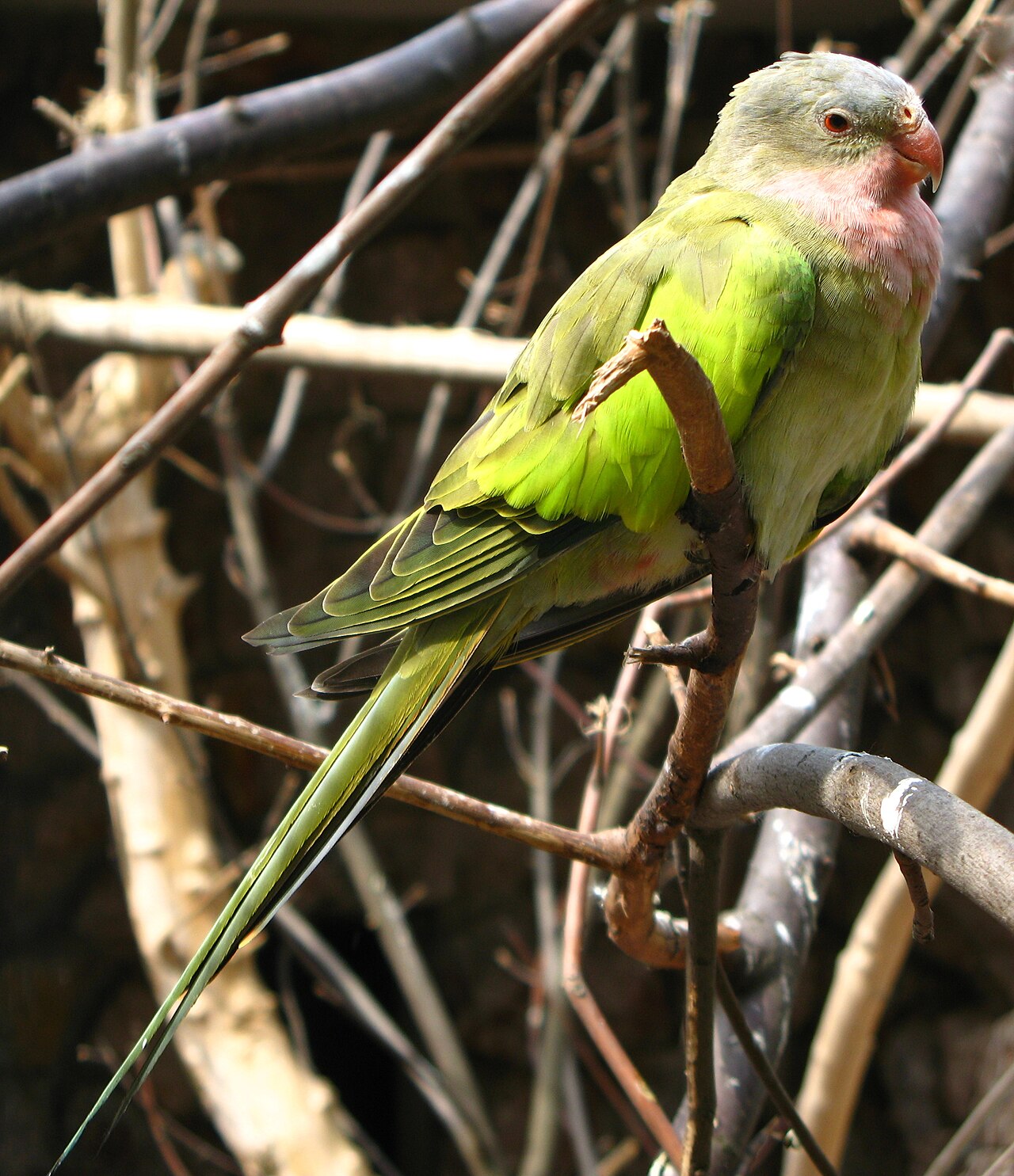
The Princess Parrot is the pastel parrot of the sandridge deserts: pale blue crown, rose-pink throat, olive-green back, violet-blue rump and an extraordinarily long, narrow tail. It is nomadic to the point of mystery — after rain it appears in numbers in a district where it has not been seen for twenty years, breeds, and vanishes again. Anyone who meets it in the interior has been lucky.
Voice
Before take-off and in flight it gives a drawn-out, harsh, chattering call, far more strident than the soft colours suggest. Perched in a Desert Oak it produces a mixture of chirrupings, short croaking notes and a low, almost grunting sound, broken by sharp, clipped notes. At a breeding group along a dry creek the whole party keeps up a continuous soft twitter.
No freely licensed recording has been found for this species yet; what to listen for is described below.
Identification
A slim parrot of about forty centimetres, of which in the male more than half is tail: the two central tail feathers are drawn out into filaments. The colours are soft and unusual for a parrot — a pale blue-grey crown, a rose-pink chin, throat and foreneck, a grey-green breast and belly washed with light green, an olive back and a striking violet-blue rump. A yellow-green patch lies across the shoulder and shows in flight as a pale bar. The bill is coral red, the iris orange. The adult male carries a spatule, a spoon-shaped extension on the third primary, visible only at close range. The female is duller, with a greyer crown and a distinctly shorter tail.
Confusion species
The two other Polytelis parrots share the slim build and long narrow tail but not the range: Superb Parrot (Polytelis swainsonii) is grass green with a yellow face and a red breast band and stays in the south-east along the Murray and Murrumbidgee, while Regent Parrot (Polytelis anthopeplus) is deep yellow with a red wing patch and lives in the mallee and the south-west. In the desert itself the nearest thing in silhouette is the Cockatiel (Nymphicus hollandicus): the same long tail, but grey, with a crest and an orange cheek patch. Budgerigar (Melopsittacus undulatus) is half the size, yellow with a black-barred back, and travels in dense flocks of hundreds.
Habitat
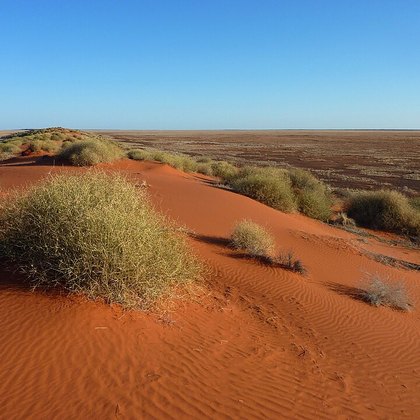
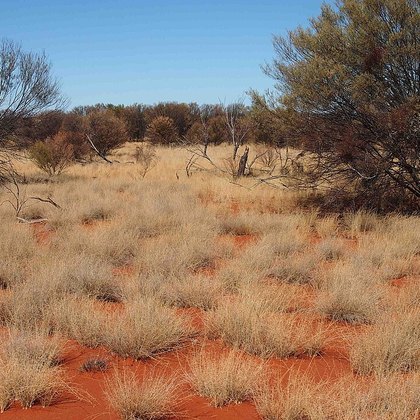
Sandridge desert and spinifex plains with scattered trees make up its world: Desert Oak, Marble Gum and isolated acacias on the dune crests, and narrow strips of eucalypt along the dry creeks. It nests in a hollow in such a tree, often low down, and several pairs will take the same stand. Food is the seed of spinifex and other desert grasses, gathered on the ground between the hummocks, along with acacia seed and blossom.
Where the bird is most often found, arranged by main group and formation.


Range and movements
The arid interior of Western and central Australia: the Great Sandy and Gibson Deserts, the eastern Goldfields of Western Australia, the southern Northern Territory and northern South Australia, reaching east into western Queensland. It keeps to no fixed place within that country: the Canning Stock Route and the Newhaven reserve produce most records, but in most years it can hardly be found anywhere. It occurs nowhere outside Australia.
- Resident
- Passage
- dark = core range, pale = thinly spread
Where and when to look
Do not look for the bird, look for the conditions: the odds are best after good inland rain, when the spinifex is setting seed. Drive slowly along a dry creek lined with large eucalypts, or along a dune crest with Desert Oaks, and listen for the chattering call and watch for the silhouette with the very long tail. It drinks early in the morning at a pool or a stock trough; waiting there beats walking the dunes.
Conservation
Near Threatened (NT). The species has an enormous range but a small, wildly fluctuating population that is extremely hard to count, and there are years with only a handful of records for the whole of Australia. The causes are indirect: the loss of the fine-grained burning pattern Aboriginal people maintained in the spinifex deserts, so that large, hot fires now strip whole districts at once; grazing by stock and camels around the few watering points; and predation by feral cats and foxes. To that was added the twentieth-century trapping for the bird trade, to which the species owes its popularity in aviculture.
Scientific name
Polytelis alexandrae | Gould, 1863
Gould described the species in 1863 as Polyteles alexandrae, placing it straight away in the right genus, so author and year carry no parentheses. The genus Polytelis was introduced by Wagler in 1832, from the Greek polytelēs, 'costly'. The epithet alexandrae honours Alexandra of Denmark, who in March of that same year married the British heir to the throne and so became Princess of Wales — the source of the Dutch name. The type locality is Howell's Ponds in central Australia.