All species › Waterfowl › Ducks, swans and geese › Radjah Shelduck
Radjah Shelduck | Radjah radjah
Radjah-eend | Tarro rajá
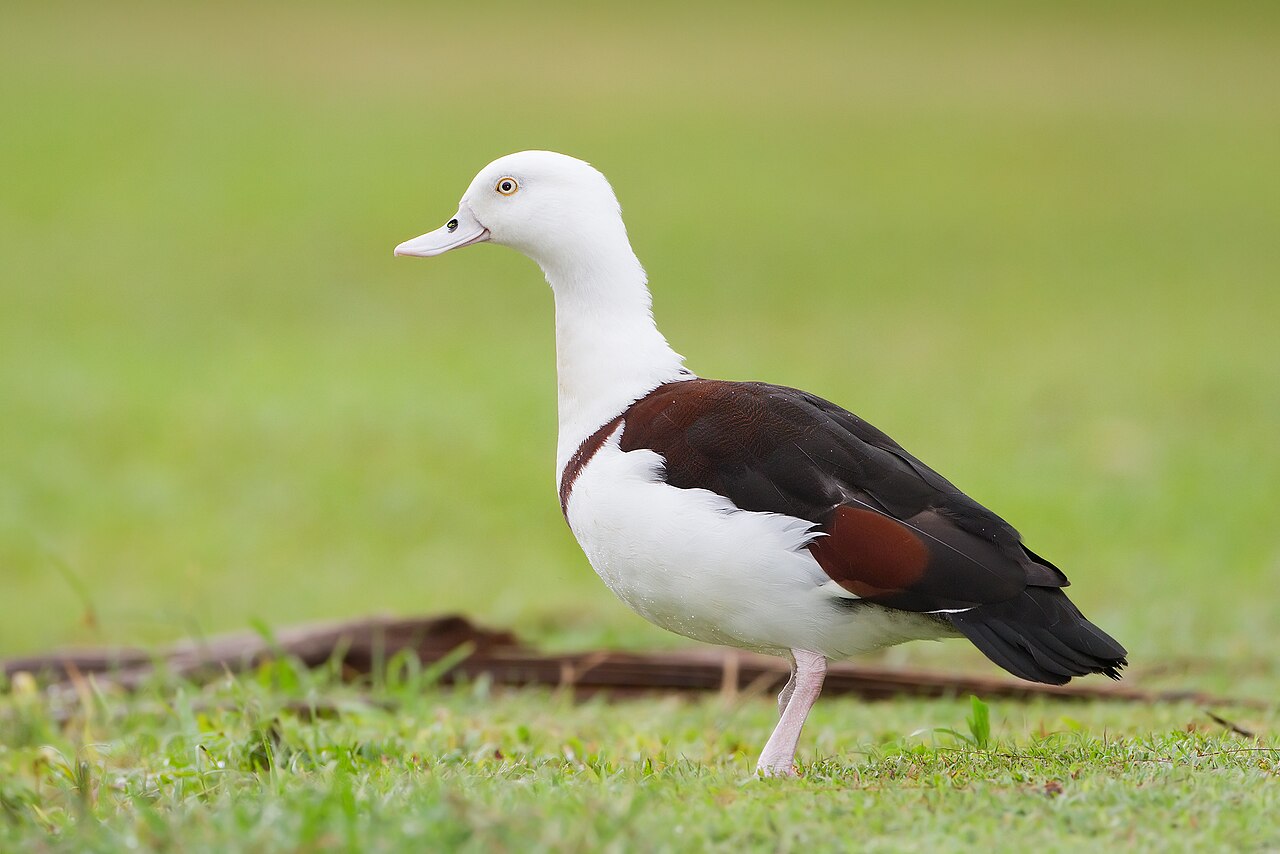
The Radjah Shelduck is the shelduck of the tropical north coast: a slim, long-legged duck with a snow-white head, neck and underparts, a black back and a narrow chestnut breast band as its only colour. Bill and legs are soft pink and the eye is almost white, which gives the head a startled look. In Australia it is called the Burdekin Duck, after the Burdekin River in Queensland.
Voice
A noisy duck, above all in the breeding season and when threatened. The male gives a hoarse, breathy whistle, a raw wheeeoo that carries across the water; the female answers with a hard rattle, rrak-rrak-rrak-rrak, which she also delivers in flight and from the roost tree. A pair defending its stretch of bank calls back and forth over the top of each other.
No freely licensed recording has been found for this species yet; what to listen for is described below.
Identification
A medium-sized duck of 51 to 61 cm that walks on wader-like legs more than it swims. Head, neck, breast and belly are pure white, the back, rump and tail black, and between them runs a narrow chestnut band across the breast — narrower on the female than on the male. The upperwing shows a large white covert panel and behind it a glossy green speculum edged white and black, so that flight produces a crisp black-and-white pattern. Bill, legs and feet are pale pink, the iris white to pale yellow; young birds are duller, washed brown on crown and neck, and still dark-eyed.
Confusion species
Within its range it is barely confusable: no other large duck of tropical northern Australia has an all-white head with a chestnut breast band. Australian Shelduck (Tadorna tadornoides) is the region's only other shelduck, but belongs in the south, is larger and has a black head with a white neck ring. Magpie Goose (Anseranas semipalmata) is also black and white and also long-legged, but far bulkier, black-headed with a knob on the crown, and flies with slow beats. Pacific Black Duck (Anas superciliosa) shares the billabong but is uniformly dark brown with a striped face.
Habitat
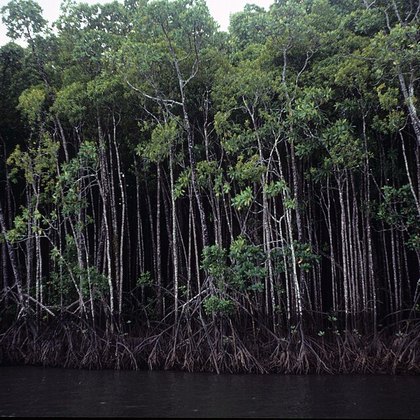
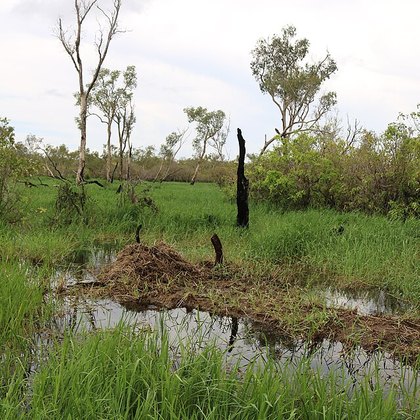
Mangrove creeks, paperbark swamp forest and estuary mudflats are the core; beyond that brackish lagoons, coastal swamps, billabongs and stock dams, but rarely far from a shoreline of some kind. It prefers to feed wading in shallow water and over mud, on molluscs, aquatic insects, sedges and algae, and does so mainly at dusk and by night; by day it rests high in a tree beside the water. The nest goes in a tree hollow close to water, by preference in an old paperbark.
Where the bird is most often found, arranged by main group and formation.


Range and movements
The tropical north coast of Australia: from the Kimberley in Western Australia across the Northern Territory coast — where it is most numerous, Kakadu among other places — and Cape York down the east coast of Queensland as far south as about central Queensland, where it is thinly spread. In the nineteenth century it still reached northern New South Wales. With the wet monsoon it moves inland to flooded plains and billabongs; in the dry season it concentrates back near the coast. Outside Australia it occurs in New Guinea and on some Moluccan islands, but it does not reach New Zealand.
- Resident
- dark = core range, pale = thinly spread
Where and when to look
In the dry season work the edge of a mangrove creek or a Top End billabong and look at the standing trees first — a resting pair is often high in a paperbark above the water rather than on it. Out on the mudflat the combination of white plumage and pink legs shows from a long way off. Go early or late: through the middle of the day it does very little.
Conservation
Not threatened (LC) and still numerous in the Northern Territory, but decidedly scarce in Queensland, and the range has pulled back at its southern edge: the former birds of northern New South Wales have been gone for over a century. Drainage and development of coastal wetlands, loss of old nesting trees, and trampling of mangrove and paperbark margins by stock and pigs all weigh on numbers. The species is protected by law in every Australian state, with penalties for killing it.
Scientific name
Radjah radjah | (Garnot & Lesson, 1828)
Lesson described the species in 1828 as Anas radjah; because it later moved to a genus of its own, author and year stand in parentheses. The type locality is the island of Buru in the Moluccas; Australian birds belong to the subspecies rufitergum, named by Hartert in 1905. radjah is Malay raja, 'prince, king' — the word Lesson took from the Moluccan name for the bird, and it suits the regal, spotless white figure. Genetic work showed the species stands so far apart from the true shelducks that it was given its own genus Radjah, in which it is the only species. The Australian name Burdekin Duck goes back to the Burdekin River in northern Queensland.