All species › Waterfowl › Ducks, swans and geese › Northern Shoveler
Northern Shoveler | Spatula clypeata
Slobeend | Cuchara norteño
The Northern Shoveler is the northern counterpart of the Australasian Shoveler and a genuine rarity in this guide's area: a heavy, low-riding duck with an enormous spoon-shaped bill almost as long as its head. Nearly every bird that reaches Australia or New Zealand is a drake in breeding plumage, and with its bottle-green head, pure white breast and chestnut flanks it is unmistakable.

Voice
Seldom heard in this part of the world. The drake has a muffled double note, took-took, nasal and wooden, mostly in display on the water. The female quacks like a Mallard, a series of falling quack-quack-quack notes. Birds taking off make a soft rattling sound with the wings.
No freely licensed recording has been found for this species yet; what to listen for is described below.
Identification
A duck of half a metre, seventy to eighty-five centimetres across the wings, which seems to hang forward in the water under the weight of its bill. The breeding drake has an unmarked dark bottle-green head, a broad white breast shield, chestnut flanks and belly, a black bill, orange legs and a yellow eye; in flight a pale blue-grey forewing and a green speculum light up. The female is pale mottled brown with an orange-brown bill and orange legs. Always look at the bill first: no other duck here carries that broad, forward-widening spoon except the Australasian Shoveler.
Confusion species
Australasian Shoveler (Spatula rhynchotis) is the only real problem. Its drake has a blue-grey head with a vertical white crescent in front of the eye and no white breast shield; the Northern drake has a plain green head and exactly that white breast. Females of the two cannot be separated reliably in the field, which is why a brown shoveler in New Zealand or Australia is almost never accepted as this species. The drake Chestnut Teal (Anas castanea) also shows a green head and chestnut flanks, but is far smaller and has an ordinary narrow duck's bill.
Habitat
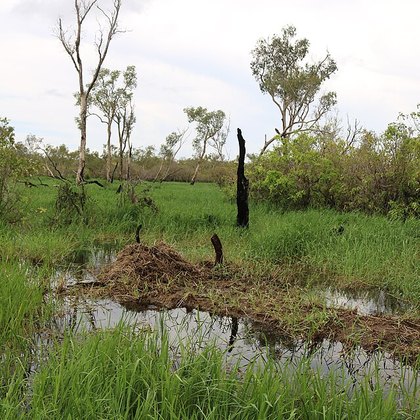
Shallow, nutrient-rich freshwater marsh over a muddy bottom, where it swims with the bill ploughing through the surface film and sieves the water through fine lamellae. Vagrants in this area turn up mostly on oxidation and sewage ponds, shallow lake margins and sheltered lagoons — places rich in plankton and small crustaceans. It does not use deep or fast-flowing water.
Where the bird is most often found, arranged by main group and formation.


Range and movements
A vagrant. New Zealand has about thirty-five accepted records, nearly all of readily identifiable drakes in breeding plumage; a pair was confirmed only once, at Pauri Lake near Whanganui in August 1989. In 2017 at least five drakes arrived together, and some of those were still being seen on the same waters in 2024. Australia likewise carries the species as a vagrant, with a handful of records. Its breeding grounds lie far away, across northern Eurasia and North America.
- Winter
- Passage
- dark = core range, pale = thinly spread
Where and when to look
In New Zealand or southern Australia work steadily through the Australasian Shoveler flocks on oxidation ponds and shallow lakes, and look only at the drakes' heads: plain green with no white crescent, plus a white breast, is the one. Do it between November and March, when northern birds may strand in the south after migration, and take a photograph — a record here nearly always needs proof.
Conservation
Least Concern (LC): the world population runs to millions, over five million in North America alone. The species is fully protected in New Zealand, but the real pressures lie outside this guide's area, in the drainage and pollution of Asian wintering marshes. For Australia and New Zealand it carries no management interest of its own, since it does not breed here.
Scientific name
Spatula clypeata | (Linnaeus, 1758)
Linnaeus described the species in 1758 as Anas clypeata; because molecular work in 2009 moved it to the genus Spatula, author and year are bracketed. Spatula was introduced by Boie in 1822 and is the Latin word for a spoon or spatula. clypeata means 'bearing a shield', from clypeus, a round shield, after the broad shield-like bill. The type locality is Europe, in practice restricted to Sweden.