All species › Waterfowl › Ducks, swans and geese › Australasian Shoveler
Australasian Shoveler | Spatula rhynchotis
Australische slobeend | Cuchara australiano
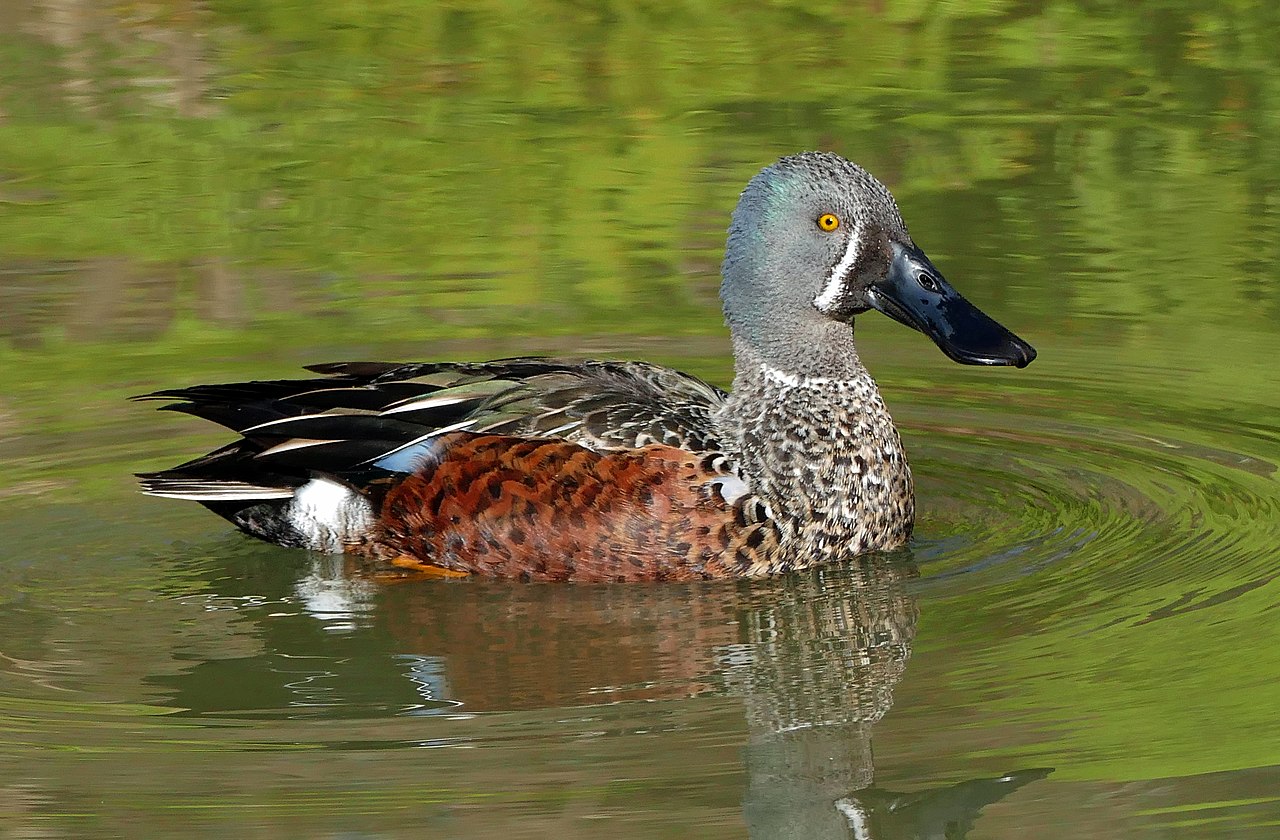
The Australasian Shoveler is the shy, heavy-billed sieving duck of dense swamps: a squat bird that rides low in the water, always with that outsized black spoon held before it. The drake has a blue-grey head with a crisp white crescent just in front of the yellow eye — on still water one of the handsomest duck heads in the region.
Voice
A quiet species. In display the drake gives a run of soft, wooden chuff-chuff or toot-toot notes with low grunting between them; the female has a soft husky quack and a chattering rattle used mostly in flight. More often than a call you hear the sharp whistle of the wings as birds burst away.
No freely licensed recording has been found for this species yet; what to listen for is described below.
Identification
A duck of forty-six to fifty-three centimetres with a strikingly heavy, spatulate black bill and orange legs. The breeding drake has a dark blue-grey head and neck with a vertical white crescent in front of the yellow eye, a black back and rump, chestnut underparts finely barred darker, and a white patch on the rear flank. In flight a pale blue forewing, a white bar and a green speculum light up. The female is mottled brown with warmer underparts and a dark brown eye. Out of breeding the drake is much duller, but the bill is always the anchor.
Confusion species
Northern Shoveler (Spatula clypeata), a rare vagrant here, has a drake with a plain bottle-green head and no crescent, plus a broad white breast shield; the females of the two cannot be separated in the field. Pink-eared Duck (Malacorhynchus membranaceus) also carries an oversized bill, but one ending in two limp skin flaps, and the bird is far paler and finely barred. The drake Blue-billed Duck (Oxyura australis) is chestnut too, but has a vivid blue bill, a cocked stiff tail, and dives rather than sieves.
Habitat
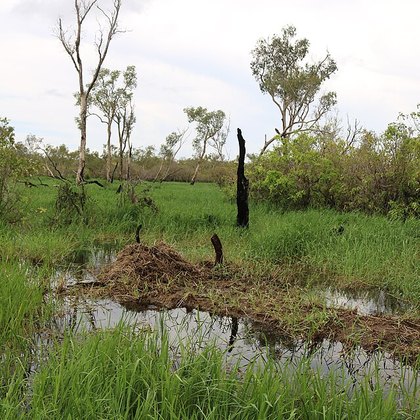
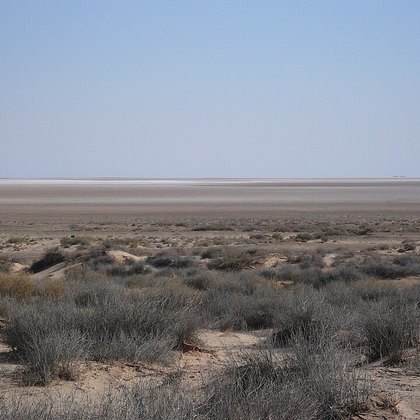
Large, undisturbed and heavily vegetated freshwater swamps with plenty of reed and sedge are the preference, along with open lakes, shallow reservoirs and ephemeral claypans that fill after rain. In winter it also appears on sheltered estuaries, brackish coastal lakes and sewage ponds. It sieves plankton, small crustaceans, insects and seeds from the surface film while swimming, often in wheeling parties that work each other's stirred-up food.
Where the bird is most often found, arranged by main group and formation.


Range and movements
In Australia from the south-west of Western Australia north to North West Cape, and in the east from Tasmania to about Cairns, with the largest numbers in the south-east; in the dry interior it appears irregularly, following floods. In New Zealand the endemic race variegata, the kuruwhengi, breeds across both main islands, with an estimated fifteen to thirty thousand birds; it has gone as a breeder from the Chathams. Norfolk Island has scattered records only.
- Resident
- dark = core range, pale = thinly spread
Where and when to look
Work the reed edge of a large swamp, where it likes to stay under overhanging cover; flushed, it goes away steeply and fast — one of the quickest ducks in the region. Werribee near Melbourne, the Coorong in South Australia and the shallow lakes of Canterbury and Southland give the most reliable flocks. On a distant swimming duck watch the posture: a bird that constantly ploughs the surface with its bill and hangs forward as it does so is almost always a shoveler.
Conservation
Least Concern (LC) and rated Not Threatened in New Zealand. It is a game bird in both countries: some six and a half thousand are shot in New Zealand each year, about half of them in Otago and Southland, and Fish & Game counts showed a modest decline between 2000 and 2011. Drainage and the drying out of lowland swamp is the main long-term pressure; where wetland is restored it returns quickly.
Scientific name
Spatula rhynchotis | (Latham, 1801)
Latham described the species in 1801 as Anas rhynchotis; because it later moved to the genus Spatula, author and year are bracketed. Spatula was introduced by Boie in 1822 and is the Latin word for a spoon or spatula. rhynchotis comes from Greek rhunkhos, 'bill', and amounts to 'well-billed'. The type locality is New South Wales. There are two subspecies: rhynchotis in Australia and variegata in New Zealand, known in Maori as kuruwhengi.