All species › Waterfowl › Ducks, swans and geese › Freckled Duck
Freckled Duck | Stictonetta naevosa
Stippeleend | Pato pecoso
The Freckled Duck is a dark, unobtrusive duck you recognise by its outline: a large head rising to a point at the rear, and a narrow, slightly upturned bill with a hollow upper line. The whole plumage is grey-brown and thickly sown with small white and buff specks. It is the sole member of a subfamily of its own, and so the most isolated duck in Australia.

Voice
Silent for a duck. The contact note is a soft musical piping passed back and forth within a party; in alarm comes a flute-like, plaintive whee-oo. Only at the nest and in display does it grow loud, with harsh, discordant quacks that sit oddly with its otherwise reticent manner.
No freely licensed recording has been found for this species yet; what to listen for is described below.
Identification
A duck of 48 to 59 cm, dark grey-brown overall and, in good light, evenly freckled from head to tail with small white or buff specks. The head is large and runs out to a distinct peak at the rear, which makes the profile look angular. The bill is narrow, deep at the base, hollow along the top and slightly upturned; in the male the base of the bill turns crimson in the breeding season, the one bright accent the species owns. Bill and legs are otherwise grey. In flight the bird is evenly dark, with no speculum and no white.
Confusion species
Pacific Black Duck (Anas superciliosa) swims the same swamps and is the main risk at range and in poor light; it is however paler, with a sharply drawn face pattern of dark lines through and above the eye, a green speculum and a straight bill. Hardhead (Aythya australis) is warmer brown, sits lower and shows a white eye and a white wingbar. When in doubt look only at the profile: the peaked rear crown and the hollow, upturned bill belong to no other Australian duck.
Habitat
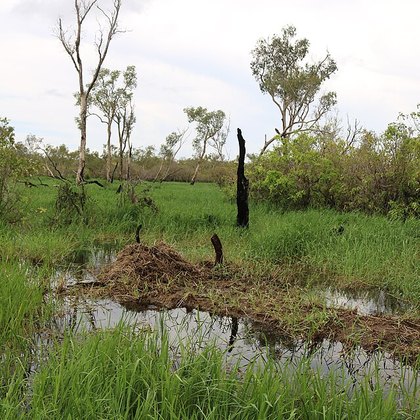
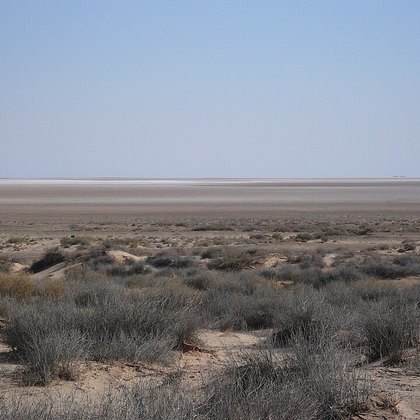
Permanent freshwater swamps and creeks with heavy growth of cumbungi, lignum or tea-tree, where it rests by day in cover and feeds at dusk and through the night. It breeds in the large temporary swamps thrown up by flooding in the Bulloo and Lake Eyre basins and along the Murray-Darling system. As those dry it falls back on lakes, reservoirs, farm dams and sewage ponds.
Where the bird is most often found, arranged by main group and formation.


Range and movements
Mainland Australia only, with its centres of gravity in the south-east — New South Wales, Victoria, southern Queensland and South Australia — and a separate population in south-western Western Australia. Breeding happens far inland, the wintering and the drought retreat on the coast. In dry years the whole population piles into a handful of refuge swamps, which gives the impression that it is commoner than it is.
- Resident
- dark = core range, pale = thinly spread
Where and when to look
Look for it in a dry year, not a wet one: the birds are then concentrated on the permanent swamps and sewage ponds of the south-east and can be picked out from the bank with a scope. Work through every party of dark ducks for a bird with an angular, rear-peaked head; that mark holds even when the freckling is lost at distance.
Conservation
Least Concern globally (LC), but on a small population: assessed in 2016 at seven thousand three hundred to seventeen thousand mature birds, with numbers swinging hard. The states rank it higher — vulnerable in New South Wales and South Australia, endangered in Victoria. The pressures are the draining of swamps, river regulation that switches off the breeding floods, trampling of margins by stock, and illegal shooting: in dry years it mixes with quarry ducks on the coastal swamps and is misidentified at the opening of the season.
Scientific name
Stictonetta naevosa | (Gould, 1841)
Gould described the species as Anas naevosa; he read the description to the Zoological Society of London in 1840 and it appeared in print the following year, so 1841 stands as the date. Since the species later moved to a genus of its own, author and year stand in parentheses. That genus, Stictonetta, was introduced by Reichenbach in 1853 and combines Greek stiktos, 'dappled', with netta, 'duck'. naevosa is Latin for 'full of moles', from naevus, 'a mole'. The type locality is fixed no more precisely than Australia. The species stands so far from all other ducks that it was given a subfamily of its own, the Stictonettinae.