All species › Waterfowl › Ducks, swans and geese › Australian Shelduck
Australian Shelduck | Tadorna tadornoides
Australische bergeend | Tarro australiano
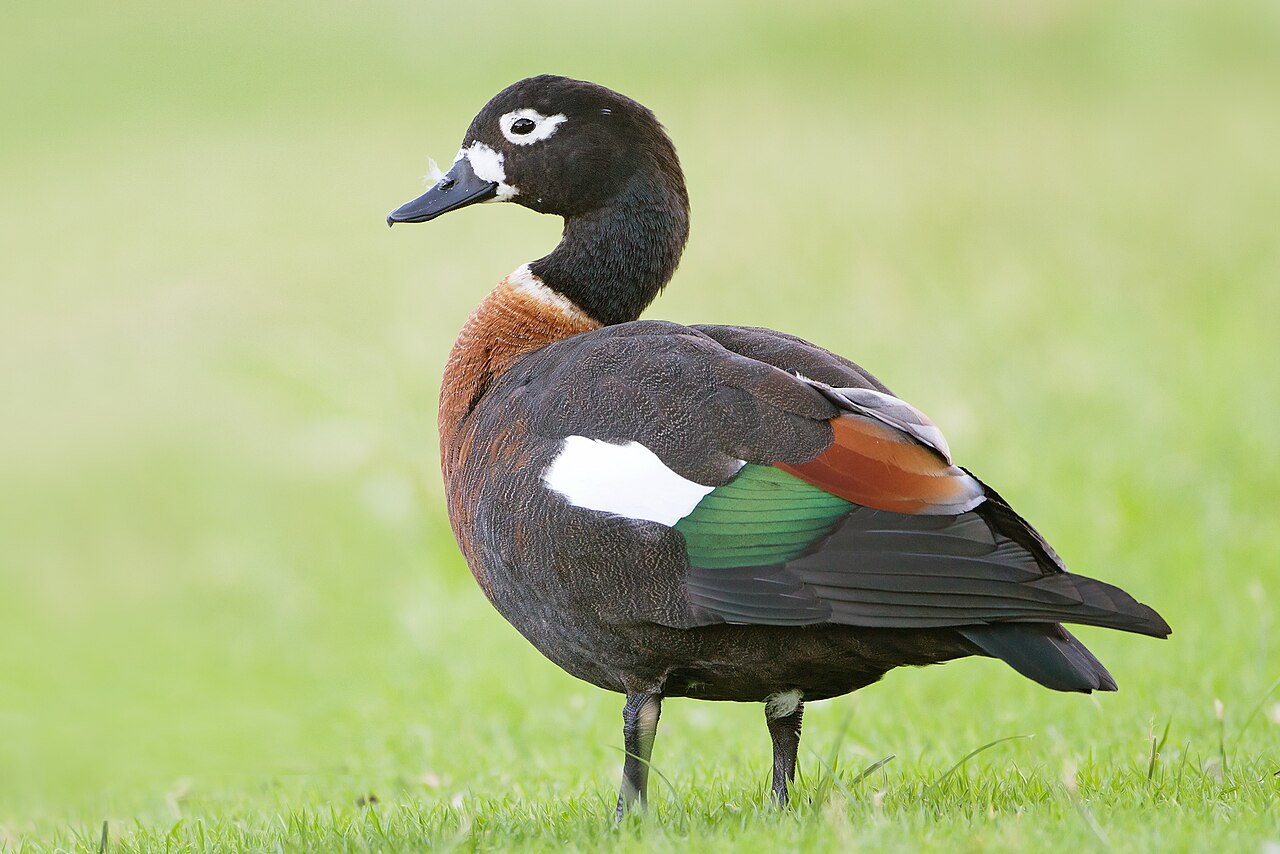
The Australian Shelduck is the large, goose-like shelduck of southern Australia: an upright duck with a black, green-glossed head, a sharp white neck ring and a chestnut breast, which grazes short pasture and shows a broad white wing panel in flight. After breeding the birds gather in their thousands at a handful of traditional moulting sites.
Voice
A loud, far-carrying honk that travels across open pasture. The male calls deep, grunting and goose-like, the female much higher, resonant and penetrating, zeek, zeek, and it is she who alarms without pause if you come near the nest or the brood. In a large moulting flock those voices merge into a continuous murmur.
No freely licensed recording has been found for this species yet; what to listen for is described below.
Identification
A solid duck of 56 to 72 cm that stands upright on the grass like a small goose. The male has a black head and neck with a green gloss, a narrow but crisply drawn white neck ring, a cinnamon breast and an otherwise dark brown to black body. The female is smaller, with a white eye-ring and a white patch at the base of the bill, and a brighter chestnut breast. Both sexes carry a large white covert panel on the upperwing with a green speculum and deep chestnut markings behind it, so that a bird taking off breaks into black, white and rufous. Bill, legs and feet are black.
Confusion species
Radjah Shelduck (Radjah radjah) is Australia's only other shelduck, but sits in the tropical north and has an all-white head with a narrow chestnut breast band. Paradise Shelduck (Tadorna variegata) of New Zealand closely resembles this species in the male, but lacks the white neck ring and has chestnut rather than black undertail coverts, and its female has an entirely white head. Australian Wood Duck (Chenonetta jubata) grazes the same paddock but is far smaller, grey with a plain brown head and no white on the neck.
Habitat
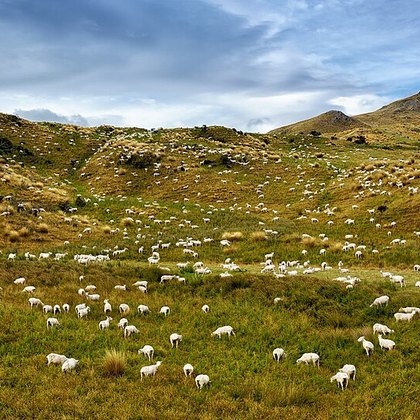
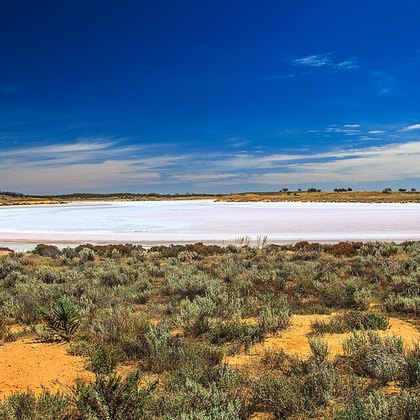
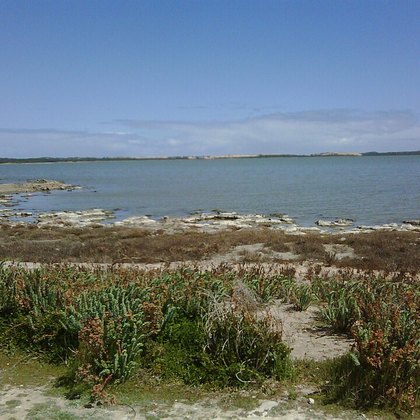
Open, largely treeless country with water nearby: lakes and reservoirs, stock dams, the salt lakes and salt pans of the Western Australian wheatbelt, estuaries, samphire flats and coastal lagoons. It is largely a plant eater — short green grass on land or in shallow water, plus algae, insects and molluscs — and even in saline habitat it needs fresh drinking water within reach. The nest goes high in a roomy tree hollow, thickly lined with down, but also in a rabbit burrow or a cliff crevice; the female incubates alone while the male guards the ground.
Where the bird is most often found, arranged by main group and formation.


Range and movements
South-western and south-eastern Australia, Tasmania included: the wheatbelt and salt-lake country of Western Australia, South Australia, Victoria, inland New South Wales and northern Tasmania. Outside the breeding season many birds move north, exceptionally as far as the Kimberley and central Australia. After breeding they fly to a small number of major moulting grounds — Lake George near Canberra and the Coorong in South Australia are the best known — where flocks of a thousand birds and more come together. In New Zealand it is a rare vagrant, with a run of records since 1973 and one breeding record, near Lake Tekapo in 1985.
- Resident
- dark = core range, pale = thinly spread
Where and when to look
Drive the Coorong or Lake George in late summer and scan the open shore: the moulting flocks stand packed on the grass and show from kilometres away. Watch the neck ring — on a sitting bird that narrow white line is the quickest separation from any other dark duck. On a pair, go to the face: white around the eye and bill base means the female.
Conservation
Not threatened (LC) and still common across southern Australia; it is one of the few native ducks to have clearly gained from agriculture, because stock dams and the conversion of woodland to cropland and pasture have widened its ground. Threats are local: the loss of large old nesting trees from farmland, salinisation and drainage of wetlands, and the vulnerability of moulting flocks that sit flightless for some weeks at a handful of sites. It is a game bird with bag limits in several states.
Scientific name
Tadorna tadornoides | (Jardine & Selby, 1828)
Jardine and Selby described the species in 1828 as Anas tadornoides; because it later moved to Tadorna, author and year stand in parentheses. The type locality is New South Wales. tadornoides means literally 'resembling a Tadorna', an odd name now that the species sits in that very genus: its describers first placed it in Anas and saw only the likeness to the European Shelduck. The genus name Tadorna itself goes back through French tadorne to a Celtic root meaning 'pied waterfowl'. In Australia the bird is also known as Chestnut-breasted Shelduck, after the cinnamon breast.