All species › Waterfowl › Ducks, swans and geese › Paradise Shelduck
Paradise Shelduck | Tadorna variegata
Paradijscasarca | Tarro maorí
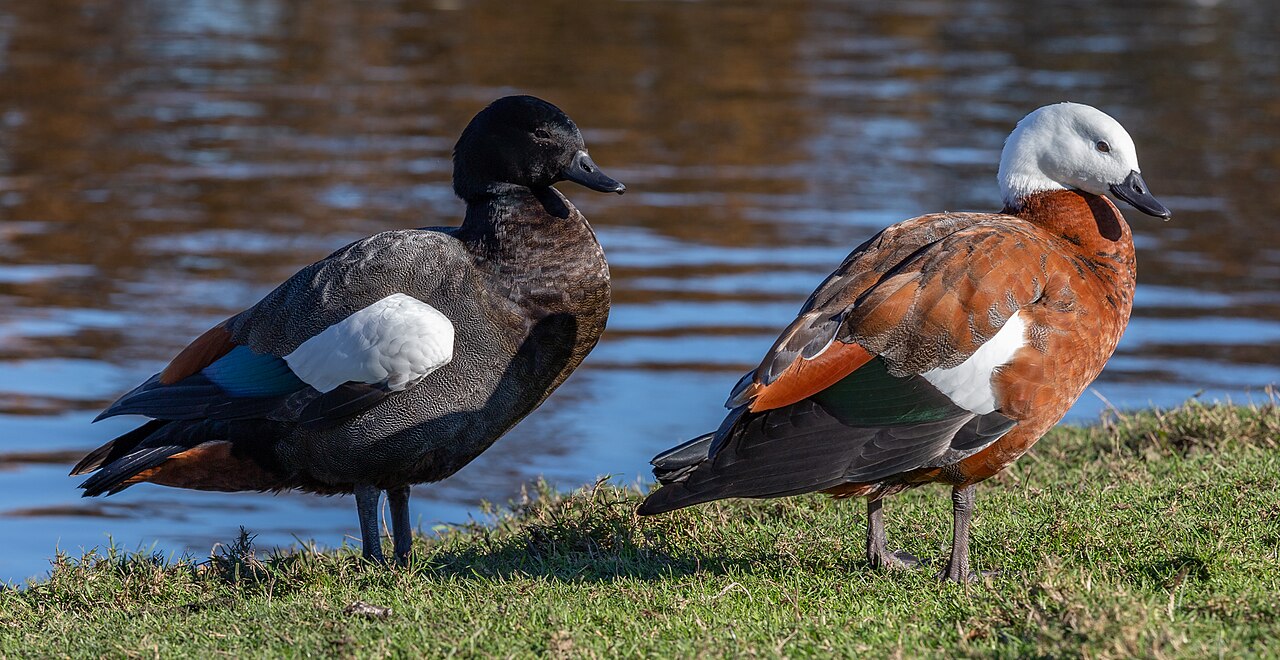
The Paradise Shelduck is the most conspicuous waterbird of New Zealand farmland, and the only duck in this guide in which the female is the showier bird: she has a snow-white head and neck on a chestnut body, while he is dark grey with a jet-black head. You almost always see them in twos, because pairs stay together for life and hold the same paddock all year round.
Voice
A loud pair that never hides its presence. The male gives a low, disyllabic goose-like honk, zonk zonk; the female answers with a far higher, penetrating and faster zeek-zeek-zeek, which she repeats insistently in flight and at any intruder. Walk across a paddock that holds a pair and the duet starts at once — it is the female who sounds the alarm.
No freely licensed recording has been found for this species yet; what to listen for is described below.
Identification
A large, goose-like duck of 63 to 70 cm that stands upright on the grass. The male is uniformly dark grey to black, finely vermiculated, with a black head that glosses green in sunlight. The female has a pure white head and upper neck against a warm chestnut body — at range a white dot in the paddock. Both sexes share chestnut undertail coverts, black primaries and green secondaries, and in flight a large clean white panel on the upperwing that works at any distance. Downy young are banded brown and white like humbugs. Young females begin with white flecks around the eye and bill base, which over a few years spread to the whole white head.
Confusion species
Australian Shelduck (Tadorna tadornoides) is a rare vagrant from Australia and resembles the male, but has a white neck ring, a chestnut to buff breast and black undertail coverts where the Paradise Shelduck is chestnut. Canada Goose (Branta canadensis) grazes the same paddock but is far larger, with a long neck and a white chin strap. Black Swan (Cygnus atratus) is darker at range and much longer-necked. In the female the white head is so distinctive that confusion is hardly possible.
Habitat
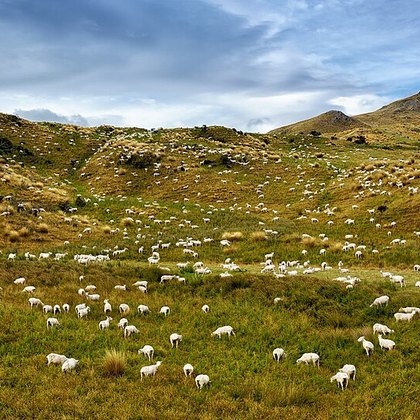
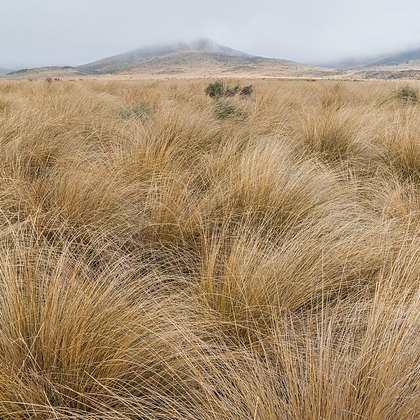
Short-grazed pasture beside water makes the picture: dairy paddocks, river flats, lake and hydro-dam margins, and increasingly sports fields, golf courses and town parks as well. Beyond that, high-country tussock grassland, the shingle beds of the braided rivers, and sheltered coastal bays. It grazes grass and clover like a goose and works shallow water for water plants and small animals. The nest goes under a fallen log, in a hole in the ground, in a hay shed, or in a tree cavity up to twenty-five metres above ground.
Where the bird is most often found, arranged by main group and formation.



Range and movements
New Zealand's most widely distributed waterfowl: throughout the North and South Islands, Stewart Island and the larger inshore islands, and after liberations between 1915 and the 1960s the Chatham Islands as well. It does not occur in Australia. From December to February pairs leave their territories and gather in large moulting flocks on lakes, hydro lakes and ponds, where they are flightless for some weeks; outside that period each pair is fixed to its own patch of ground.
- Resident
- dark = core range, pale = thinly spread
Where and when to look
Scan any stretch of short pasture along a river or lake on the South Island: a white dot beside a dark dot is almost always a pair of Paradise Shelduck. The female gives the pair away with her shrill alarm long before you get a clear view. Go to a high-country or hydro lake in January to see the moulting flocks — hundreds of birds together that will not leave the water.
Conservation
Not threatened (LC), and in New Zealand formally 'Not Threatened'; at well over six to seven hundred thousand birds (2011 estimate) it is the country's most numerous waterfowl after the Mallard. The nineteenth century was different: over-hunting made it scarce, and recovery only began after stricter hunting rules and two or three decades of cautious management, turning since 1990 into an expansion in both numbers and range. Unlike most native ducks it has actually gained from the conversion of forest to pasture and from the digging of stock ponds. It is a licensed game bird with permits and daily bag limits; some two hundred thousand are shot each year and the population still grows.
Scientific name
Tadorna variegata | (Gmelin, 1789)
Gmelin described the species in 1789 as Anas variegata; because it later moved to Tadorna, author and year stand in parentheses. variegata means 'variegated, particoloured', after the strongly contrasted plumage. The genus name Tadorna goes back through French to a Celtic root meaning 'pied waterfowl'. The type locality was given vaguely as 'Habitat in nova Seelandia' and was later fixed on Dusky Sound in Fiordland, where Cook put in on his second voyage. The Maori names putangitangi and putakitaki are both formed after the call; 'paradise' in the Dutch and English names owes itself to the striking pattern of the female.