All species › Gamebirds › Megapodes › Australian Brushturkey
Australian Brushturkey | Alectura lathami
Boskalkoen | Alectura lathami
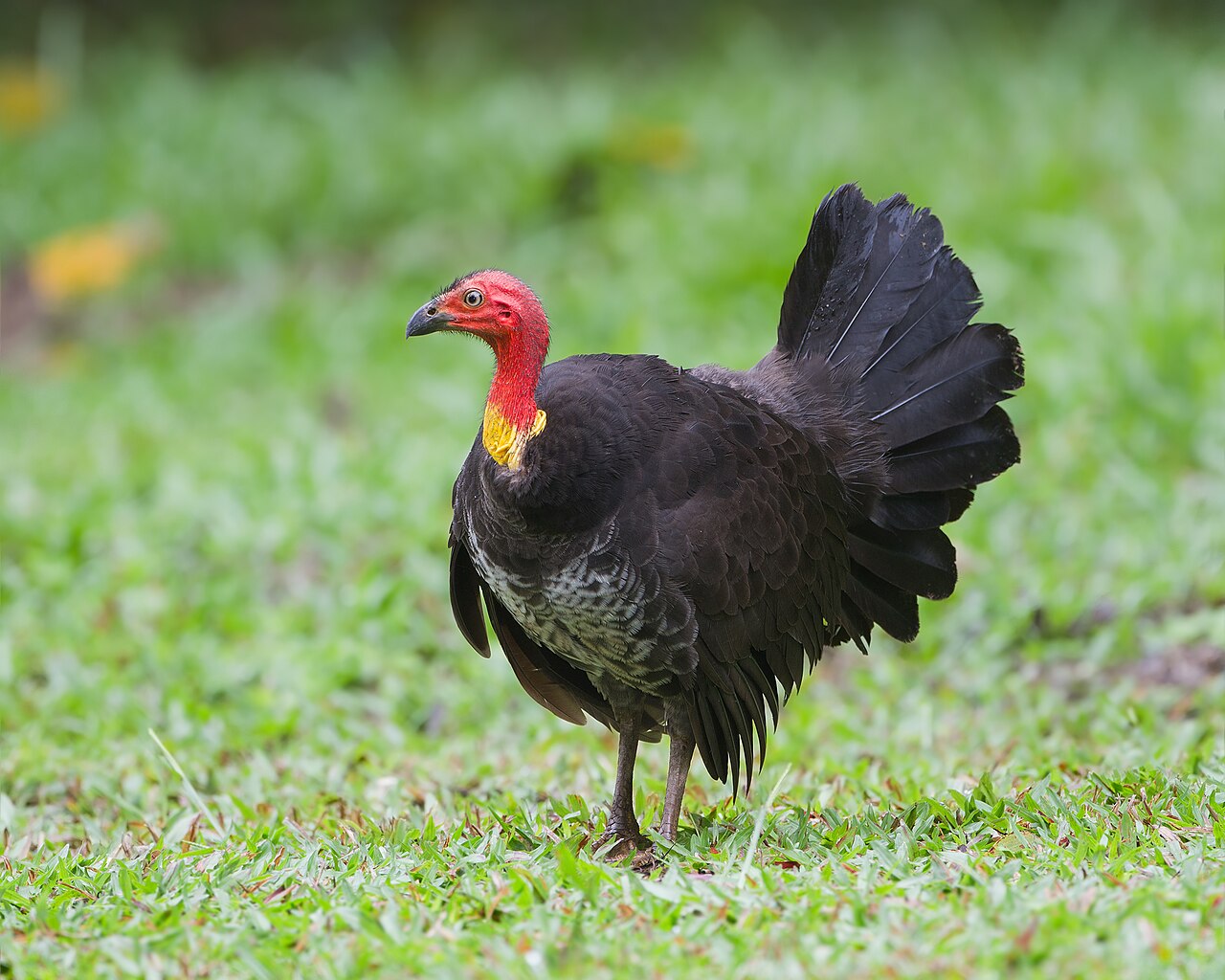
Australian Brushturkey is the largest of Australia's three megapodes: a heavy, glossy black forest bird with a bare red head, a yellow throat wattle and a laterally flattened tail carried upright like an open book. It does not brood its eggs but buries them in a huge heap of leaf litter, whose temperature the male guards for months on end. In Brisbane and northern Sydney it now works over the back gardens as a matter of course.
Voice
At the mound the male gives a deep, booming call, inflating his neck pouch to resonate it; a low, almost subsonic oo-oomp ... oo-oomp that shivers through the forest and is hard to place. Alongside come sequences of throaty growls, nasal clucking and gulping notes. Flushed, the bird goes off with a sharp high rasp and a loud clatter of wings.
No freely licensed recording has been found for this species yet; what to listen for is described below.
Identification
A big gallinaceous forest bird of sixty to seventy-five centimetres, largely glossy black, with pale feather edges below that give a faint scaling close up. Head and upper neck are bare and bright red with sparse black bristles; in the breeding season the male carries a swollen, bright yellow throat wattle, pale blue in the northern birds of Cape York. The tail is distinctive: long, broad and flattened side to side, so that head-on it is a narrow strip and in profile a fan. The legs are heavy and dark. It walks a great deal and flies seldom, but roosts high in the trees.
Confusion species
Orange-footed Scrubfowl (Megapodius reinwardt) is the other megapode of the eastern tropics: far smaller at 45 cm, brown rather than black, with a pointed crest and bright orange legs, and no bare red head. Malleefowl (Leipoa ocellata) of the southern mallee is brown with fine white, black and rufous barring and shares no ground with the brushturkey. Wild Turkey (Meleagris gallopavo), feral on Kangaroo Island, is bulkier, browner, has a broad spreading tail and red wattles hanging over the bill. No Australian corvid or ibis carries that flat, upright tail.
Habitat
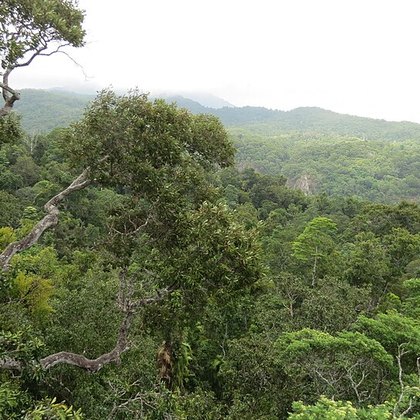
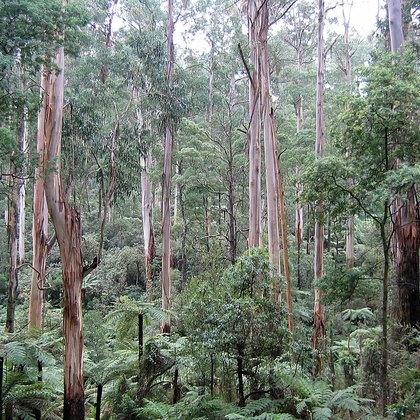
Tropical rainforest and wet eucalypt forest with a deep litter layer are the core, but it also works drier scrub and vine thicket, and in the south gardens, parks and woodland edges right inside the city. Wherever it settles the requirements are the same: shade, litter and damp, because it needs rotting leaves to heat its mound. In the north it summers higher in the ranges and drops to the lowlands in winter; in the south it stays put all year.
Where the bird is most often found, arranged by main group and formation.


Range and movements
The eastern margin of Australia, from the tip of Cape York in Queensland south to the northern suburbs of Sydney and the Illawarra district of New South Wales, almost always within a couple of hundred kilometres of the coast. The northern birds of Cape York, with the pale blue wattle, are treated as a separate race. Beyond that it has been introduced to Kangaroo Island in South Australia, well outside its natural range, where it has held on. It does not occur in New Zealand.
- Resident
- dark = core range, pale = thinly spread
Where and when to look
Find the mound before you look for the bird: a heap of leaf litter three to four metres across and a metre high on the forest floor marks a territory, and in spring the owner is nearly always within earshot. Listen from August to December for the low booming, which stands out at once once you know to expect it. In the parks of northern Sydney and the Brisbane suburbs it simply walks the lawns; be warned, it will strip a flower bed in a morning.
Conservation
Least Concern (LC), and one of the few large Australian forest birds to have gained ground in recent decades. Through the nineteenth and early twentieth centuries hunting and egg-collecting made it scarce in many districts; since protection, and the end of the fox-baiting campaigns, it has recovered and moved into the cities. Foxes and feral cats take chicks and eggs, and rainforest clearing costs it ground, but neither outweighs the gain. In town the friction runs the other way: it digs up gardens and builds its mound in a border, which brings a steady trickle of illegal killing.
Scientific name
Alectura lathami | Gray, 1831
J.E. Gray described the species in 1831 as Alectura lathami, in the first volume of his Zoological Miscellany, and it has stayed in that genus, so author and year carry no parentheses. Alectura is built from Greek alektor, 'cock', and oura, 'tail' — 'cock-tail', after the striking upright tail. The epithet lathami honours John Latham, the English physician and ornithologist who set down the first great descriptions of Australian birds at the end of the eighteenth century. The type locality is near Sydney.