All species › Passerines › Pardalotes › Red-browed Pardalote
Red-browed Pardalote | Pardalotus rubricatus
Roodbrauwdiamantvogel | Pardalote cejirrojo
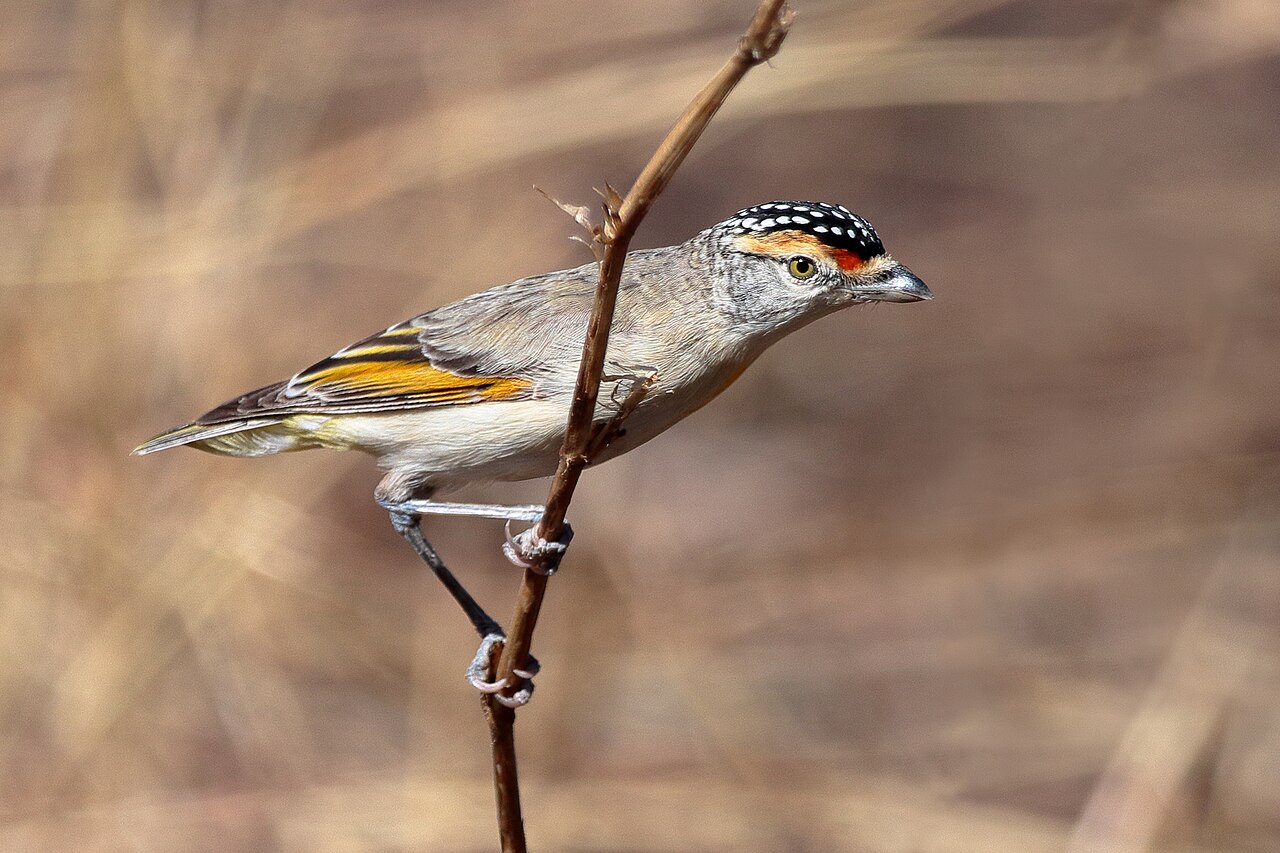
The Red-browed Pardalote is the pardalote of the dry interior: a shade larger than its relatives, with a black crown full of white spots, a pale eyebrow and, at the front of it, a short orange-red patch above the eye. It forages high in the foliage of eucalypts along watercourses and gives itself away with a song heard, in the silence of the inland, long before the bird is seen.
Voice
A distinctive song of five or six notes in which the first is longer and lower and the rest rise in pitch and speed — an ascending run that carries far across open woodland from the canopy. The male repeats the phrase at intervals to mark his territory, mainly in the early morning. There is also a short hard contact note between partners. Song is given all year, peaking in the breeding season from July to December; in the arid interior singing often starts only after rain.
Recording: Eddy Smith — CC BY-NC-SA 4.0 · Yarraden, Cook Shire, Queensland, Australia · xeno-canto
Identification
Ten to twelve centimetres and about eleven grams; the largest of the Australian pardalotes. The crown is black with crisp white spots, below it runs a broad yellow to buff eyebrow, and at the front of that stands a short orange to reddish brow patch above the base of the bill — the character it is named for and the decisive one. The iris is pale and stands out. There is a yellow breast patch and a yellow to orange wing panel. Upperparts grey-brown, underparts off-white. The sexes are alike and there is no seasonal plumage. The northern subspecies yorki is brighter, with a bright yellow breast patch and an orange wing panel; young birds are paler with a duller crown pattern.
Confusion species
Striated Pardalote (Pardalotus striatus) overlaps across much of this range and also shows a striped or plain black crown, but lacks the orange-red brow patch and has a white rather than yellow eyebrow and a clear white wing stripe or wing spot. Spotted Pardalote (Pardalotus punctatus) is smaller, has a chestnut rump, white spots over the whole wing and a white eyebrow stripe, and keeps mainly to moister southern forest. Thornbills of the genus Acanthiza are slimmer, lack the spotted crown and have a finer, sharper bill. The brow patch remains the one character that needs no interpretation.
Habitat
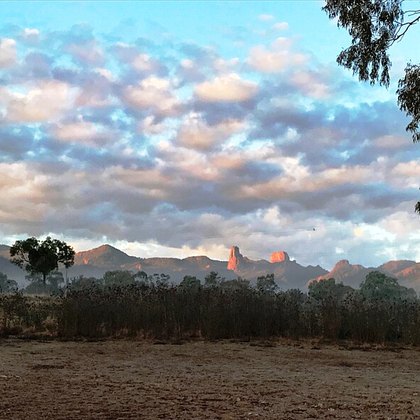
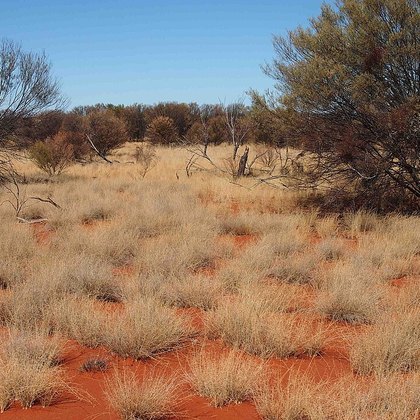
Eucalypt woodland in the dry and semi-arid interior, with a clear preference for the tree ribbons along watercourses: river red gum and coolibah along creeks and dry river beds. Beyond that, bloodwood and marble gum woodland, eucalypt shrubland such as mallee (low, multi-stemmed eucalypt scrub of dry southern Australia), and acacia shrubland where the trees carry enough leaf. It is an arboreal bird and forages almost entirely in foliage, taking lerps (sugary scale secreted by psyllids, food for honeyeaters) and small insects off the leaves. It breeds in a self-dug tunnel of six to over a hundred centimetres in a creek bank or sandy slope, with a nest chamber at the end.
Where the bird is most often found, arranged by main group and formation.


Range and movements
Widely distributed across northern and central Australia, extending into southern and south-central Western Australia, north-eastern South Australia around the Lake Eyre Basin, and south-western New South Wales. It also occupies the Great Sandy, Gibson and Great Victoria Deserts, always tied to tree growth along watercourses. Two subspecies: the nominate over most of the range and the northern yorki, described in 1913. It is sedentary, but in the interior it follows the rain and may appear and disappear locally.
- Resident
- Winter
- dark = core range, pale = thinly spread
Where and when to look
Find the tree ribbons along a dry inland creek and listen in the first hours after sunrise for the ascending run of five or six notes. The bird is almost always high in the foliage and moves slowly for a pardalote, which gives time to get the head in view. Then look at the spot right above the base of the bill: an orange-red smear above a yellow eyebrow, and the identification is settled. In the breeding season it also pays to scan creek banks for nest tunnels.
Conservation
Least Concern (LC). The species is common across a very large range and the population is regarded as stable. It does depend on the riverine woodland of the interior, which is under pressure from water extraction, stock eating out the regrowth and old trees disappearing without replacement. Where the river red gum ribbons along the creeks stay intact, the bird stays too. No reliable estimate of the number of mature birds exists.
Scientific name
Pardalotus rubricatus | Gould, 1838
Gould described the species in 1838 as Pardalotus rubricatus; the genus has not changed since, so author and year stand without parentheses. Pardalotus comes from Greek pardalotos (spotted like a leopard), after the fine spotting of these birds; the Dutch 'diamantvogel' refers to the same bright specks. rubricatus is Latin for 'coloured with red ochre' and refers to the brow patch. The Dutch name states that character exactly.