All species › Passerines › Pardalotes › Striated Pardalote
Striated Pardalote | Pardalotus striatus
Geelvlekdiamantvogel | Pardalote estriado
The Striated Pardalote is the most widespread of the four pardalotes: a nine-centimetre bird that lives high in the eucalypt canopy, picking lerp, psyllids and small caterpillars off the leaves. It is heard long before it is seen, the short phrase running all day from the treetops. It nests low down instead, in a tunnel the pair digs for itself in an earth bank.

Voice
A clear, sharp chip-chip, the second note a shade lower, repeated at intervals of a few seconds for minutes on end; Australians write it as pick-it-up or witta-witta. There is also a soft low trill that keeps the birds in touch within the canopy, and a short cutting tchip at any disturbance. At the nest the pair calls back and forth without pause.
No freely licensed recording has been found for this species yet; what to listen for is described below.
Identification
A compact bird of 8 to 10 centimetres with a short tail and a fine, blunt bill. The crown is black, finely streaked white in some subspecies; a white brow runs above the eye with a yellow spot in front of it. The back is olive-grey, the throat yellowish, the underparts off-white. A white stripe runs along the folded wing with a red or yellow spot at its front end. Sexes are alike; young birds are paler with a duller crown.
Confusion species
Spotted Pardalote (Pardalotus punctatus) has a black crown and wings covered in white spots, a rufous rump and a deeper, plaintive whistle. Red-browed Pardalote (P. rubricatus) of the dry interior has a grey, finely streaked crown and an orange spot above the eye. Forty-spotted Pardalote (P. quadragintus) is dull olive without a white brow and sits only in southeastern Tasmania. Weebill is smaller still and lacks the wing stripe.
Habitat
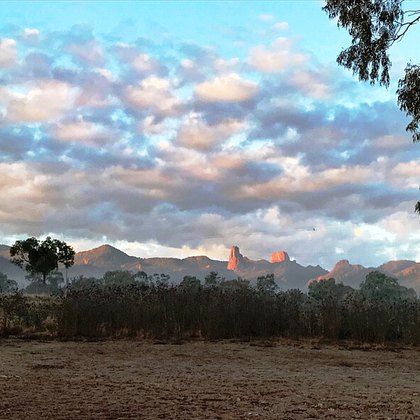
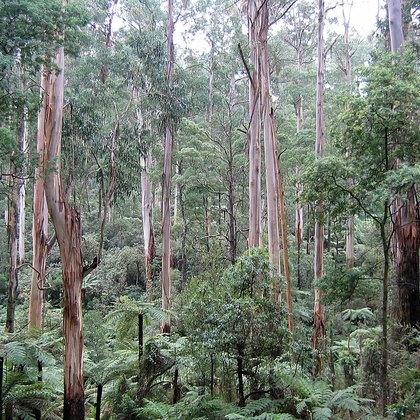
Almost any country with trees or shrubs, but the weight of the population is in dry eucalypt woodland and the wet forest beside it. River red gum along creeks, mallee, casuarina woodland and old gardens with large trees all count as well. What it needs is a hollow or a steep earth face — a road cutting, a creek bank, the root plate of a fallen tree — in which the pair excavates a tunnel.
Where the bird is most often found, arranged by main group and formation.


Range and movements
Across virtually all of Australia, from Cape York to Tasmania and on into the southwest; only the driest sand deserts stay empty, and the species occurs nowhere else. Six subspecies divide that ground; several were once treated as full species, but where their plumage forms meet they interbreed freely. Tasmanian birds cross Bass Strait in March and April and winter on the mainland.
- Resident
- dark = core range, pale = thinly spread
Where and when to look
Look up and follow the call: the bird is usually in the outer foliage of a tall eucalypt and gives itself away only by its phrase. In spring it pays to search a road cutting or a creek bank for round holes the width of a thumb; stand still a moment and the pair will fly in and out. Holes in walls, pipes and even planter boxes are used too.
Conservation
Least Concern (LC). The species is numerous and widespread, and because it accepts almost any wooded habitat it has suffered less from the clearing of Australia than most forest birds. Locally, competition for hollows with Common Starling and Common Myna costs broods, and nest tunnels in road verges are lost to grading and mowing; cats and foxes dig out burrow nests.
Scientific name
Pardalotus striatus | (Gmelin, 1789)
Gmelin described the bird in 1789 as Pipra striata, among the manakins; because it was later moved to another genus, author and year stand in parentheses. The genus Pardalotus was introduced by Vieillot in 1816, from Greek pardalotos, 'spotted like a leopard'. striatus means 'striated', after the streaked crown of the southern forms. The type locality is Tasmania.