All species › Passerines › Flowerpeckers › Red-capped Flowerpecker
Red-capped Flowerpecker | Dicaeum geelvinkianum
Papoeahoningvogel | Picaflores capirrojo
The Red-capped Flowerpecker is a vagrant here: a minute, short-tailed canopy bird of New Guinea that now and then crosses Torres Strait and turns up on the northernmost Australian islands and in the far north of Cape York. Only a few tens of records exist, and in most years it is not seen at all. The male carries a red cap, a red rump and a red spot on the breast.

Voice
A sharp, metallic tsik dropped from high in the canopy and repeated in short runs, usually the only thing that gives the bird away; the note is so high and dry that it is easily taken for an insect. The song is a thin, hurried chittering of a few seconds, without melody and without carrying power. Birds on the move call continuously, which betrays a passage across the crowns.
Recording: GABRIEL LEITE — CC BY-NC-SA 4.0 · Oro Bay Rural LLG (near Pongani), Ijivitari District, Northern Province, Papua New Guinea · xeno-canto
Identification
A bird of nine centimetres, with a short conical bill and a tail that barely passes the wing tips, so that the whole animal looks almost round. The male is olive-grey to dark above with a scarlet crown, a scarlet rump and a red spot in the middle of the grey-white breast. The female lacks the red crown and is dull olive-grey, with only a rusty wash on the rump. Both sexes move fast and restlessly and stay high in the tree.
Confusion species
Mistletoebird (Dicaeum hirundinaceum) is the only relative common in Australia and overlaps in the north: the male is glossy blue-black above with a red throat and red undertail coverts, but has no red crown. Females of the two are grey and hardly separable; better to leave a grey bird unnamed. Scarlet Myzomela (Myzomela sanguinolenta) is larger, has a curved bill and red on head and back alike.
Habitat
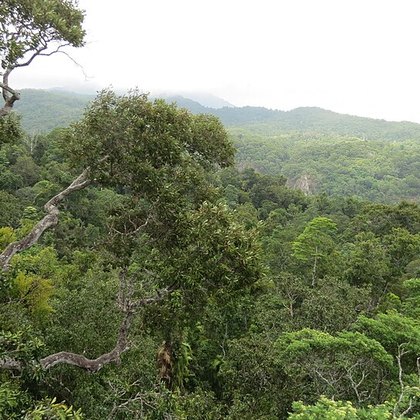
Monsoon forest and vine thicket, mangrove and the edges of tropical rainforest, out into secondary growth and gardens. It follows mistletoes in flower and fruit, its main food, and moves between the trees carrying them. The bird stays in the crown and rarely comes lower than a few metres above the ground.
Where the bird is most often found, arranged by main group and formation.


Range and movements
The species is endemic to New Guinea and its islands and occurs throughout the lowlands there. In Australasia it appears only as a vagrant, on the northernmost islands of Torres Strait — which lie a few kilometres off the Papuan coast — and in the far north of Cape York. These are scattered records without a pattern; in most years there is none at all.
- Breeding (summer)
- dark = core range, pale = thinly spread
Where and when to look
To see it you must be in the northern Torres Strait and work the flowering mistletoes in mangrove and vine thicket. Go by ear: the sharp tsik from the crown is almost always the first sign. Then look deliberately at crown and rump, because only those two panels separate it reliably from Mistletoebird; a grey female is better left unidentified.
Conservation
Least Concern (LC). The species is numerous and widespread in the New Guinea lowlands and its numbers are held to be stable. For Australasia there is nothing to conserve: these are wanderers from a population that lives outside the region. What does matter is that clearing of the southern New Guinea lowlands will in time reach the source of these vagrants too.
Scientific name
Dicaeum geelvinkianum | Meyer, 1874
Meyer described the bird in 1874 already in the genus Dicaeum, so author and year carry no parentheses. The genus was introduced by Cuvier in 1816; the name goes back to Greek dikaion, an Indian bird mentioned by Aelian. geelvinkianum refers to Geelvink Bay in the northwest of New Guinea, itself named after the Dutch ship Geelvinck; the type locality lies on the islands in that bay.