All species › Waders, gulls and terns › Sandpipers and allies › Red Knot
Red Knot | Calidris canutus
Ijslandse strandloper | Playero rojo
The Red Knot is a compact, short-necked, pot-bellied sandpiper the size of a starling: plain grey through the southern summer, brick-red on the head and underparts in breeding dress. With the Bar-tailed Godwit it is the bird that fills the great tidal flats of Australia and New Zealand in their thousands, and in New Zealand it carries the Maori name huahou.

Voice
A quiet bird. Single birds rarely say anything; in flocks there is a low, short, grunting knutt, and just before departure north the flocks give a two-note knuup-knuup that carries across the flat. A soft murmur runs through a flock as it lifts.
No freely licensed recording has been found for this species yet; what to listen for is described below.
Identification
Twenty-three to twenty-five centimetres, compact and broadly built, with a short neck and a rounded belly — a sandpiper that suggests a small plover rather than a wader on stilts. The bill is black, straight and short: about as long as the head, and evenly thick. The legs are short and dull green-grey to yellow-grey, never black. In non-breeding plumage the upperparts are plain grey with fine pale feather edges and a faint pale brow, the underparts white with light streaking on breast and flanks. The rump is pale grey and finely barred, not white. In flight a narrow white wingbar runs along the inner wing. In breeding plumage head, neck and underparts turn chestnut-red.
Confusion species
Great Knot (Calidris tenuirostris) is what this comes down to: the two are the only true knots of the region and often stand in the same flock. The Great Knot is clearly larger (twenty-six to twenty-eight against twenty-three to twenty-five centimetres), longer and slimmer in the body, and its bill is noticeably longer than the head and tapers finer towards the tip, where the Red Knot's stays about head length and stays stout to the point. The Great Knot also carries heavy black spotting on breast and flanks and a paler, whitish rump; the Red Knot stays more evenly grey. Curlew Sandpiper (Calidris ferruginea) is smaller and slimmer, with longer black legs, a clearly downcurved bill and a clean white rump patch. Grey Plover (Pluvialis squatarola) is a plover, with a short thick bill, black armpits and the typical run-stop-peck.
Habitat
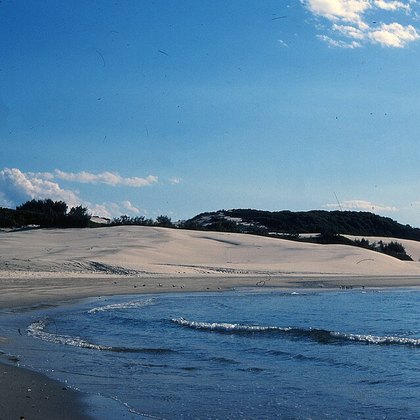
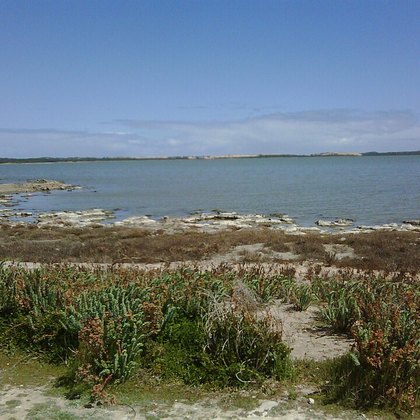
Wide sand and mudflats that dry out at low tide, in sheltered bays, harbours and estuaries. It feeds out on the wet flat, swallowing bivalves whole and crushing them in the gizzard, and gathers at high tide on shellbanks, sandspits and low saltmarsh, usually in dense flocks among the godwits.
Where the bird is most often found, arranged by main group and formation.

Range and movements
Around nearly the whole Australian coast, with by far the largest numbers in the north-west: counts on Eighty Mile Beach have reached almost thirty thousand birds, and Roebuck Bay at Broome is another stronghold. Further south, in Gulf St Vincent and along the south-east coast, it is scarcer, and it hardly uses the interior. In New Zealand it is the second most numerous migrant wader after the godwit: about thirty thousand birds, down from nearly sixty thousand in the early 1990s, with the Firth of Thames at Miranda, Manukau Harbour, Farewell Spit, Awarua Bay and Lake Ellesmere as the main sites, and regular numbers on the Chatham Islands. Roughly a tenth — almost all immatures of one to three years — stays through the winter. Birds arrive from mid-September and leave in March and April. Two subspecies reach the region: Calidris canutus rogersi in New Zealand and eastern Australia, Calidris canutus piersmai in north-western Australia.
- Resident
- Breeding (summer)
- dark = core range, pale = thinly spread
Where and when to look
Look for it at the high-tide roost rather than out on the flat. Work along the godwits and pick out the smaller, dumpy grey birds with short straight bills among them; set the bill against the length of the head and you have the split from Great Knot at the same time. By March the first birds already show red on the breast.
Conservation
Near Threatened (NT) globally, and rated Declining in New Zealand: the halving of the New Zealand population since the 1990s is one of the most clearly measured falls on the whole flyway. The cause lies largely outside this region, at the staging grounds on the Yellow Sea, where reclamation of tidal flats — the closure of Saemangeum in South Korea is the best known case — has removed the flyway's filling station. On top of that come disturbance at high-tide roosts and the shifting of the tundra insect peak under a warming climate.
Scientific name
Calidris canutus | (Linnaeus, 1758)
Linnaeus described the species in 1758 in the tenth edition of his Systema Naturae as Tringa canutus; because it now sits in Calidris, author and year take parentheses. The genus Calidris goes back to Greek kalidris, a word Aristotle used for grey waterside birds. canutus is often said to refer to King Cnut, who commanded the tide to retreat at the waterline — pleasing for a bird that runs to and fro with the tide, but there is no historical basis for it; more likely it imitates the grunting call. The type locality is Europe, later restricted to Sweden. The Dutch name points at Iceland, where the western birds stage on migration.