All species › Waders, gulls and terns › Sandpipers and allies › Sanderling
Sanderling | Calidris alba
Drieteenstrandloper | Playero arenero
The Sanderling is the small white bird that chases each retreating wave down the sand and races back ahead of the next, on legs that move so fast they look like wheels. It is the palest sandpiper in the region and the only one without a hind toe.

Voice
In flight a short, sharp, clear kwit or a quickly repeated twick twick twick that carries over the sound of the surf. Flocks give soft twittering and the occasional short trill; on the ground the bird is all but silent.
No freely licensed recording has been found for this species yet; what to listen for is described below.
Identification
Eighteen to twenty centimetres, and in non-breeding plumage the palest of all the sandpipers here: nearly white from head to undertail, with very pale grey, unmarked upperparts. The black shoulder patch at the bend of the wing is the mark that fixes the species in that plumage. The bill is black, straight and short, thick at the base and slightly blunt at the tip; the legs are short and black, and there is no hind toe — unique among the small sandpipers. In flight a broad white wingbar shows against a dark hand, the boldest wing pattern in the group. In breeding plumage head, neck and breast turn rufous with dark spotting, so that it then looks one of the darker sandpipers.
Confusion species
In non-breeding plumage its whiteness and the black shoulder spot make it hard to miss, but at range and in poor light the small stints come into play. Red-necked Stint (Calidris ruficollis) is smaller (thirteen to sixteen centimetres), greyer and finer-billed, and does have a hind toe; it also feeds out on the mudflat rather than in the surf. Little Stint (Calidris minuta) is smaller and finer again. Curlew Sandpiper (Calidris ferruginea) has longer legs, a clearly curved bill and a white rump. Red Knot (Calidris canutus) is larger, dumpier and dull grey, without the shoulder spot and without the running from the waves. With this species behaviour is very nearly a field mark in its own right.
Habitat
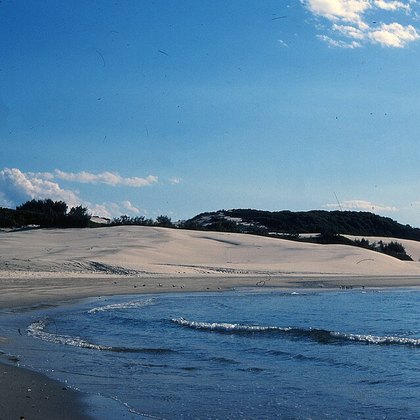
Open ocean beaches, right on the line between wet and dry sand where the waves run out, and beyond that sandbars, spits and the sandy parts of estuaries. It roosts on bare sand at the foot of the dunes or behind piled kelp, where the pale plumage makes it almost invisible.
Where the bird is most often found, arranged by main group and formation.

Range and movements
Widespread along virtually every Australian coast, in small parties of a few to a few dozen birds; the largest concentrations are in the north-west, where counts on Eighty Mile Beach have exceeded three thousand, and along the long ocean beaches of the Coorong and south-eastern Australia. It arrives from September and leaves by early April, with a small number staying the winter. In New Zealand it is a regular but scarce visitor: one or two birds a year, occasionally parties of four to six, at Parengarenga and Kaipara Harbours, Maketu, Farewell Spit, Lake Ellesmere and Waituna Lagoon.
- Resident
- dark = core range, pale = thinly spread
Where and when to look
Walk a surf beach on a falling tide and watch the waterline rather than the mudflat: a small, strikingly white bird running to and fro with the waves is almost always this species. On a standing bird check the bend of the wing for the black patch, and as it takes off look for the broad white wingbar.
Conservation
Least Concern (LC): the species breeds right around the high Arctic and winters on sandy beaches across half the world, which makes it far less dependent on a handful of tidal flats than the mudflat specialists of this flyway. It is listed as Vulnerable at state level in New South Wales. The pressure here is on the beach itself: vehicles, dogs and recreation along the waterline disturb feeding and roosting birds, and this species too uses the shrinking tidal flats of the Yellow Sea on migration.
Scientific name
Calidris alba | (Pallas, 1764)
Pallas described the species in 1764 as Trynga alba; the move into Calidris puts author and year in parentheses. The genus Calidris goes back to Greek kalidris, Aristotle's word for grey waterside birds, and alba is Latin for 'white', after the pale winter plumage. The type locality is the coast of the North Sea. The English name comes from Old English sand-yrthling, 'sand-ploughman', and the Dutch name points at the missing hind toe: three toes are left.