All species › Waders, gulls and terns › Sandpipers and allies › Sharp-tailed Sandpiper
Sharp-tailed Sandpiper | Calidris acuminata
Siberische strandloper | Correlimos acuminado
The Sharp-tailed Sandpiper is the sandpiper of the inland: where the other Palearctic waders crowd the tidal flats, this one stands in the grass by the dozen at the edge of a shallow freshwater swamp, a sewage farm or a flooded paddock. It is eighteen to twenty-two centimetres, with a rusty cap, a narrow white eye-ring and a breast that fades into the white belly without any sharp edge. Virtually the entire world population spends the southern summer in Australia.

Voice
The call is a soft, rolling trreep, much warmer and less piercing than the squeaks of the small stints, and heard mostly as a flock lifts or shifts ground. Within a feeding flock there is a low, sustained twittering in which that same wheep keeps recurring. Birds flushing often call two or three times in quick succession, and the sound hangs over the swamp for a moment afterwards.
No freely licensed recording has been found for this species yet; what to listen for is described below.
Identification
A medium-sized sandpiper of eighteen to twenty-two centimetres, compactly built, with a short, straight dark bill with a slightly paler base and olive to yellow-green legs. The crown is bright rufous and sharply outlined, with a pale supercilium below it and a strikingly narrow white eye-ring that gives the bird a startled look. Back and wing feathers are warm brown to chestnut with pale fringes. The key feature is on the breast: the brown streaking fades into the white belly along a vague, feathered boundary, never a clean line. In breeding plumage black arrowheads mark the flanks and run onto the undertail coverts. Young birds, which are the commonest here, are the handsomest: an orange-buff wash across the breast, vivid chestnut feather fringes and a pale V over the mantle. Males are about fifteen per cent larger than females.
Confusion species
Pectoral Sandpiper (Calidris melanotos) is the only genuinely difficult one and often stands in the same pool: on that bird the dark breast streaking ends in a dead-straight, sharp line against the white belly, it lacks the rufous cap, and its bill is more clearly two-toned with a pale base. Curlew Sandpiper (Calidris ferruginea) has a bill decurved along its whole length, longer legs and a white rump in flight. Ruff (Calidris pugnax) is bulkier, longer in neck and leg, small-headed, and shows two white ovals at the sides of the rump in flight. Broad-billed Sandpiper (Calidris falcinellus) is smaller, with a double supercilium and a bill kinked at the tip. Red-necked Stint (Calidris ruficollis) is far smaller and black-legged.
Habitat
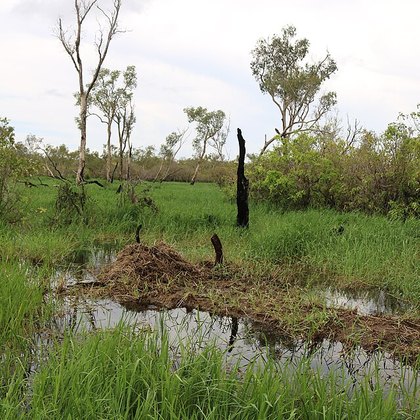
The grassy margins of shallow inland freshwater and brackish swamps are its core ground, along with sewage farms, settling ponds, flooded paddocks and the overgrown edges of reservoirs. It likes to walk in the vegetation itself, half hidden among grass and sedge, rather than out on bare mud. On the coast it uses tidal flats, mangrove edge, saltmarsh and at times rocky shore and beach, but always in smaller numbers than inland.
Where the bird is most often found, arranged by main group and formation.


Range and movements
Australia is the wintering destination of almost the entire species. The largest concentrations lie in the southeast — the Werribee sewage farm near Melbourne, the Coorong, the swamps of the Riverina and the Murray-Darling — but in the right season it reaches the heart of the continent, where flooded claypans briefly open up an enormous area to it. Arrival begins in August in the northwest, numbers peak between December and February, and departure falls in March. In New Zealand it is a scarce visitor between September and April: until the 1990s an average of one to two hundred birds a year, in recent decades fewer than twenty-five, with Lake Ellesmere and Miranda on the Firth of Thames as the regular sites and occasional records from the Chathams and the Kermadecs.
- Resident
- Breeding (summer)
- dark = core range, pale = thinly spread
Where and when to look
Do not look for it on the tidal flats but at a sewage farm or a flooded paddock, and walk the grassy margin rather than the open water. The quickest feature is the head: a bright rufous cap with a narrow white eye-ring beneath it. Then look at the breast and ask yourself one thing — does the streaking fade out, or does it stop in a straight line? Faded means Sharp-tailed Sandpiper, straight means Pectoral Sandpiper. In November and December most birds are juveniles in fresh plumage, and then the species can be picked out at range on the orange glow across the breast.
Conservation
Vulnerable (VU). The world population is falling steeply, and because the species breeds in one restricted corner of northeastern Siberia and winters almost wholly in Australia, any loss at either end tells at once. The heaviest bottleneck lies on the flyway, at the reclaimed tidal flats and river deltas of the Yellow Sea. Within the map window the draining and building over of shallow inland swamps counts too, along with water extraction in the Murray-Darling basin and the loss of temporary floodplains to dams and irrigation. In New Zealand the fall from two hundred to fewer than twenty-five birds a year is one of the clearest measurements of that decline in existence.
Scientific name
Calidris acuminata | (Horsfield, 1821)
Horsfield described the bird in 1821 as Totanus acuminatus, with Java as the type locality — a bird on passage, then, far from its breeding grounds; because of the move to Calidris, author and year stand in parentheses. The epithet acuminatus means 'tapering to a point' and refers to the pointed tail feathers, the same feature carried in the English name. The Dutch name instead points to the breeding grounds in Siberia. In Maori it is kohutapu. The genus Calidris goes back to a Greek word of Aristotle's for a grey waterside bird.