All species › Waders, gulls and terns › Sandpipers and allies › Ruddy Turnstone
Ruddy Turnstone | Arenaria interpres
Steenloper | Vuelvepiedras común
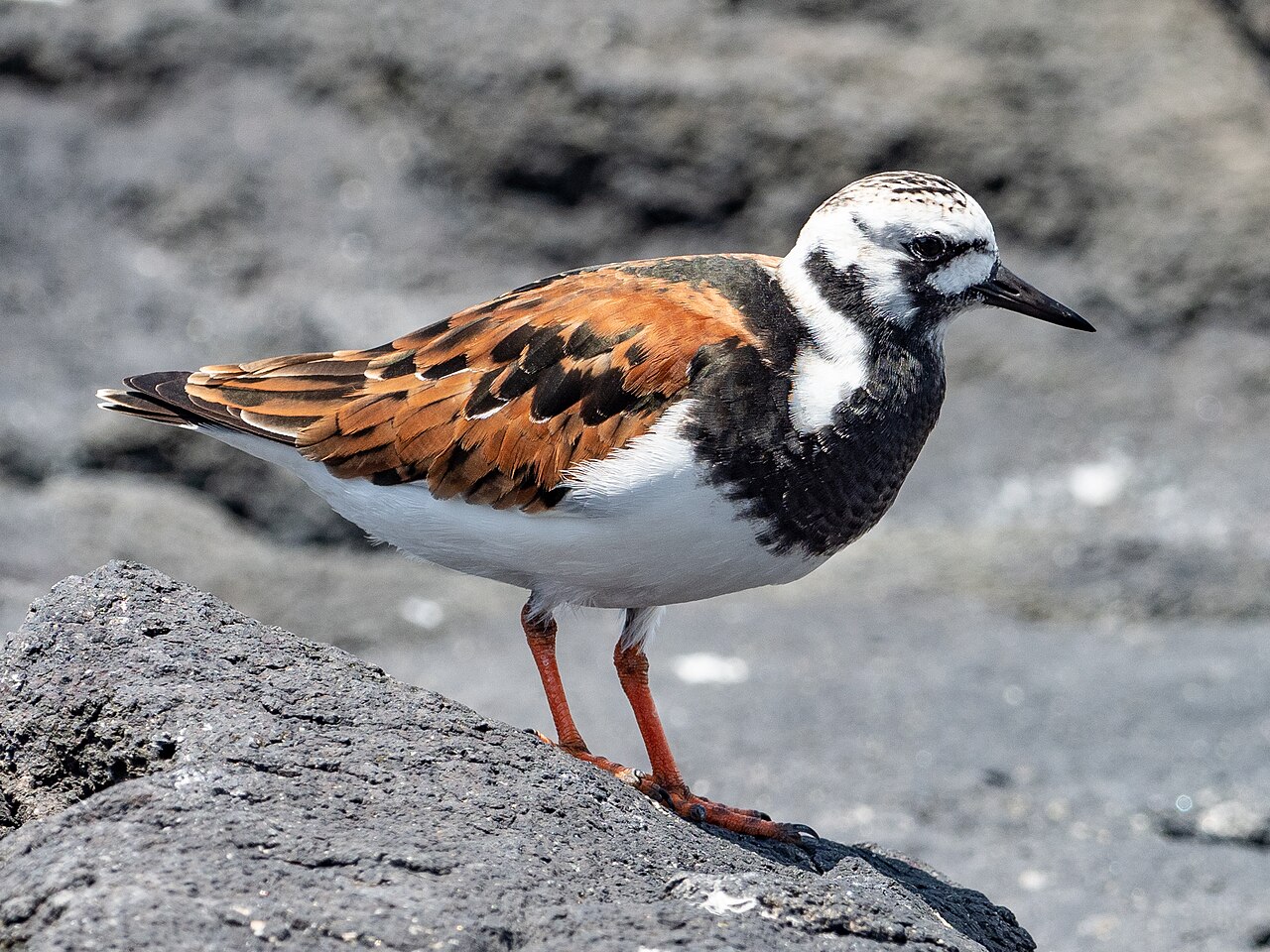
The Ruddy Turnstone is the most boldly marked wader of the coast and the only one here that makes its living by turning stones and seaweed over. It is squat, short in leg and bill, with orange-red legs and a harlequin pattern of black and white on head and breast; in flight it breaks up into a tangle of white stripes and patches that no other bird here matches.
Voice
The call is a dry, rattling, staccato chatter that runs quickly up and down: tuk-a-tuk-tuk, alongside a sharp kittick, a clear keeoo and a twittering kititit, often in flight and when uneasy. It is a hard, clicking sound without the whistled roundness of the shanks, and on a rock platform it gives a party away before you have found the birds among the weed. When a whole flock lifts, the rattles merge into a continuous clatter.
Recording: David Darrell-Lambert — CC BY-NC-SA 4.0 · Spurn Bird Observatory, Kilnsea, United Kingdom · xeno-canto
Identification
A squat, medium-sized wader of twenty-two to twenty-four centimetres and about a hundred and fifteen grams, low on short orange-red legs. The bill is short, black and wedge-shaped, with a slightly upturned tip: a chisel for levering under stones, not an awl for probing. In summer plumage the head, neck and breast are boldly pied black and white and the upperparts chestnut blotched with black, as though the bird wore a tortoiseshell; in winter that turns dark grey-brown, but the black breastband and white throat remain. In flight it is unmistakable: a white wingbar, a white band across the shoulder, a white rump and a black tail band, together a piebald pattern recognisable at long range.
Confusion species
In summer plumage confusion is impossible; in winter plumage and at range it is another matter. Wandering Tattler (Tringa incana) and Grey-tailed Tattler (Tringa brevipes) share the rocky shore and the short yellow legs, but are plain grey with no white flight pattern and have a longer straight bill. Common Sandpiper (Actitis hypoleucos) is smaller, plainer and teeters more strongly. Among the calidrids only Great Knot (Calidris tenuirostris) is about the same size, but it is slimmer, longer-legged and has a longer straight bill and no orange legs. In flight all doubt ends: no other wader here has the combination of wingbar, shoulder band, white rump and black tail band.
Habitat
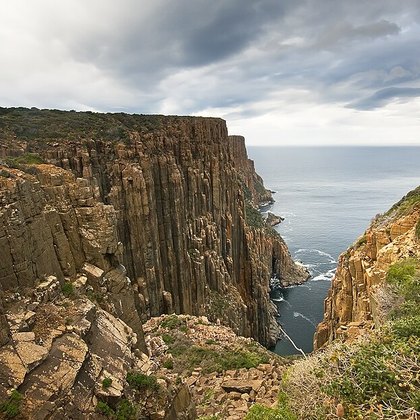
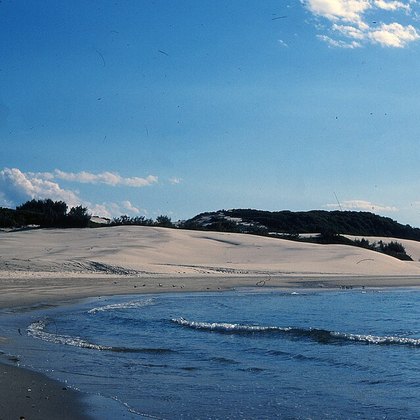
Hard, cluttered ground rather than open mud: rocky shores and drying reefs, coral platforms, beaches with stranded weed, breakwaters, jetties and harbour moles, and in the north also ordinary intertidal mud and sandflats. There it works the tideline systematically in small parties, turning stone after stone and weed clump after weed clump with the bill and at times with the breast, and eating whatever appears beneath: crustaceans, molluscs, insects, worms, and where the chance arises eggs and carrion too.
Where the bird is most often found, arranged by main group and formation.


Range and movements
Widespread along the whole coast of Australia and its offshore islands, with the largest numbers on rocky and reefy stretches; birds are present roughly from September to May. New Zealand receives a thousand to three thousand each year, with regular sites such as Parengarenga, Kaipara and Manukau Harbours, Tauranga Harbour and the Waipu estuary, and seventy to five hundred birds — mostly immatures — stay through the southern winter. Arrival there runs from August to November, departure from March to May. On Norfolk Island it is present every year.
- Resident
- dark = core range, pale = thinly spread
Where and when to look
Walk a breakwater or a rock platform at low tide and look at the weed rather than the water: turnstones sit with their backs to you among the brown weed and only register when something moves. Once the party lifts it is over — the piebald pattern of white stripes and patches shows in any light. Watch the legs too: on a rocky shore, orange-red legs on a squat little bird are an identification in themselves.
Conservation
Near Threatened (NT): the species breeds in an enormous ring right around the Arctic, from Greenland and Scandinavia to Alaska and Canada, but the world population is falling and the Red List has therefore moved it out of Least Concern. For the birds of this flyway the bottleneck is the same as for the other waders here: the intertidal flats around the Yellow Sea, where it must refuel on the outward journey and much of which has been reclaimed. Beyond that, disturbance of rocky shores and the cleaning of beaches — the removal of stranded seaweed — strike at exactly the food supply it lives off in Australasia.
Scientific name
Arenaria interpres | (Linnaeus, 1758)
Linnaeus described the species in 1758 as Tringa interpres, with Gotland in Sweden as the type locality; because of the move to Arenaria, author and year stand in parentheses. The genus name comes from Latin arenarius, 'belonging to sand', from arena, 'sand'. The epithet interpres means 'interpreter, messenger'; Linnaeus had the Swedish word tolk in mind, although in the Gotland dialect that simply meant 'legs'. The English and Dutch names both describe exactly what the bird does: turning stones. The birds reaching Australia and New Zealand belong to the nominate form interpres.