All species › Waders, gulls and terns › Sandpipers and allies › Red-necked Stint
Red-necked Stint | Calidris ruficollis
Roodkeelstrandloper | Correlimos cuellirrojo
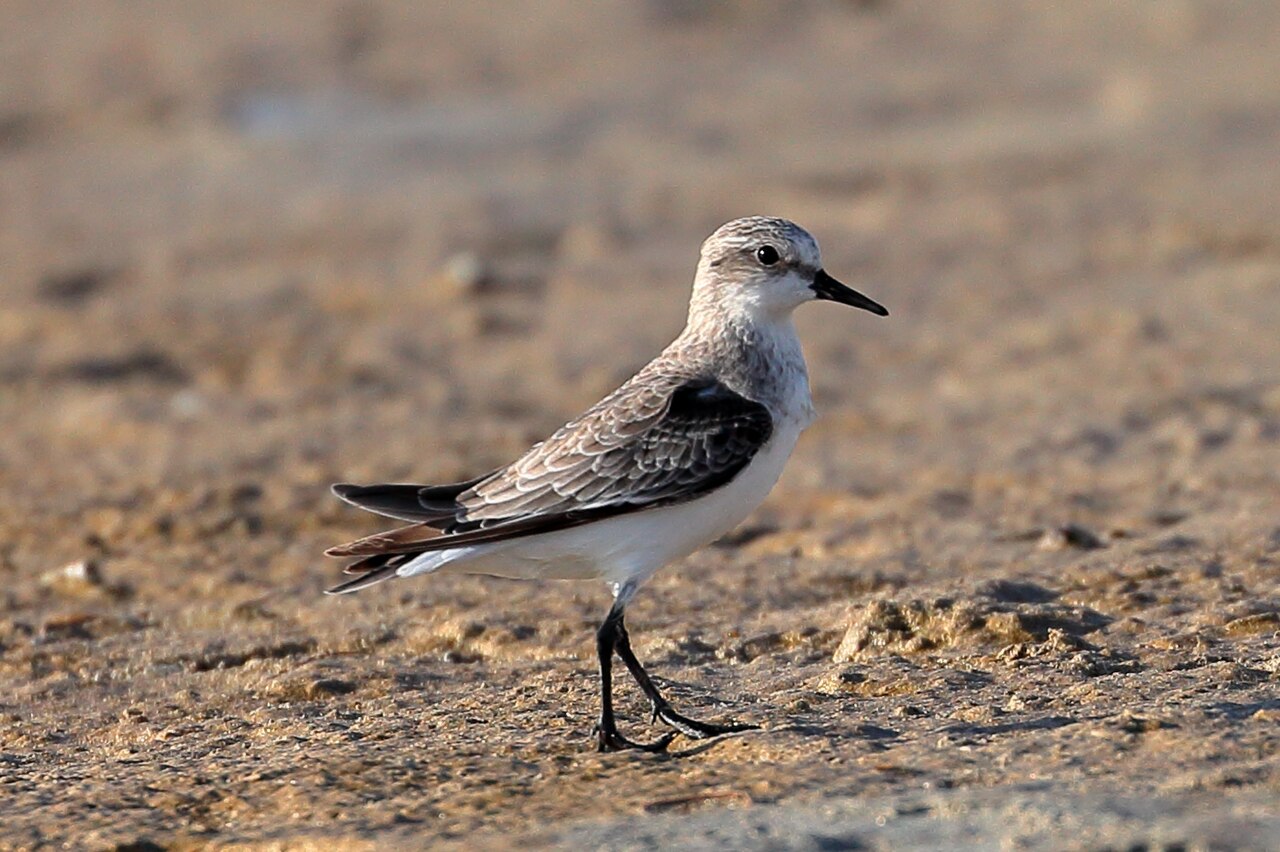
The Red-necked Stint is the most numerous small wader in Australia and the smallest shorebird that arrives here in bulk: thirteen to sixteen centimetres and about twenty-five grams, no more than a House Sparrow, and yet on the road for ten thousand kilometres twice a year between the Siberian tundra and the south coast of Australia. On the flats it is a squat, short-legged little ball with jet-black legs and a short, straight black bill, running across the mud in flocks of hundreds. Just before departure in March the head, throat and upper breast turn brick-red.
Voice
The call is a thin, high, clipped chit, often hoarse in tone and usually given at the moment a bird lifts off; when a whole flock shifts it sounds like a sustained, wispy rustle of hundreds of voices at once. Feeding birds are largely silent, giving only an occasional soft, short contact note. In an alarmed flock the note sharpens into a faster, repeated stit-stit.
No freely licensed recording has been found for this species yet; what to listen for is described below.
Identification
A very small wader of thirteen to sixteen centimetres, squat, short-legged and notably horizontal and hunched while feeding. The bill is short, straight, wholly black and slightly thickened and blunt at the tip — shorter than the head. The legs are black, and that is the one feature that always works in the field, separating the bird at a glance from Long-toed Stint. In non-breeding plumage it is grey-brown with pale feather edges above, white below, with a grey smudge at the side of the breast and a pale supercilium. In breeding plumage, seen here only in February and March, head, throat and upper breast turn brick to salmon-red, with no white dividing the bill from the red. In flight: a narrow white wingbar and a dark central stripe down rump and tail with white sides.
Confusion species
Little Stint (Calidris minuta) is the hardest and occurs here only as a vagrant: it also has black legs, but is longer in the leg, finer and more pointed at the bill tip, and juveniles show a clear white V across the mantle and a far more contrasting upperside; in breeding plumage it is more orange with a white throat, whereas Red-necked Stint carries the red right into the throat. Long-toed Stint (Calidris subminuta) is the second candidate and separates outright on leg colour: yellow-green rather than black, and beyond that longer in leg and neck, darker above, with a striped rather than scalloped mantle. Sanderling (Calidris alba) is larger, much paler, heavier-billed, lacks a hind toe and runs the surf line on sandy beaches instead of packing into muddy flocks. Broad-billed Sandpiper (Calidris falcinellus) is slightly larger, with a longer bill kinked down at the tip and a double supercilium.
Habitat
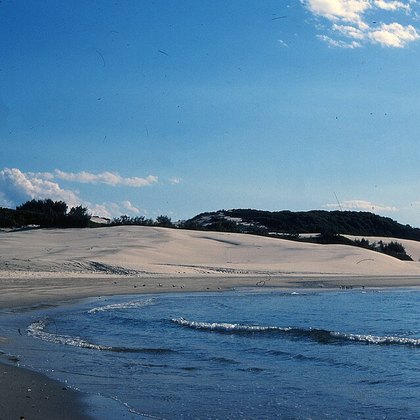
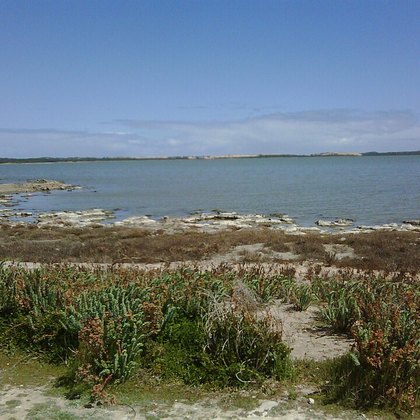
Broad intertidal flats of mud and sand in estuaries, harbours and sheltered bays, where at low water it picks and trips rapidly over the top centimetre or two. Beyond that, shallow brackish coastal lakes with samphire along the margin, saltworks ponds and sewage farms, and at high water the shellbanks, sandspits and saltmarsh edges where it sleeps in dense, hunched flocks.
Where the bird is most often found, arranged by main group and formation.


Range and movements
Along virtually the whole Australian coast, with by far the largest numbers in the southeast — Corner Inlet, Western Port, the Coorong and Gulf St Vincent — and in the northwest at Eighty Mile Beach and Roebuck Bay; it touches the interior mainly on passage and after rain. Australia thus holds the bulk of the world population. In New Zealand it is far scarcer: fifty to two hundred birds a year, spread across Lake Ellesmere, Awarua Bay, Manukau Harbour, Farewell Spit, Porangahau, Parengarenga, Kaipara, Lake Grassmere and the Firth of Thames, with fewer than fifty staying through the southern winter. Arrival runs from late August to November, departure from early March to mid-April. On Norfolk Island it is at best a chance passage bird.
- Resident
- dark = core range, pale = thinly spread
Where and when to look
Go to a high-tide roost on a rising tide and work the flock of small waders methodically: look at the legs first. Black means Red-necked Stint almost every time; a bird with pale, yellow-green legs is worth ten more minutes, because that is Long-toed Stint. Only then look at the bill — short, straight and blunt in this species. In February and March the birds already colouring up are the easiest of all: the brick-red head stands out at long range among hundreds of grey companions.
Conservation
Near Threatened (NT), and that is a recent reversal: until the 1980s this was a bird nobody worried about. The cause lies almost entirely outside Australia and New Zealand, at the staging grounds of the East Asian flyway, where the tidal flats of the Yellow Sea have been reclaimed on a vast scale for ports, industry and aquaculture; a twenty-five gram bird cannot cross that distance without refuelling. Within the map window the main issue is disturbance of high-tide roosts by dogs, quad bikes and beach walkers, along with the conversion of saltworks and saltmarsh.
Scientific name
Calidris ruficollis | (Pallas, 1776)
Pallas described the species in 1776 as Trynga ruficollis, with southern Transbaikalia in eastern Siberia as the type locality; because of the later move to another genus, author and year stand in parentheses. The epithet ruficollis is formed from Latin rufus, 'reddish', and -collis, 'necked', and refers to the breeding plumage. The genus name Calidris was introduced by Merrem in 1804 and goes back to Ancient Greek kalidris or skalidris, a word Aristotle used for a grey waterside bird. The Dutch name stresses the red throat and the English the red neck, and both describe the same plumage.