All species › Tropicbirds › Tropicbirds › Red-tailed Tropicbird
Red-tailed Tropicbird | Phaethon rubricauda
Roodstaartkeerkringvogel | Rabijunco colirrojo
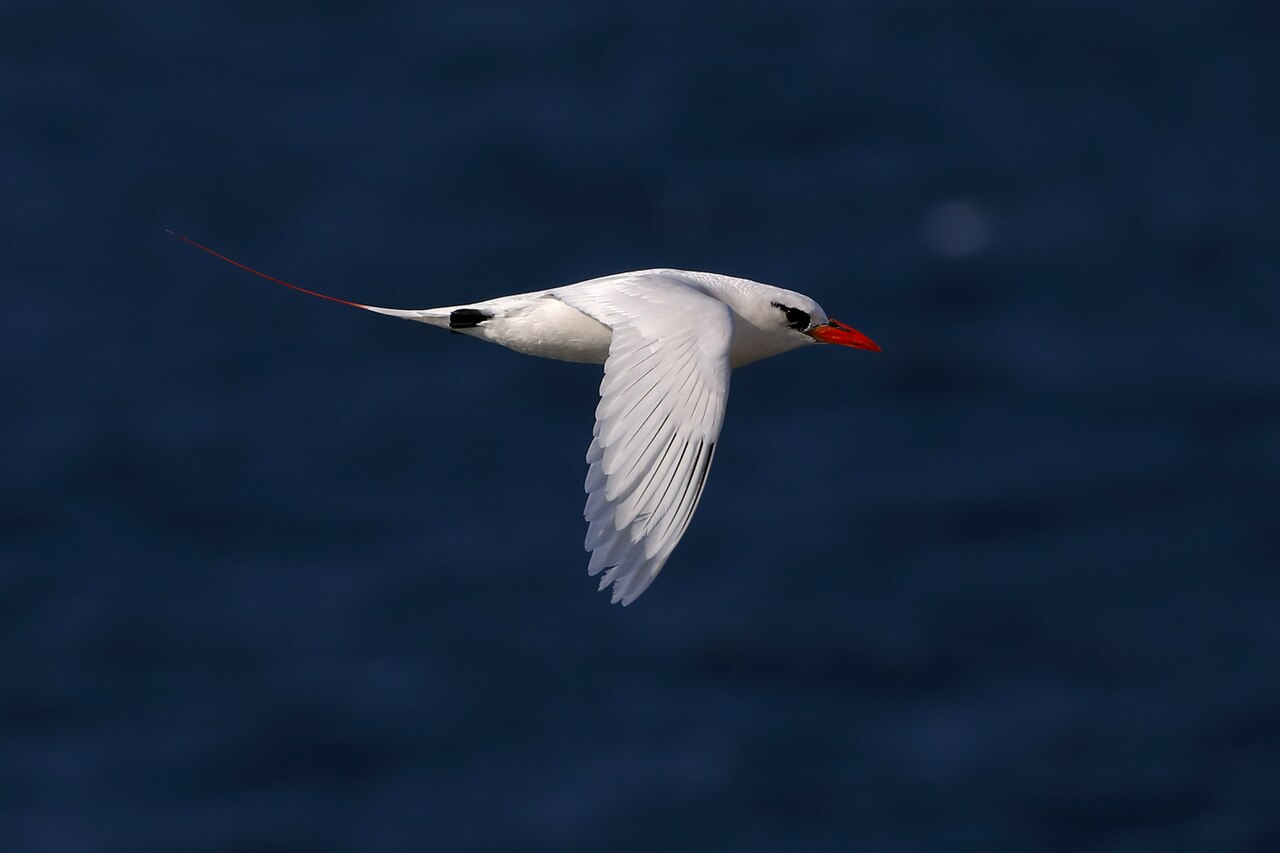
The Red-tailed Tropicbird is the white seabird of warm water: a stocky, pigeon-like body with a heavy red bill and two thread-thin red tail streamers almost as long as the bird itself. It breeds on islands from the Abrolhos to the Kermadecs and holds the world's southernmost colony at Cape Naturaliste in Western Australia.
Voice
Over the colony it is loud: harsh, drawn-out guttural notes, trumpeting growls and a hard rattling cackle, usually from two birds circling one another in slow arcs. At the nest it gives a growling krrr-aa at anything that comes too close, adult or chick. At sea it is almost always silent, so anyone who hears one is standing beneath a breeding site.
No freely licensed recording has been found for this species yet; what to listen for is described below.
Identification
An all-white seabird of 46 centimetres, with two narrow red tail streamers adding another forty, and a rosy flush over head and underparts that is strongest in fresh plumage. The bill is heavy, straight and bright red; a short black line runs through the eye, and black is otherwise confined to the shafts of the outer primaries and a flank patch. The sexes are alike. Young birds lack the streamers, show a black to greenish-yellow bill and are finely barred black above. Flight is high and stiff on quick shallow beats; when fishing it hovers briefly and plunges obliquely with wings half folded.
Confusion species
White-tailed Tropicbird (Phaethon lepturus) is smaller and slighter, with an orange-yellow bill, white streamers and a broad black diagonal bar across the upperwing. At long range a tropicbird can pass for a large tern, but a tern has a forked tail, a lighter body and a far looser flight action. When the streamers are missing — in young birds and in moult — go by bill colour and by the barred back, which separates the two species without a tail as well.
Habitat
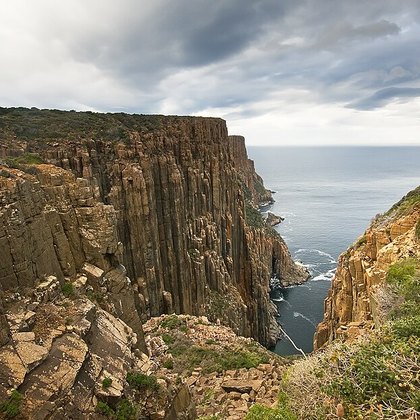
Warm, deep ocean well offshore, where it hunts flying fish and squid alone; it avoids the continental shelf and the cold water south of the subtropical convergence. It breeds on rocky coasts, cliff ledges and coral islets, the nest a scrape under an overhanging shrub, in a crevice or beneath a boulder. It needs no fresh water and comes ashore only to breed.
Where the bird is most often found, arranged by main group and formation.


Range and movements
Across the tropical and subtropical Indian and Pacific Oceans. Within this region it breeds on the islands of Western Australia — the Houtman Abrolhos, the Rowley Shoals and Sugarloaf Rock at Cape Naturaliste — on the cays of the Coral Sea and the Great Barrier Reef, on Lord Howe and Norfolk, and in the north on the Kermadecs, where Raoul alone holds fifty to a hundred pairs. Outside the breeding season it wanders thousands of kilometres over open water and is rarely seen from land. Its New Zealand status is increasing, helped by the removal of rats from Raoul.
- Resident
- dark = core range, pale = thinly spread
Where and when to look
Go to Sugarloaf Rock near Dunsborough in Western Australia between October and April and watch around the middle of the day: that is when birds hang in display flight above the rock with the streamers trailing behind them. At sea it is a matter of luck; a pelagic trip over the shelf edge off north Queensland may produce one, usually high and passing through.
Conservation
Least Concern (LC), with some tens of thousands of pairs worldwide and a stable to slightly increasing picture in this region. On the colonies rats, cats and feral pigs are the main threat, and a severe cyclone can cost an entire island population its chicks in a single season. Where mammals have been removed, as on Raoul, numbers recover visibly.
Scientific name
Phaethon rubricauda | Boddaert, 1783
Boddaert described the bird in 1783 as Phaeton rubricauda, from a coloured plate by Daubenton; author and year stand without parentheses, because only the spelling of the genus was later corrected. The genus Phaethon goes back to Linnaeus, 1758, after Phaethon, son of the sun god, for a bird of full light. rubricauda means red-tailed, from Latin ruber and cauda. The type locality is Mauritius.