All species › Tropicbirds › Tropicbirds › White-tailed Tropicbird
White-tailed Tropicbird | Phaethon lepturus
Witstaartkeerkringvogel | Ave del trópico de cola blanca
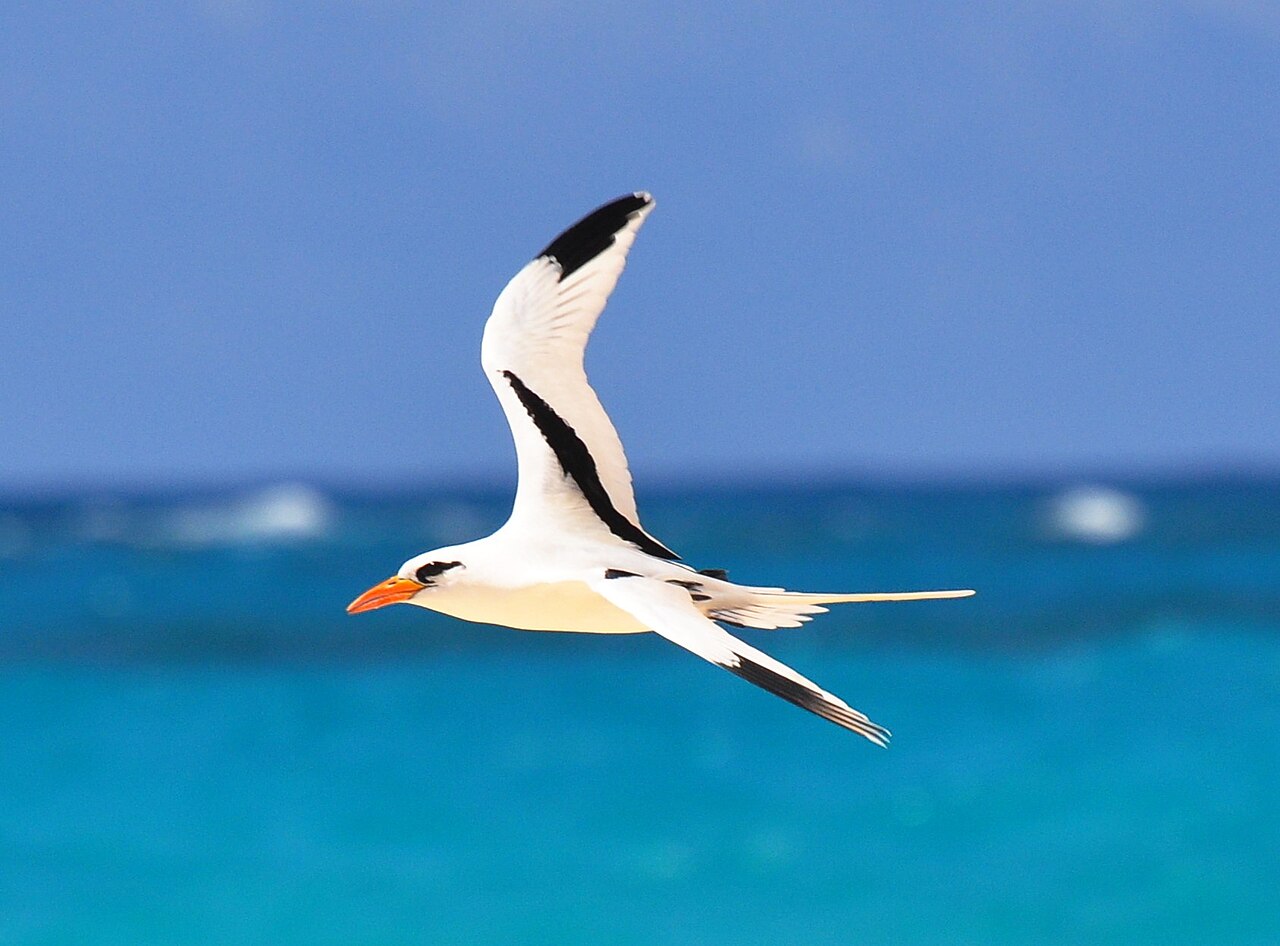
The White-tailed Tropicbird is the slenderest and lightest of the tropicbirds: a silky white seabird with a black eye-stripe, a black diagonal bar across the upperwing and two tail streamers longer than its whole body. It soars high over warm blue water and plunges from tens of metres onto flying fish.
Voice
At sea it is almost always silent; a bird passing overhead makes no sound at all. At the colony and in display flights around the cliff comes a shrill, rapidly repeated kek-kek-kek-kek that suggests a tern at range, with a rasping scream between bouts. Birds circling together above a breeding cliff call to each other in short high notes.
No freely licensed recording has been found for this species yet; what to listen for is described below.
Identification
A slight, wholly white seabird with a body of some forty centimetres and behind it two thin white streamers that nearly double its length. The pattern is a black stripe through the eye to the nape, a broad black diagonal bar across the inner upperwing and black outer primaries; the bill is orange-yellow to orange-red. Flight is quick and pigeon-like, stiff fluttering beats alternating with glides, and much higher above the sea than any tern flies. Young birds lack the streamers, have a green-yellow bill and a finely black-barred back.
Confusion species
Red-tailed Tropicbird (Phaethon rubricauda) is the species you are far more likely to meet here: larger and heavier, with a red bill, near-plain white upperwings without the black diagonal bar, and thin red streamers that often go unnoticed at range. That black upperwing bar is the character that works at any distance. Young Red-tails are more coarsely and densely barred on the back and have a darker bill than young White-tails. A White Tern or a distant gannet may briefly draw the eye, but neither has the streamers or the high, flickering flight.
Habitat
Open warm tropical ocean with a surface temperature above twenty-two degrees, usually far offshore over deep water beyond the continental shelf. It feeds alone or in small parties, plunging from height onto flying fish and squid. Nests are on oceanic islands, in crevices and on ledges of sea cliffs and under overhanging vegetation — within the map window of this guide it does not breed.
Where the bird is most often found, arranged by main group and formation.


Range and movements
Within this map window it is above all a bird of the warm Coral Sea: sparse off tropical Queensland, and after cyclones sometimes further south into New South Wales. Norfolk Island has only a handful of records. In New Zealand it is a vagrant with some twenty beach-cast records, nearly all immatures in summer and nearly all in the northern North Island; the southernmost specimen came from Taranaki. The nearest breeding colonies lie just outside the window, in New Caledonia and on islands further east in the Pacific.
- Resident
- dark = core range, pale = thinly spread
Where and when to look
Look for it on a pelagic trip out of tropical Queensland in the warm season, and look higher than you expect: tropicbirds often hang so high that they first show as a white speck above the horizon. Read the silhouette before the colour — the stiff quick beat and the long streamers fix the family, and only then does the black wing bar decide which of the two it is. In New Zealand, walking the northern beaches after a tropical storm is what pays.
Conservation
Least Concern (LC): the species is spread across all three oceans and numbers hundreds of thousands of birds, so the population as a whole is robust. Locally things go less well, and almost always through what has been let loose on a breeding island: rats and cats take eggs and chicks from the cliff crevices, and on Christmas Island — outside this map window — the yellow crazy ant presses on the colony. Within this area it does not breed, so there is no colony here to protect.
Scientific name
Phaethon lepturus | Daudin, 1802
The French zoologist Daudin described the species in 1802 as Phaethon lepturus, and it has stayed in that genus, so author and year carry no parentheses. The genus Phaethon was introduced by Linnaeus in 1758 and refers to Phaethon, son of the sun god Helios in the Greek tales — a name for a bird of the fierce tropical sun. lepturus is formed from Greek leptos, 'thin', and oura, 'tail', after the two thread-thin central tail feathers. The type locality is Mauritius. The Dutch name and the English 'bosunbird' both point at that same tail.