All species › Waders, gulls and terns › Skimmers, noddies, terns and gulls › Greater Crested Tern
Greater Crested Tern | Thalasseus bergii
Grote kuifstern | Charrán piquigualdo
The Greater Crested Tern is the tern you meet on every Australian jetty, breakwater and sandbank: large, solidly built, with a long lemon-yellow bill and a shaggy black crest that lifts in the wind. After the Caspian Tern it is the largest tern of this region, and with more than half a million birds one of the most numerous seabirds in Australia.

Voice
A hard, grating and slightly hoarse kree-krek or kerr-kerr, often in flight and far rougher than the shrill notes of the smaller terns. Over a colony hundreds of such calls run together into a continuous rattling roar audible well before the island comes in sight. Young birds beg with a thin, high, repeated squeak and keep it up for months after fledging, even out at sea.
No freely licensed recording has been found for this species yet; what to listen for is described below.
Identification
A large tern approaching half a metre, with a wingspan of about a metre and a quarter and a weight over three hundred grams. The bill is long — five and a half to six and a half centimetres — straight, powerful and lemon to greenish yellow; the legs are black. The crown carries a black cap with a long bristling crest at the nape, but a narrow white band always remains between bill and cap, even at the height of the breeding season; out of season that white runs back over the crown and only the crest stays dark. The mantle is mid-grey and contrasts with a white rump and tail, and the tail is deeply forked. Flight is powerful and direct with slow beats; it fishes with an angled plunge and regularly follows fishing boats for whatever goes over the side.
Confusion species
Lesser Crested Tern (Thalasseus bengalensis) is the twin species and the whole problem: clearly smaller and lighter (35–43 cm against 46–49, and over a third less weight), though on a sandbank with nothing to compare that counts for little. Bill colour decides it: lemon to greenish yellow in Greater Crested, warm orange in Lesser Crested. Then check the forehead — Greater Crested keeps its white forehead band all year, while in breeding Lesser Crested the black runs right to the base of the bill — and the rump, white and contrasting with the greyer mantle in Greater Crested, as grey as the back in Lesser Crested. Caspian Tern (Hydroprogne caspia) is bulkier still, with a thick red bill, a much shorter tail and dark underwing tips. Australian Tern (Gelochelidon macrotarsa) and Gull-billed Tern (Gelochelidon nilotica) have a short jet-black bill and no crest. White-fronted Tern (Sterna striata) is smaller, slighter and black-billed.
Habitat
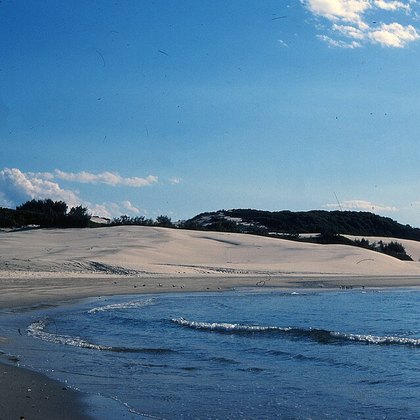
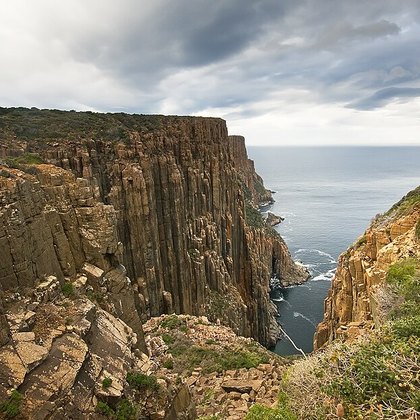
Coastal waters and the continental shelf, from the surf line to well out of sight of land, and within that mostly the sheltered side: bays, estuaries, harbours, reefs and sandbanks. It breeds in dense colonies on sparsely vegetated islets, coral cays and offshore shellbanks, with nests barely a metre apart. Away from the colony it rests on jetties, breakwaters, buoys, pilings and drying flats.
Where the bird is most often found, arranged by main group and formation.



Range and movements
Around the whole Australian coast, from the Kimberley and the Great Barrier Reef to Tasmania and the Houtman Abrolhos, with breeding colonies on hundreds of islets; the Australian subspecies, at over half a million birds, is much the most numerous of the five. It has also been recorded on Norfolk Island. In New Zealand, by contrast, it is a rare vagrant with only a few dozen records: a bird found on a beach there is a rarity, not the default crested tern.
- Resident
- dark = core range, pale = thinly spread
Where and when to look
Walk a harbour or a fishing jetty and look at the terns resting on the piles: this is almost always the species sitting there, and the yellow bill shows at a hundred metres. If a smaller bird with an orange bill is among them, look again at once — you then have both crested terns side by side and the size difference settles itself in one glance.
Conservation
Not threatened (LC), with a stable world population above half a million birds and its centre of gravity in Australia. It does well because it nests on predator-free islands and adapts easily: it follows fishing boats and uses harbours, jetties and artificial islets without hesitation. Where things go wrong it is colonies on islets that have become reachable by rats or visitors, and disturbance by boats in the breeding season; in parts of Southeast Asia numbers are falling for those reasons.
Scientific name
Thalasseus bergii | (Lichtenstein, 1823)
Lichtenstein described the species in 1823 as Sterna bergii; because it later moved to Thalasseus, author and year stand in parentheses. The genus Thalasseus was introduced by Boie in 1822 and comes from Greek thalasseus, 'of the sea'. The epithet honours Carl Heinrich Bergius, a Prussian apothecary and collector who gathered the first specimens near Cape Town; the type locality is accordingly the Cape of Good Hope. Dutch and English names both point at the crest, the Spanish one at the yellow bill.