All species › Waders, gulls and terns › Skimmers, noddies, terns and gulls › Lesser Crested Tern
Lesser Crested Tern | Thalasseus bengalensis
Bengaalse stern | Charrán bengalí
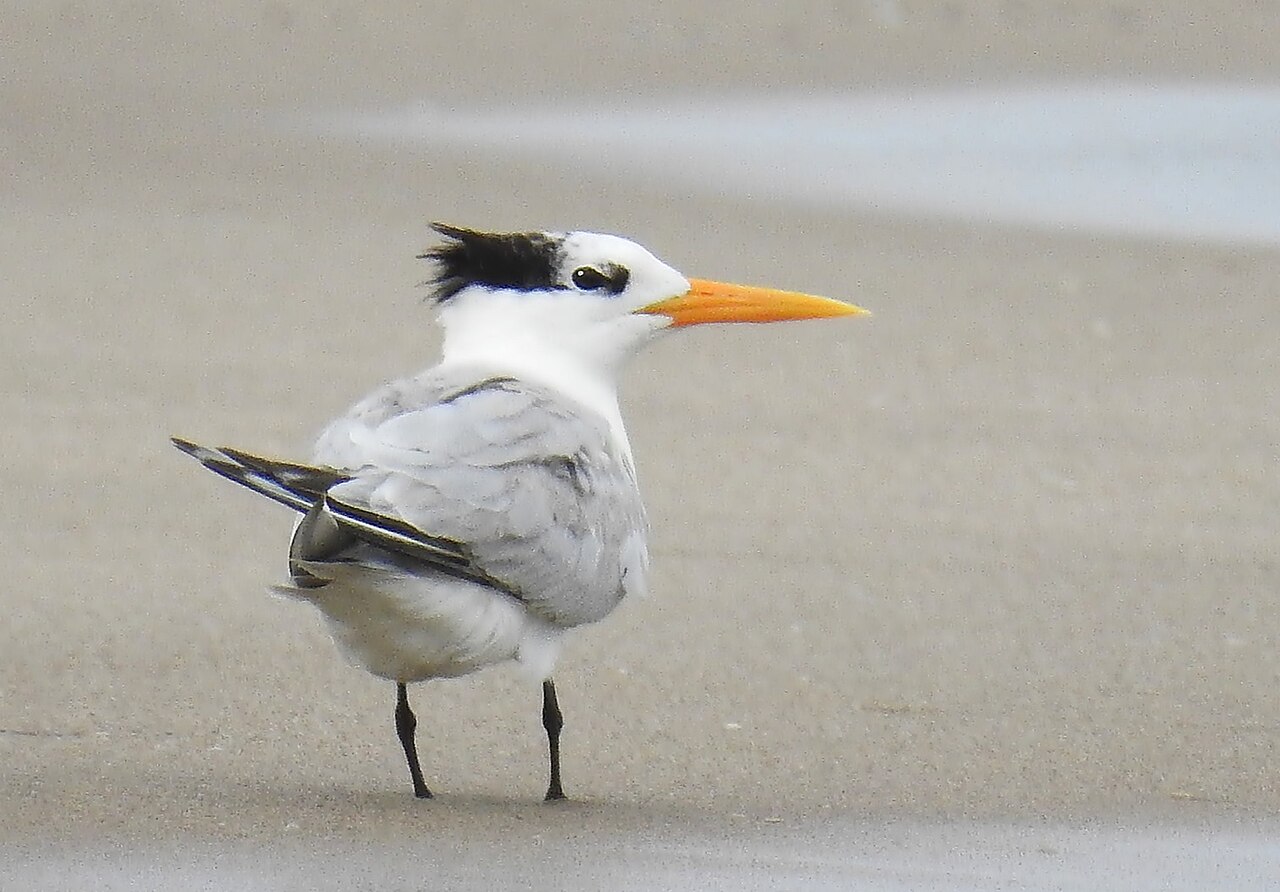
The Lesser Crested Tern is the smaller of this region's two crested terns: a pale, elegant seabird with a warm orange bill, black legs and a bristling black crest. It is nearly always among Greater Crested Terns, and that is exactly where to find it — a shade paler, a size smaller and with a bill shifted from yellow to orange.
Voice
A hoarse, grating kree-rik, higher and thinner than the raw roar of Greater Crested Tern but in the same key; in flight it comes out as a short, pinched kerrik. Over a mixed colony the higher voice stands out from the deeper rasping of the larger species once you are listening for it. Young birds beg with a high, urgent squeaking.
No freely licensed recording has been found for this species yet; what to listen for is described below.
Identification
A medium-large tern of thirty-five to forty-three centimetres, with a wingspan around a metre and a weight of some two hundred grams — clearly lighter in build than Greater Crested Tern. The bill is long, slim, straight and warm orange to orange-yellow; the legs are black. In breeding plumage the cap is jet black and the black runs right to the base of the bill, with a shaggy crest at the nape; out of season the forehead turns white and only the nape stays dark. The upperparts are pale pearl-grey and, unlike Greater Crested Tern, rump and tail are as grey as the mantle, so the upperside looks uniform. The tail is deeply forked, the flight light and buoyant; it fishes with a short plunge and often hunts just outside the surf.
Confusion species
Greater Crested Tern (Thalasseus bergii) is the only real confusion species and is usually standing right beside it. Bill colour decides: orange in Lesser Crested, lemon to greenish yellow in Greater Crested. Then size — Lesser Crested is a quarter shorter and over a third lighter — the paler grey plumage, and the rump, here as grey as the back where Greater Crested shows a white rump and tail contrasting with the mantle. In breeding plumage the black reaches the bill in Lesser Crested, while Greater Crested keeps its white forehead band. Caspian Tern (Hydroprogne caspia) has a thick coral-red bill and is far bulkier. Gull-billed Tern (Gelochelidon nilotica) and Australian Tern (Gelochelidon macrotarsa) are black-billed and crestless. Bear in mind that the two crested terns hybridise rarely but demonstrably, so the odd bird with an intermediate bill colour cannot be named.
Habitat
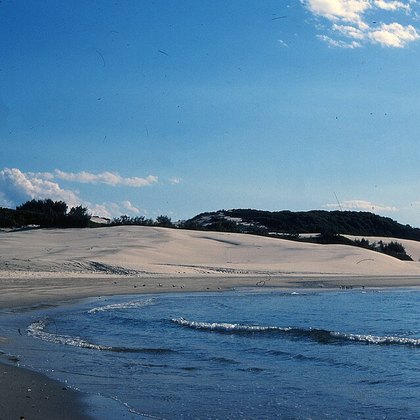
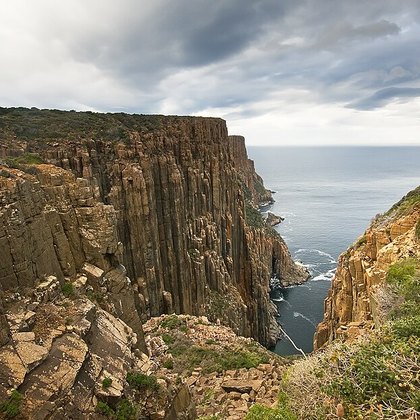
Warm coastal water and the shallow part of the continental shelf: reefs, sandbanks, estuary mouths and the sea just beyond the surf. It breeds in dense colonies on sparsely vegetated coral cays and sand islets, usually within or immediately beside a Greater Crested Tern colony, and rests on sandspits, reefs and jetties. It penetrates bays and harbours less far than its larger relative.
Where the bird is most often found, arranged by main group and formation.


Range and movements
Within the window of this guide an Australian coastal bird of the tropics and subtropics. It breeds on islets off the Kimberley and Pilbara coasts and on the cays of the Great Barrier Reef, and spreads south along both coasts outside the breeding season — regularly into New South Wales on the east side and to about Perth on the west, with stray birds further south again. It has not been recorded in New Zealand; worldwide its range runs from the Red Sea across the whole Indian Ocean to here.
- Resident
- dark = core range, pale = thinly spread
Where and when to look
Do not look for it on its own but in the crested tern flock: work along a resting group on a sandbank watching bill colour only, and the orange bill will pick itself out among the yellow ones. If that fails, check the upperside in flight — an evenly pale grey back, rump and tail without contrast is nearly always this species.
Conservation
Not threatened (LC). The species has a wide range along the tropical coasts of the Indian Ocean, and the Australian population breeds largely on remote, predator-free islands of the Kimberley and the Great Barrier Reef. The vulnerability lies in the colonial habit itself: all the eggs sit together on a handful of islets, so one boat landing, one rat introduction or one storm surge at the wrong moment can cost a whole season. In the Mediterranean, where only a handful of pairs breed, the species is permanently vulnerable for that reason.
Scientific name
Thalasseus bengalensis | (Lesson, 1831)
Lesson described the species in 1831 as Sterna bengalensis; because it later moved to Thalasseus, author and year stand in parentheses. Thalasseus is Greek thalasseus, 'of the sea', introduced by Boie in 1822. bengalensis means 'of Bengal', and the type locality is indeed the coast of India, far from the Australian waters where the bird is most numerous. The three book names pull in different directions: two name Bengal, the English one names its lesser size beside the Greater Crested Tern.