All species › Waders, gulls and terns › Skimmers, noddies, terns and gulls › Fairy Tern
Fairy Tern | Sternula nereis
Elfenstern | Charrancito australiano
The Fairy Tern is Australasia's own little tern: a tiny pale bird with a wholly orange-yellow bill and no black tip, hunting on the hover over shallow bays and shellbanks. In New Zealand it goes by the name tara-iti and is the country's rarest breeding bird — some forty birds, a handful of pairs, all on one strip of Northland coast. In Australia it is commoner, but under pressure there too.

Voice
The everyday call is a rapid, chattering chip-chip-chip, high and dry, passed between hunting birds. At an alarm over the breeding ground it turns into a rasping, angry ket ket, and a bird seeing off an intruder keeps that up without a break. Out of season it is notably quiet; at most a short squeak as it lifts off a shellbank. The voice is a shade fuller and less shrill than the Little Tern's, though in the field that difference rarely decides anything.
No freely licensed recording has been found for this species yet; what to listen for is described below.
Identification
One of the two smallest terns of this region, at twenty-five centimetres a fraction larger and at just over seventy grams noticeably more solid than the Little Tern. The upperparts are pale grey, the underparts white, the wings narrow and the tail shallowly forked. The head decides it: in breeding plumage the bill is wholly orange-yellow with no black tip, and the black cap stops short of the bill, so the lores stay white and the white of the forehead runs forward of the eye. The legs are orange. In flight the wingtip carries only a narrow dark edge, and rump and tail stay greyish, continuing the colour of the mantle. Out of season the bill darkens and the crown becomes mottled.
Confusion species
Little Tern (Sternula albifrons) is the only real confusion, and the head settles it: a black tip on the yellow bill, black lores running on to the base of the bill, a white rump and tail standing out against the grey mantle, and in flight a clear black wedge in the outer primaries instead of a narrow dark edge. It is also slightly smaller and lighter. Range helps only in part: in New Zealand the two overlap in the northern harbours, and along the Australian coast the Fairy Tern's western and southern range meets the Little Tern's eastern one. Out of season, when both have a dark bill, the lores remain the most useful character. Every other tern here is far larger: Common Tern (Sterna hirundo) and White-fronted Tern (S. striata) are both in another class.
Habitat
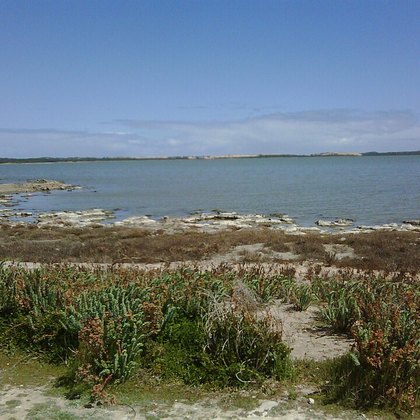
Sheltered sandy beaches, shellbanks, spits and sandbars in estuaries and shallow harbours, plus samphire saltmarsh and the ponds of saltworks. The nest is a scrape in shell grit or clean sand, usually on a bare bank just above the highest water, in small loose groups. It hunts on the hover in shallow clear water in bays and tidal channels, seldom beyond the surf and almost never out at sea.
Where the bird is most often found, arranged by main group and formation.


Range and movements
Three separate populations, two of them inside this map window. In Australia the range runs from Shark Bay in Western Australia along the south coast to Gulf St Vincent and Victoria, with colonies in the estuaries and saltworks between. In New Zealand it means the east coast of Northland — Waipu, Mangawhai, Te Arai and Pakiri — with Papakanui Spit on the Kaipara as the other regular site. The third population, in New Caledonia, lies outside this window.
- Resident
- Breeding (summer)
- dark = core range, pale = thinly spread
Where and when to look
Always look at the bill first: wholly orange-yellow means Fairy Tern, a black tip means Little Tern. In New Zealand, go to the fenced breeding beaches at Mangawhai or Waipu between November and January and stay behind the tape; the birds feed in the estuary alongside and show well from the edge. In Australia a saltworks pond in South Australia or a shellbank near Rottnest is worth the walk.
Conservation
Vulnerable (VU), and inside this region the picture is more lopsided than that category suggests. The New Zealand tara-iti numbers some forty birds and survives only on intensive management: trap lines against rats, stoats and cats, fences and wardens around every nest, and the rescue of clutches that would otherwise wash away. The Australian birds face four-wheel drives and dogs on the beach, foxes, feral cats and Silver Gulls robbing nests, and storm tides and rising sea level flooding the low shellbanks.
Scientific name
Sternula nereis | Gould, 1843
John Gould described the species in 1843, in the years when he was assembling the birds of Australia; it now stands in Sternula, the genus Boie introduced in 1822 as a diminutive of Sterna, the classical word for tern. nereis is Greek for 'sea nymph', after the Nereids, daughters of the sea god Nereus — the same idea behind the English name Fairy Tern and the Dutch elfenstern. The Maori name tara-iti means literally 'little tern', with the same tara that stands in the name of the White-fronted Tern.