All species › Passerines › Bulbuls › Red-whiskered Bulbul
Red-whiskered Bulbul | Pycnonotus jocosus
Roodoorbuulbuul | Bulbul orfeo
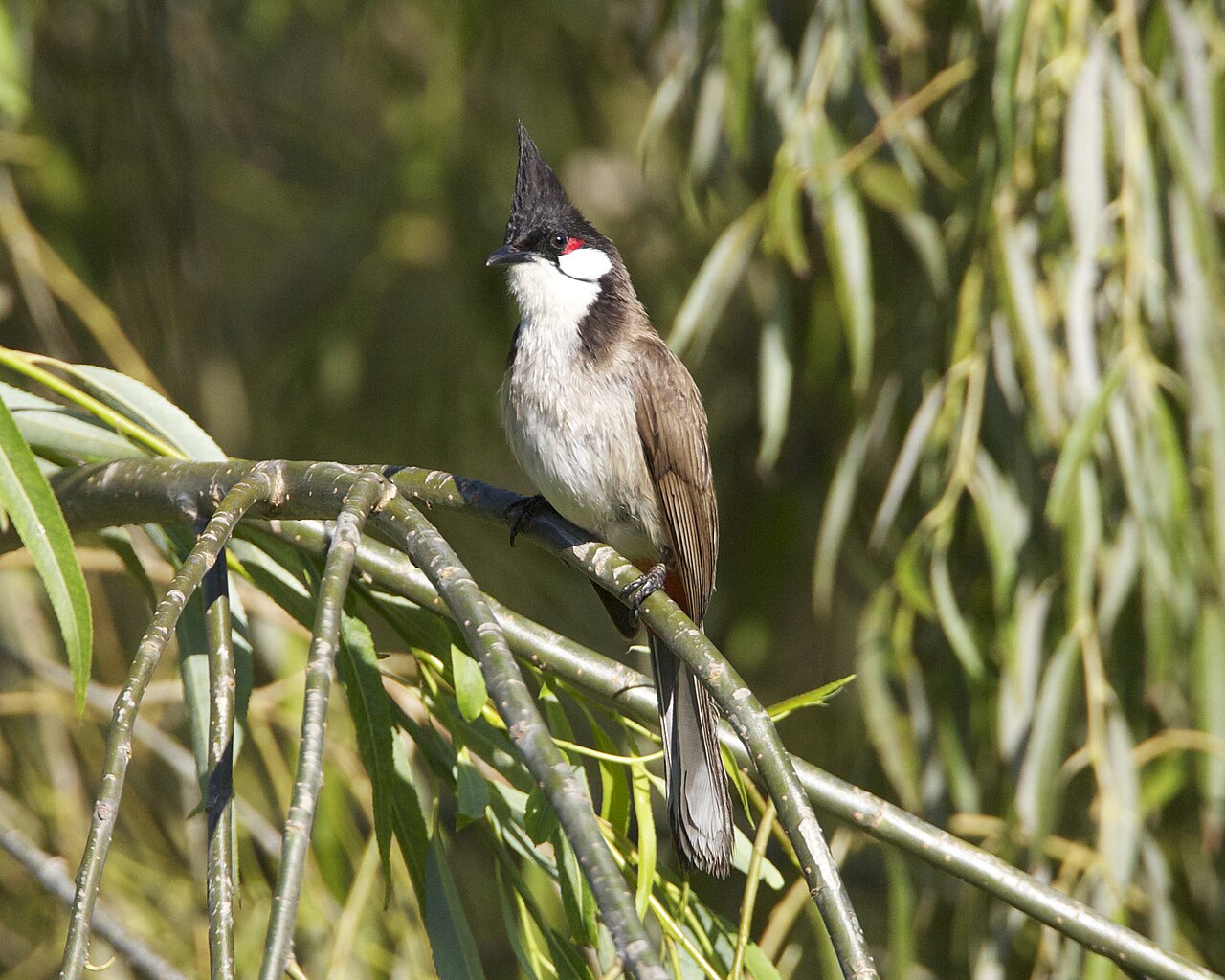
The Red-whiskered Bulbul is an Asian garden bird that has been in Sydney since 1880 and has spread along the east coast ever since: a slim, long-tailed bird with a pointed black crest, a white cheek and a bright red patch below the eye. It sits out in the open on a hedge or a wire without concern, calls all day, and spreads in its droppings the seeds of precisely the shrubs Australia would rather be rid of.
Voice
A loud, clear, rolling call of three or four syllables, usually written kink-a-joo or pettigrew, coming from gardens and hedges all day and audible at a fair distance. Beyond that a short sharp pit as a contact note and a rapid scold at cats and raptors. The species has no song in the strict sense; the call itself serves as the territorial signal.
Recording: Ujjal Kishor De — CC BY-SA 4.0 · Ambedkar College, fatikroy, Unakoti, Tripura, India · xeno-canto
Identification
A slim bird of twenty to twenty-two centimetres with a striking upright black crest that often leans forward. The head is black with a large white cheek, edged by a thin black line, and a scarlet patch behind the eye — the mark the species is named for. The upperparts are plain brown, the underparts white with a broken brown breast band; the undertail coverts are red. The long tail is dark with white tips. Young birds lack the red and have a greyer crown.
Confusion species
There is no second bulbul at large in Australia, so confusion arises mainly at range. Pycnonotus cafer, which has turned up repeatedly in New Zealand and been eradicated each time, has a black head without the white cheek, a scaled breast and a white rump. Common Myna is brown with bare yellow skin around the eye and walks on the ground rather than climbing about in shrubs. A Common Starling is shorter-tailed, glossy and spotted, and never crested.
Habitat
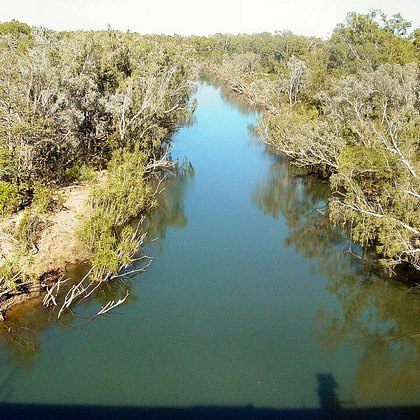
Gardens, parks, golf courses and street trees are the heart of its range, together with dense weedy growth along urban creeks. Beyond that it uses orchards, vineyards and the edges of cropland. It wants fruiting shrubbery with an open perch above it, and avoids closed native forest and the dry interior entirely.
Where the bird is most often found, arranged by main group and formation.


Range and movements
In Australia confined to two introduced populations: the Sydney birds, released around 1880 and established across the whole city by 1920, from where they have pushed north and south along the coast, and a smaller and far more localised group around Melbourne dating from the mid-twentieth century. Western Australia and most other states keep it out. Its native range is southern and southeastern Asia, from India to southern China.
- Resident
- dark = core range, pale = thinly spread
Where and when to look
Look for it in the Sydney suburbs: any hedge, fig tree or overgrown creek bank near the coast will produce a calling bird within a quarter of an hour. Follow the call, then find the highest open branch nearby, which is where it likes to sit. Watch the shape of the crest — even against the light it stands as a sharp point on the skyline.
Conservation
Least Concern (LC) globally and numerous in its native Asian range. In Australia it is an introduced species and has been declared a pest in several places: it pecks at soft fruit in orchards and gardens, and the seeds in its droppings spread invasive shrubs such as lantana, camphor laurel, privet and blackberry. Outside Sydney and Melbourne, stray birds are tracked down and removed to prevent new foci.
Scientific name
Pycnonotus jocosus | (Linnaeus, 1758)
Linnaeus described the bird in 1758 as Lanius jocosus, among the shrikes; because it was later moved to another genus, author and year stand in parentheses. The genus Pycnonotus was introduced by Boie in 1826, from Greek puknos, 'dense', and notos, 'back', after the thick soft plumage on a bulbul's back. jocosus is Latin for 'merry', from iocus, 'joke'. The type came from China.