All species › Passerines › Honeyeaters › Rufous-throated Honeyeater
Rufous-throated Honeyeater | Conopophila rufogularis
Roodkeelhoningeter | Mielero golirrufo
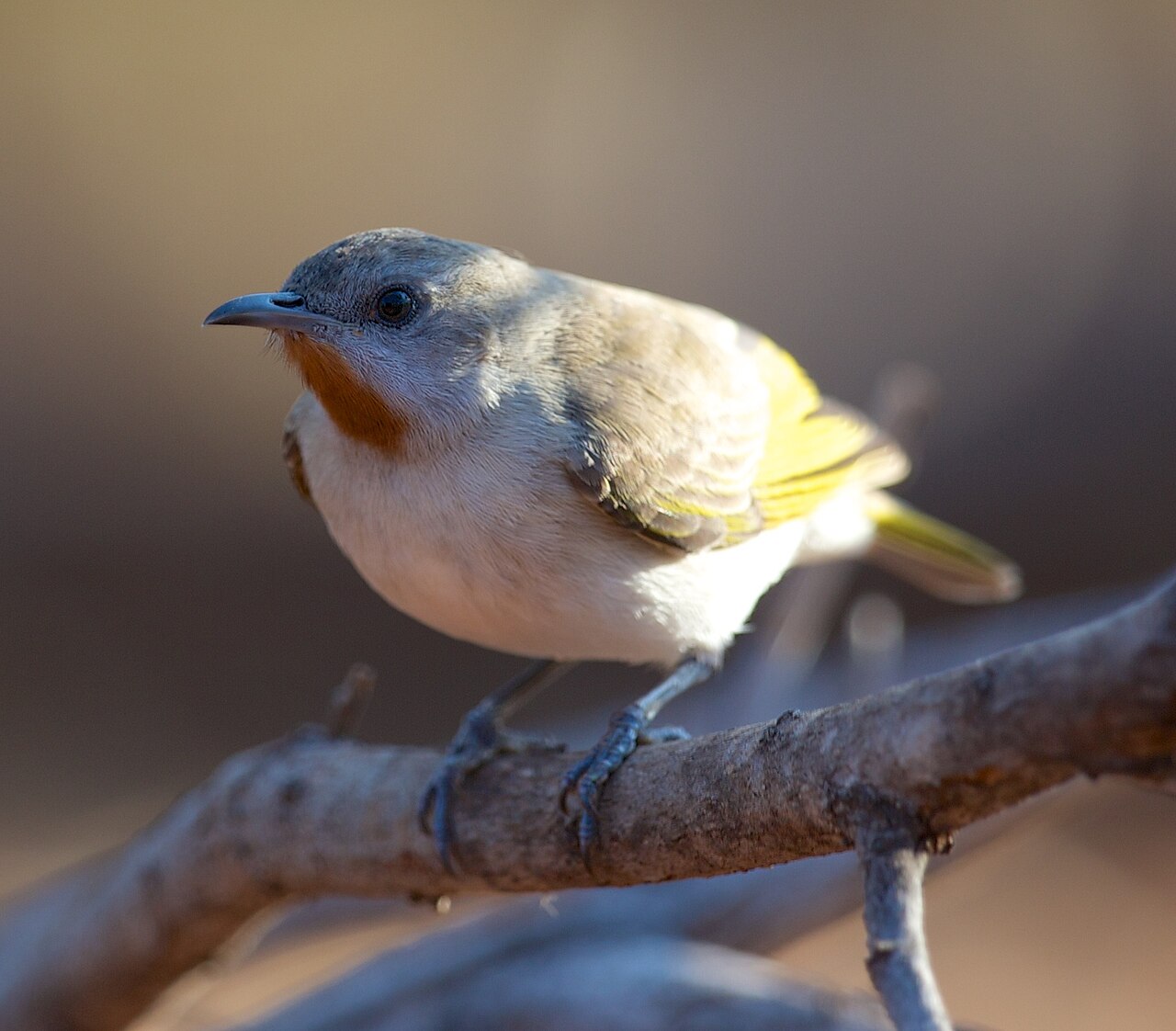
The Rufous-throated Honeyeater is one of those small, unremarkably grey-brown honeyeaters of tropical northern Australia that you only see properly when the light is right: then the throat turns out to be warm rusty red and the wing to be edged with bright yellow. It is a bird of water in a dry land — the belt of paperbark, pandanus and gum along creeks and billabongs (cut-off river channel that flows only at high water) — and it is extremely active, always on the move, often in small parties. In gardens in Broome and Darwin it comes without ceremony to drink and bathe, and that is where you will see it best.
Voice
A small, lively sound in keeping with the bird's restlessness: a run of clear, high, slightly squeaky notes delivered quickly one after another, alternating with a sharp, short chip passed between the birds of a party as a contact call. In the early morning and at flowering trees this becomes a sustained chattering from several birds at once. Exactly which throat produces what is hard to sort out in the field, because the small honeyeaters of the north all have a thin, high, hurried repertoire; certainty usually comes only with a view of the bird.
Recording: Nigel Jackett — CC BY-NC-SA 4.0 · Roebuck Plains, Shire of Broome, Western Australia, Australia · xeno-canto
Identification
A small, slim honeyeater of eleven to fourteen centimetres with a fine, straight to barely curved bill and a dark eye. The upperparts are plain grey-brown, the underparts off-white, and the mark is on the throat: a warm rusty to orange-red patch, bright on a fresh bird but faint on worn or young ones. Just as important are the wings: the flight feathers and coverts have broad, bright yellow edges that together form a distinct yellow panel, the most conspicuous feature on a moving bird. The tail likewise has yellow edges and pale tips. There is no white spot behind the eye. Young birds lack the red throat entirely and are then little more than a small brown honeyeater with yellow in the wing.
Confusion species
Three small honeyeaters of the tropical north closely resemble one another and overlap in habitat as well. Rufous-banded Honeyeater (Conopophila albogularis) has the pattern exactly reversed: a white throat with a rufous band across the breast below it, plus a greyer head; it keeps more closely to the coastal strip of the Top End and Cape York. Grey Honeyeater (Conopophila whitei) is a plain grey bird with no red at all and no yellow wing panel, living in the mulga (acacia scrub of the dry interior, dominated by Acacia aneura) of the dry centre far from the northern creeks. From the related genus Ramsayornis, Brown-backed Honeyeater (Ramsayornis modestus) shares its creeks and paperbark swamps: it is brown above and white below with fine dark scalloping on the breast and has a pink bill base, not a red throat. Bar-breasted Honeyeater (Ramsayornis fasciatus) is known by its coarse dark barring across the whole underside. Outside this group the main pitfall is Brown Honeyeater (Lichmera indistincta), just as small and just as brown, but with a small white spot behind the eye that Rufous-throated Honeyeater lacks, and without the yellow wing panel.
Habitat
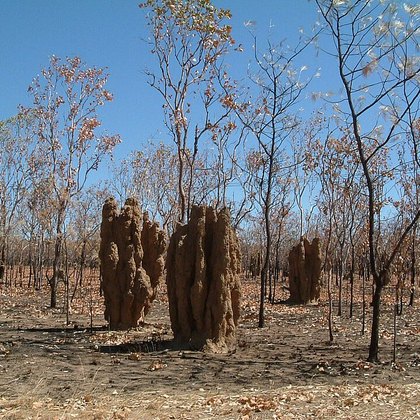
The green ribbons of the north: woodland and thicket along creeks, rivers and billabongs, with paperbark, pandanus and riverine trees, and the margins of melaleuca swamp forest. Alongside that, open savanna and woodland as long as water is near, and increasingly the gardens, parks and backyards of northern towns, where the bird drinks from and dives into birdbaths without hesitation. It takes nectar from flowering eucalypt, grevillea and melaleuca and also catches many insects, partly on the wing. The nest is a small suspended cup of bark and cobweb on a low branch, often over or close to water, with two or three eggs. The species is largely sedentary, with local shifts that follow the flowering.
Where the bird is most often found, arranged by main group and formation.



Range and movements
Endemic to northern Australia: from the Kimberley in Western Australia east across the Top End and the Gulf country to the western side of Cape York Peninsula, and on the eastern side south to about Rockhampton in Queensland. Within that it remains strongly tied to water; on the map the picture is a net of watercourses rather than a solid block. It is absent from the arid interior, from Tasmania and from the south of the continent, and does not occur in New Zealand.
- Resident
- dark = core range, pale = thinly spread
Where and when to look
In the dry season sit at first light by water — a billabong, a leaking stock tank, or simply a birdbath in a Broome or Darwin garden — and wait. The Rufous-throated Honeyeater comes quickly and repeatedly, and is fond of diving into it as well. When assessing one, look first at the wing: the yellow panel is more conspicuous in this species than in the small honeyeaters it is confused with. Then find the throat: with a clean male in view the rusty red is unmistakable. If the red runs as a band across the breast rather than as a patch on the throat, you are looking at Rufous-banded Honeyeater (Conopophila albogularis).
Conservation
Least Concern (LC), with a wide range across the whole tropical north and no sign of a downward trend. The species also adapts well to people: in northern towns, where gardens flower and water is put out, it is common to numerous. The risks lie in the quality of the riparian vegetation it depends on: trampling and grazing of creek banks by stock and buffalo, water extraction, the spread of large exotic grasses such as gamba and the hotter, later fires that come with them can locally damage paperbark and pandanus woodland. At the scale of the whole range no population effect of this has so far been demonstrated.
Scientific name
Conopophila rufogularis | (Gould, 1843)
John Gould described the species in 1843 as Entomophila rufogularis, from a bird from the north coast of Australia, later restricted to Derby in the Kimberley; author and year stand in parentheses, because the species later moved to Conopophila, a genus erected by Ludwig Reichenbach in 1852. That genus name is formed from Greek konops, 'gnat', and philos, 'loving' — a name that stresses the insect half of the diet rather than the nectar. The epithet rufogularis comes from Latin rufus, 'reddish', and gula, 'throat'. The English name, the Dutch roodkeelhoningeter and the Spanish mielero golirrufo all follow that epithet. Note that naming within this genus runs confusingly close: Conopophila albogularis is the Rufous-banded Honeyeater, with the red on the breast rather than the throat.