All species › Passerines › Honeyeaters › Rufous-banded Honeyeater
Rufous-banded Honeyeater | Conopophila albogularis
Roodborsthoningeter | Mielero pechirrufo
The Rufous-banded Honeyeater is a small, busy bird of the wet tropical north: grey head, clean white throat and, straight below it, a broad rufous breast band. It likes water — mangrove, paperbark swamp and riparian forest — but it is also one of the commonest small birds in the suburbs of Darwin, where it breeds in gardens and street trees. Unlike most species in this guide it is not confined to Australia: it occurs in New Guinea and the Aru Islands as well.

Voice
A remarkably lively, cheerful sound for so small a bird: a quick, bright chattering in short phrases, delivered from a projecting twig or from a flowering crown, by which a pair keeps constant track of one another. While foraging it gives short, sharp contact notes. Around the nest the voice is at its most conspicuous: juveniles beg from the adults with a sustained, thin piping, and that piping is a fixture of the late wet season in Darwin gardens.
No freely licensed recording has been found for this species yet; what to listen for is described below.
Identification
A small honeyeater of twelve to thirteen centimetres with a black, slightly decurved bill. The head is grey, the throat strikingly clean white, and below it lies a broad rufous band across the breast — together a combination no other small honeyeater of this region shows. Belly and vent are off-white, the flanks light brown. The back is brown; the flight feathers have broad yellow-olive outer edges that give the wing a yellow-green cast. The iris is brown, the legs pinkish-grey. Juveniles are browner on the head and have a faint, sometimes barely visible breast band.
Confusion species
The Rufous-throated Honeyeater (Conopophila rufogularis) is the closest relative and the first species to rule out: it carries the rufous on the throat rather than on the breast, and the breast there is off-white — exactly the reverse pattern. Where both occur, in the north of the Northern Territory and on Cape York, that is the only thing to look at. The Brown-backed Honeyeater (Ramsayornis modestus) shares the mangrove and paperbark swamp but is brown with a scalloped white underside and shows no rufous at all; the Bar-breasted Honeyeater (Ramsayornis fasciatus) has a finely barred breast. The White-throated Honeyeater (Melithreptus albogularis) also has a white throat, but is olive-green on the back, has a white nape band and no rufous. Juvenile Banded Honeyeaters (Cissomela pectoralis) are brown with yellowish ear coverts and can briefly confuse in a mixed party, but they lack the sharp division between white throat and coloured breast.
Habitat
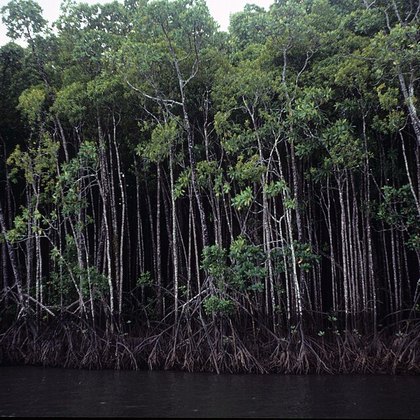
Mangrove, paperbark swamp, swampy hollows and riparian forest along creeks, and generally forest and scrub near water; also gardens, parks and street plantings in the northern towns. It reaches about six hundred metres in altitude. The diet is nectar from flowering paperbark, eucalypt and garden plants together with insects, busily gleaned from foliage; of the two, insects make up a large share. The nest is a small suspended cup in thin twigs, often over or close to water, and the clutch is usually two eggs. Outside the breeding season it forages in small, noisy parties.
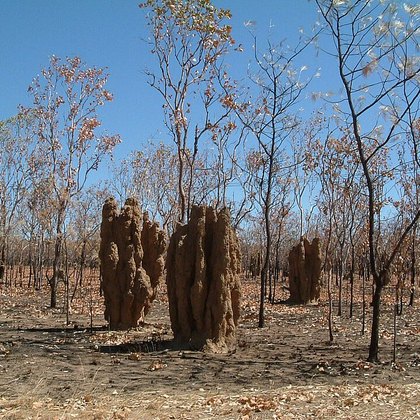
Where the bird is most often found, arranged by main group and formation.


Range and movements
The coastal belt of tropical northern Australia: the Northern Territory coast and inland to about Katherine, and the Cape York Peninsula in Queensland, with some offshore islands. Beyond Australia the species occurs in New Guinea and the Aru Islands, so that unlike most honeyeaters in this guide it is not an Australian endemic. It does not occur in New Zealand. It is resident with local movements. With rather more than eighteen thousand Australian records in ten years it is a common and well-reported bird within its limited range — which owes much to Darwin, where the birdwatchers live and where the species sits in the gardens.
- Resident
- dark = core range, pale = thinly spread
Where and when to look
Darwin is the easiest address of any species in this group: work East Point Reserve, the Botanic Gardens or simply a suburban street with flowering trees and watch the small, busy honeyeaters. Once you have one, look only at the join between throat and breast. White giving abruptly onto rufous is this species; rufous on the throat itself is the Rufous-throated Honeyeater. Early morning is most productive along the mangrove edges of the bays; in the late wet season the begging juveniles give the whole family away.
Conservation
Not threatened (LC). The species is common within its range and does strikingly well in urban greenery — in Darwin it is among the most numerous small birds of the suburbs, in a town where hardly any introduced bird species have established themselves. The concerns lie with the habitats: mangrove and paperbark swamp along the northern coast are under pressure from coastal development, and fire regime and stock determine how much flowering shrub layer is left in the hinterland. There is no decline at present.
Scientific name
Conopophila albogularis | (Gould, 1843)
John Gould described the species in 1843; author and year stand in parentheses because it has changed genus since. The genus name Conopophila comes from Greek konops (gnat) and philos ('-loving'), so 'gnat-lover', after the strongly insectivorous diet of these small honeyeaters. The epithet albogularis is Latin for 'white-throated', from albus (white) and gula (throat) — which sets up a neat tension among the names, for the scientific epithet and some older English books take the white throat, while the current English name Rufous-banded Honeyeater, the Dutch roodborsthoningeter and the Spanish mielero pechirrufo all take the rufous breast band instead. The two features lie directly above one another and in the field are only usable together. The name 'White-throated Honeyeater', incidentally, is in English use for a different species, Melithreptus albogularis, which completes the confusion. Salomonsen recognised two subspecies; Ford later disputed this.