All species › Passerines › Honeyeaters › Banded Honeyeater
Banded Honeyeater | Cissomela pectoralis
Zwartbandhoningeter | Mielero bandeado
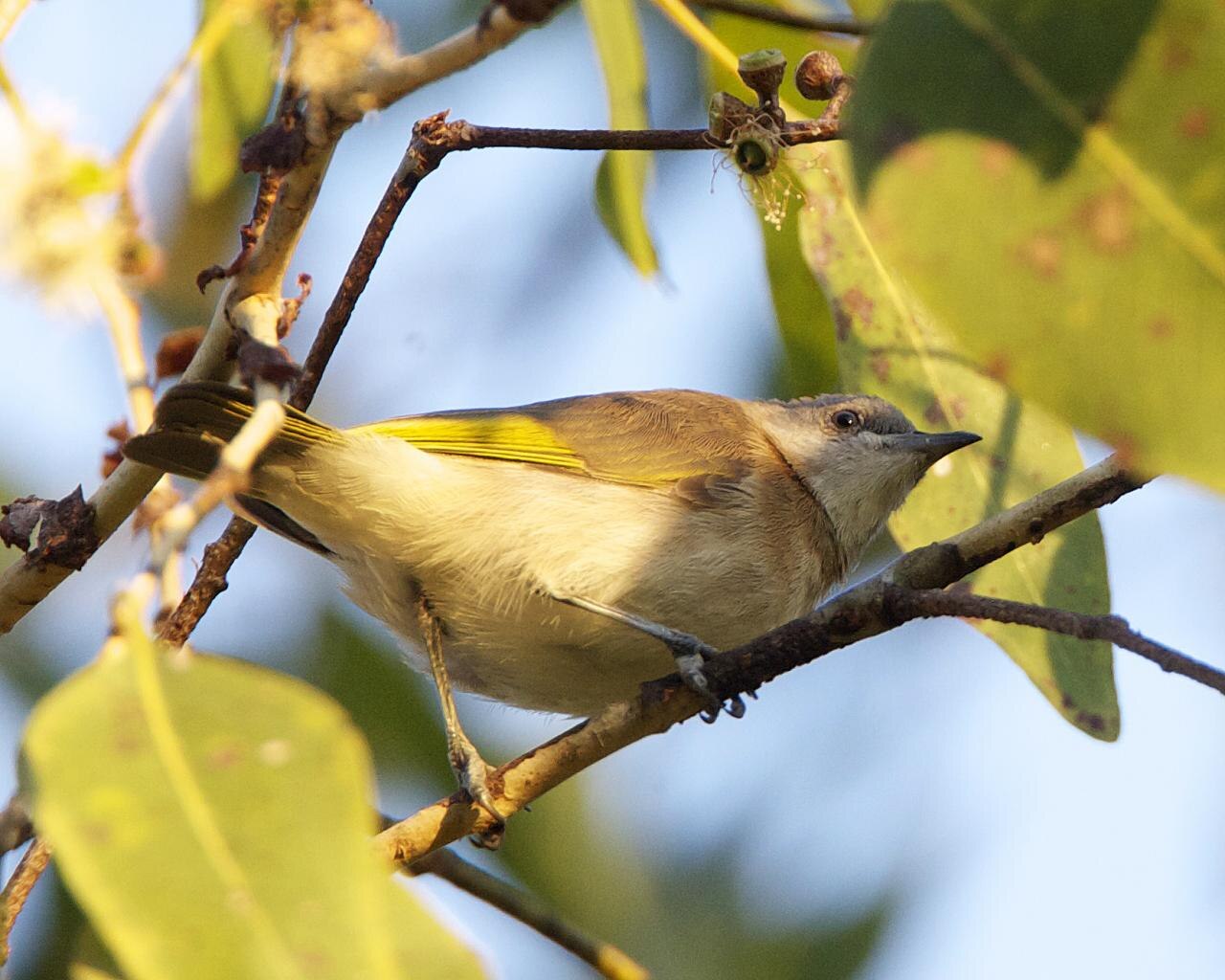
The Banded Honeyeater is one of the smallest honeyeaters in Australia and one of the most readily identified: clean white below, with a narrow black band across the breast and a black cap, back and tail. It is a blossom nomad in the purest sense — following the flowering of eucalypts, grevilleas, paperbarks and bauhinias across the tropical north in pairs or small parties, and gathering in large flocks wherever much is in bloom at once. Out of breeding plumage the black of the back fades to grey-brown and the bird becomes a good deal less conspicuous.
Voice
A busy, high, thin sound that runs almost unbroken from a foraging party: short, sharp contact notes with which the birds keep track of one another in the flowering canopy. Between them comes irritated chattering as two birds drive each other off a flower head — an ordinary sound above a paperbark in bloom. The species has no rich, striking song; the repertoire is modest and largely functional, and it is the sustained bustle of a party that draws attention rather than any single phrase.
No freely licensed recording has been found for this species yet; what to listen for is described below.
Identification
A very small, slim honeyeater of eleven and a half to thirteen and a half centimetres with a long, decurved black bill and proportionally long legs. In breeding plumage the crown, nape, back, wings and tail are black, the rump white and the whole of the underparts clean white, cut by a single narrow horizontal black band across the breast. Out of the breeding season the back turns grey-brown and the bird looks much duller, though the breast band remains visible. The legs are grey, the iris dark brown. Juveniles have brown where the adult is black, with conspicuously yellowish ear coverts and often a faint or absent breast band — those juveniles are the difficult ones.
Confusion species
The breast band is the feature: of the black-and-white honeyeaters of Australia this is the only one with a single transverse black band across a white breast. The Pied Honeyeater (Certhionyx variegatus) is much larger, has a blue skin patch below the eye and no breast band, and lives in the dry south rather than the tropical north. The Black Honeyeater (Sugomel nigrum) has, in the male, a black stripe running lengthwise down the white underparts instead. The White-throated Honeyeater (Melithreptus albogularis), which shares the same northern woodland, is olive-green on the back with a white nape band and lacks any breast band. Juvenile Banded Honeyeaters, brown with yellow ear coverts and no clear band, are easily taken for a Conopophila or Ramsayornis; but the Bar-breasted Honeyeater (Ramsayornis fasciatus) has a finely barred rather than a plain breast, and the Brown-backed Honeyeater (Ramsayornis modestus) a scalloped underside.
Habitat
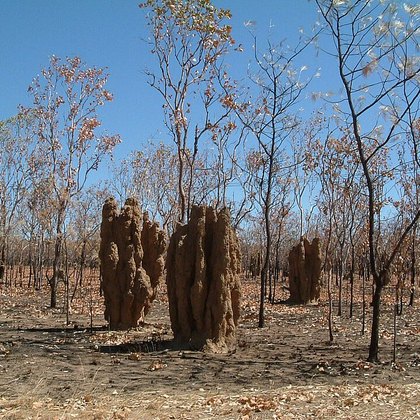
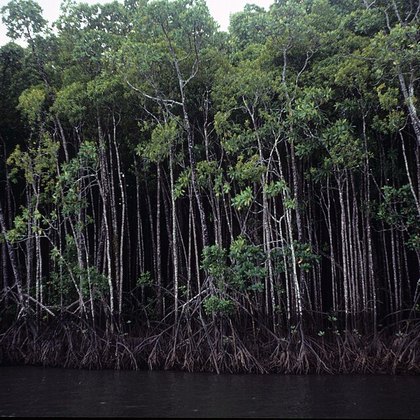
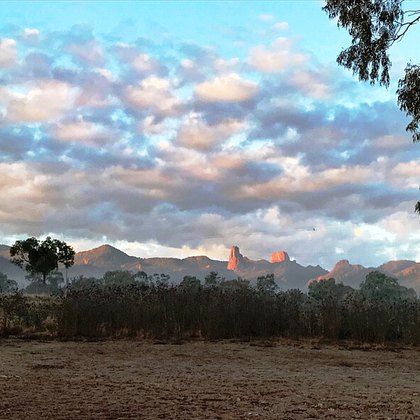
Tropical grassy woodland and open forest, mangrove and melaleuca swamp — in short, the monsoon belt of northern Australia wherever trees are in flower. The species follows the blossom and so has no fixed habitat within that broad framework. Nectar is the mainstay: eucalypt, grevillea, paperbark (Melaleuca) and bauhinia are the sources most often named, supplemented with insects gleaned from foliage. It usually moves in pairs or small groups; where much is in flower at once, large flocks gather that can occupy the whole crown of a tree.
Where the bird is most often found, arranged by main group and formation.

Range and movements
Endemic to tropical northern Australia, from the Kimberley in Western Australia — with records as far as Wyndham — across the Top End of the Northern Territory into Queensland, east to just west of Cairns. It does not occur in the dry interior, on the east coast south of Cairns, in Tasmania or in New Zealand. Within its range it is seasonally present, appearing in a district when something there comes into flower; with rather more than seven thousand Australian records in ten years it is an ordinary bird of the north, if unevenly spread through the year.
- Resident
- dark = core range, pale = thinly spread
Where and when to look
Find a flowering paperbark or eucalypt in the north — along a creek near Darwin, in the Kakadu country or in the Kimberley — and look up into the flower heads. The birds are small and restless, and give themselves away by continuous high calling. Once you have one in view, look only at the breast: a single narrow transverse band across clean white settles it. A brown bird with yellow ear coverts and a vague band is almost always a juvenile Banded Honeyeater in the same party — check the adults beside it.
Conservation
Not threatened (LC), both on the IUCN Red List and in the Northern Territory and Queensland assessments. The species is common across much of the tropical north and benefits from not being tied to one forest type but following the blossom. That also makes it sensitive to changes in the fire regime of the northern savanna: where burning is too frequent and too late in the season, the flowering shrubs and young trees such nomads fall back on disappear. No decline has been demonstrated at present.
Scientific name
Cissomela pectoralis | (Gould, 1841)
John Gould described the species in 1841 as Certhionyx pectoralis; because it has changed genus since, author and year stand in parentheses. Charles Lucien Bonaparte introduced the genus Cissomela in 1854; the name means something like 'honey magpie', tying the black-and-white plumage to the diet. The epithet pectoralis comes from Latin pectus, 'breast', and refers to the black breast band. The Dutch name zwartbandhoningeter and the English Banded Honeyeater point at the same feature. For a long time the species stood with the Pied and Black Honeyeaters in Certhionyx; molecular work in 2011 showed those three are not closely related, after which this species was left alone in its own genus Cissomela.