All species › Passerines › Honeyeaters › Pied Honeyeater
Pied Honeyeater | Certhionyx variegatus
Eksterhoningeter | Mielero pío
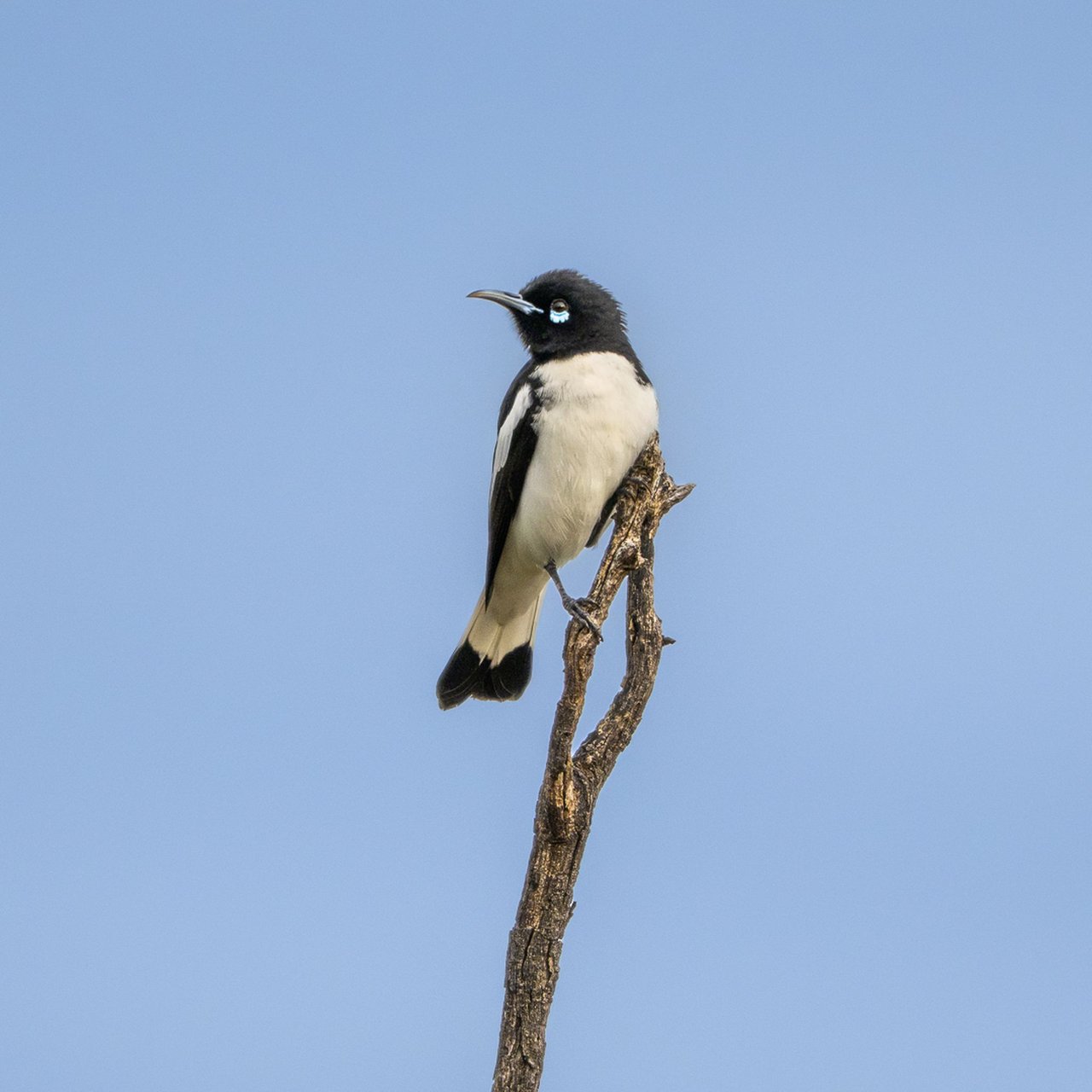
The Pied Honeyeater is the black-and-white nomad of arid Australia: a bird that lives nowhere permanently but turns up wherever rain has fallen and the emu bushes are in flower. The male is sharply pied, with a white rump and a white wing stripe; the female is brown and streaked. Both carry a patch of bare, pale blue skin below the eye that gives the species away. In good years dozens stand in a single flowering plain; the next year not one can be found in the same country.
Voice
A mournful, drawn-out whistle that carries far in the silence of the plain and is often compared with that of the Little Grassbird of the marshes. In the breeding season comes a melancholy piping note, repeated steadily. The most striking sound accompanies the display flight: the male climbs while singing, hangs for a moment and then drops vertically, turning over backwards as he falls. Pairs sometimes perform this climb and fall together, looping above the shrubs.
Recording: Pieter de Groot Boersma — CC BY-NC-SA 4.0 · Bowra Station, near Cunnamulla, Queensland, Australia · xeno-canto
Identification
A medium-sized honeyeater of fifteen to twenty centimetres with a clearly decurved bill. The male is black on head, neck, back and breast sides, with a white lower rump and upper tail, white underparts, a white stripe across the black wing and a black tail tip. The female is quite different: grey-brown above, with grey-white chin and throat grading into a whitish breast streaked and spotted dark brown, and white edges along the secondaries. Both sexes have a patch of bare, pale blue skin below the eye — semicircular in the male, more of a crescent in female and juvenile. Juveniles resemble the female. It is a restless bird that spends much of its time high in the outer branches of flowering shrubs.
Confusion species
The Black Honeyeater (Sugomel nigrum) is the classic confusion: it too is black and white and it too is a nomad of the same dry country. But it is clearly smaller, has a much finer and longer bill and a shorter tail, lacks the blue skin patch below the eye, and the male has a black stripe running down the middle of the white underparts — a feature the Pied Honeyeater does not show. The females are harder: the Black Honeyeater's is plainer, less streaked on the breast, and has simpler wing markings. The Banded Honeyeater (Cissomela pectoralis) is black and white with a transverse black breast band and lives in the tropical north, not the dry south. Outside the honeyeaters, the White-winged Triller (Lalage tricolor) resembles it in flight, but has a short straight bill, feeds on the ground and shows no bare skin patch.
Habitat
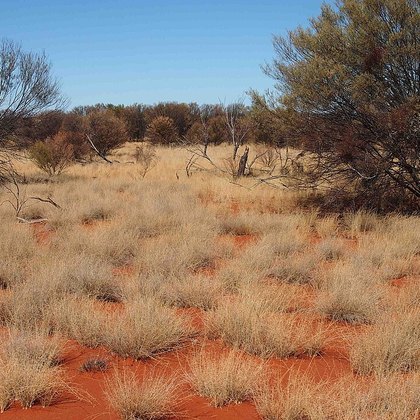
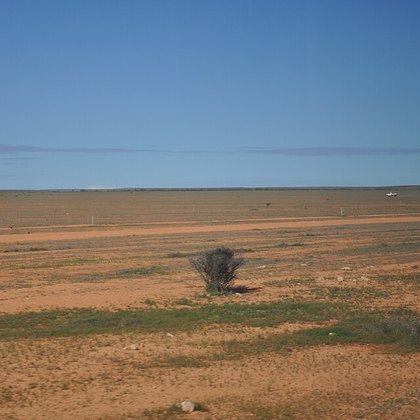
The arid and semi-arid zone: shrubland dominated by emu bush (Eremophila) and grevillea, mulga (acacia scrub of the dry interior, dominated by Acacia aneura) and other acacia scrub, mallee (low, multi-stemmed eucalypt scrub of dry southern Australia), sandhills, inland ranges and granite outcrops, plus riverine woodland of river red gum, casuarina and Myoporum along the creeks. It feeds mainly on nectar, drawn with the curved bill from tubular flowers, supplemented with insects, fruit and seed. The nest is a shallow cup of twigs and grass placed low in a shrub; the clutch is usually two eggs, incubated fourteen days, with a nestling period of thirteen days. The breeding season runs roughly June to November, but in practice follows the rain.
Where the bird is most often found, arranged by main group and formation.



Range and movements
Endemic to Australia, across most of the dry interior: southern and central Queensland, western New South Wales, northern South Australia, the Northern Territory mainly south of Alice Springs, and all of Western Australia north of Kalgoorlie to the Kimberley. It is absent from the east coast, from Tasmania and from New Zealand. Its movements are what define it: it is called nomadic, but the picture is mixed — in some places birds stay for years on end, in others they appear suddenly in numbers far outside the normal range after rain. On the coast of north-western Australia it is in some years among the commonest winter visitors, and then above all immediately after the first heavy rain.
- Resident
- Winter
- dark = core range, pale = thinly spread
Where and when to look
Look for the flowering, not for the district. Drive inland after a wet spell and stop at every plain where the emu bushes stand orange or purple; that is where they are, high in the shrub and whistling loudly. If you see a black-and-white honeyeater, work through three things: size, bill and skin patch. A substantial bird with a stout curved bill and a blue patch below the eye is the Pied Honeyeater; a small bird with a needle-fine bill and a black stripe down the white belly is the Black Honeyeater. With females the breast helps: heavily streaked belongs to this species.
Conservation
Least Concern (LC) according to the IUCN, with a very large range and a population that appears stable, although it has never been counted — difficult in a species that wanders so widely. In New South Wales it is listed as Vulnerable at state level. The concern named is the nectar supply: grazing by stock, goats and rabbits thins exactly the flowering shrub layer the species falls back on in dry years, and protecting those nectar-rich patches is regarded as the key management measure.
Scientific name
Certhionyx variegatus | Lesson, 1830
René-Primevère Lesson described the species in 1830; author and year stand without parentheses because it still sits in the genus in which Lesson described it. The epithet variegatus is Latin for 'variegated' or 'pied' and refers to the male's black-and-white plumage — the Dutch name eksterhoningeter and the English Pied Honeyeater say the same. The genus Certhionyx long also contained the Black and Banded Honeyeaters, but DNA work showed those three are not closely related at all; Christidis and Boles in 2008 left only this species in the genus, which thereby became monotypic. The Pied Honeyeater turns out to be the earliest branch of the lineage leading on to the Tui and New Zealand Bellbird and to two honeyeaters of New Guinea — a relationship that cannot be read from the plumage at all.