All species › Passerines › Honeyeaters › Yellow-faced Honeyeater
Yellow-faced Honeyeater | Caligavis chrysops
Geelmaskerhoningeter | Mielero carigualdo
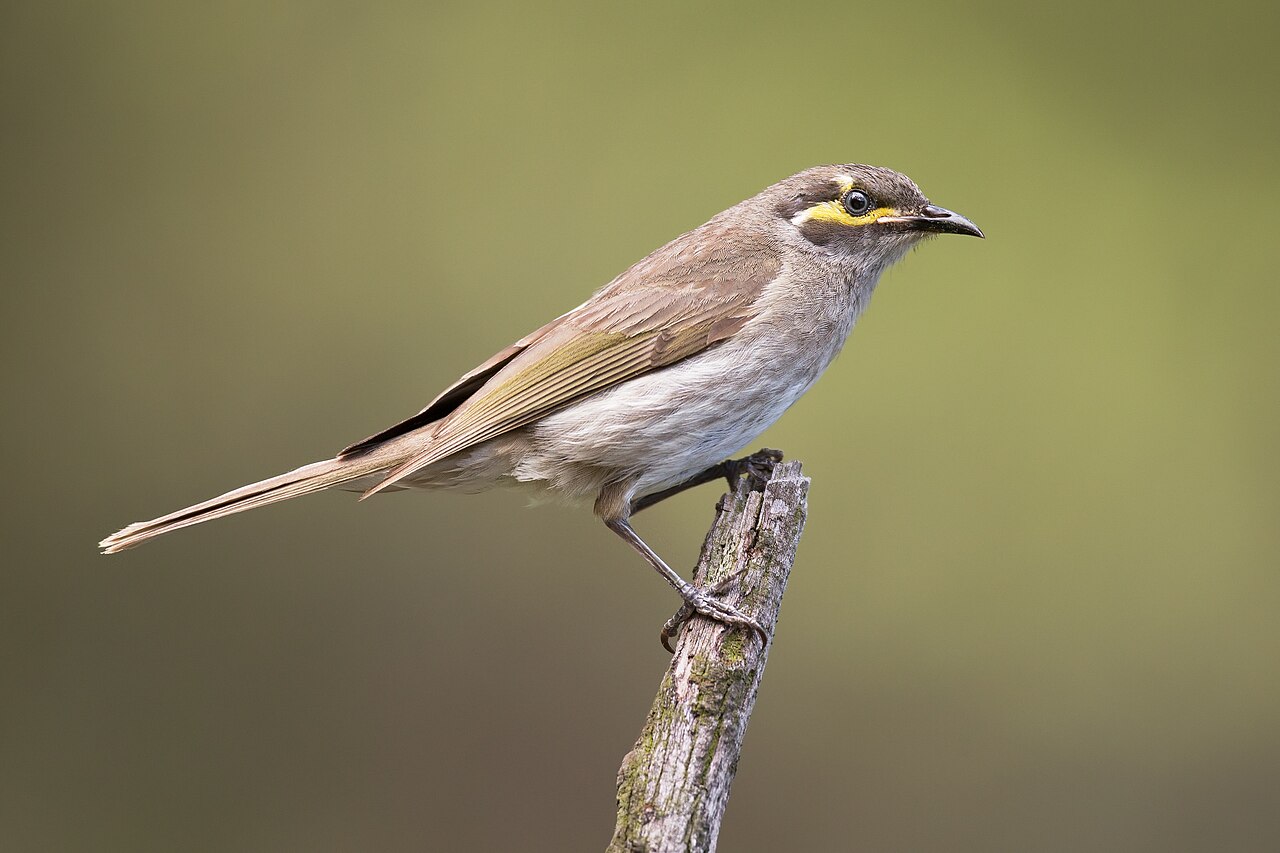
The Yellow-faced Honeyeater is one of the commonest and best-reported birds of eastern Australia, with nearly four hundred thousand records in ten years. It is otherwise a dull grey-brown bird, but the yellow stripe laid like a brushstroke straight across the eye, edged black above and below, shows at a distance and makes it unmistakable. What sets it apart is the migration: in early autumn hundreds of thousands of birds drift north along the east coast in loose flocks, one of the few genuine mass migrations of Australian songbirds.
Voice
An early singer that starts well before sunrise, loud, full and extremely varied. The most often quoted phrase sounds like chick-up, chick-up, repeated at an unhurried pace. The territorial call is a drawn-out preet with an upward inflection, the alarm call a loud trilling whistle. As a contact note comes a lively two-syllable terric, terric or put-put, put-put, and that is the sound heard from passing flocks on migration.
No freely licensed recording has been found for this species yet; what to listen for is described below.
Identification
A medium-small, slim honeyeater of fifteen to seventeen and a half centimetres, with a slightly decurved black bill and a cream gape. The upperparts are dark grey-brown to olive-brown, the underparts pale grey-brown with fine dark streaking on chin, throat and breast and a light grey belly. The feature is the face: a narrow yellow stripe beginning above the gape, broadening and curving below the eye to a small white ear patch, bordered black above and below, with a yellow to off-white spot behind the eye set in that black border. The iris is dusky blue in adults and brown in juveniles, which also lack the head streaking. The legs are grey-brown. The sexes are alike, the male slightly larger.
Confusion species
The yellow stripe runs straight through the eye and not below it — the quickest separation from nearly every relative. The Bridled Honeyeater (Bolemoreus frenatus) and the Eungella Honeyeater (Bolemoreus hindwoodi), both from the same ex-Lichenostomus complex, are much larger, have a white neck patch and lack the yellow face stripe; the first also has a yellow-and-black bill. Lewin's Honeyeater (Meliphaga lewinii) has a crescent-shaped yellow patch on the ear coverts rather than a stripe through the eye. The Yellow-tufted Honeyeater (Lichenostomus melanops) has a black mask with a bright yellow tuft and a yellow throat. From the Ptilotula honeyeaters, such as the White-plumed Honeyeater (Ptilotula penicillata) and the Fuscous Honeyeater (Ptilotula fusca), the black-edged yellow stripe also separates it: those species have a white or yellowish plume or stripe without a black border. The Singing Honeyeater (Gavicalis virescens), finally, is larger, duller, and its yellow stripe stays below the eye.
Habitat
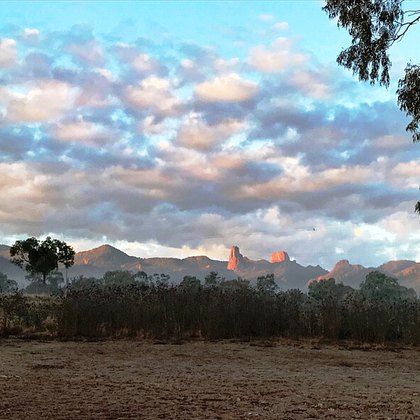
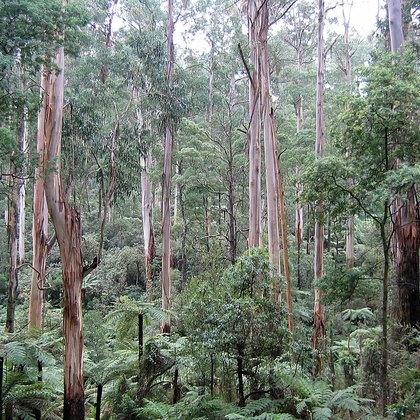
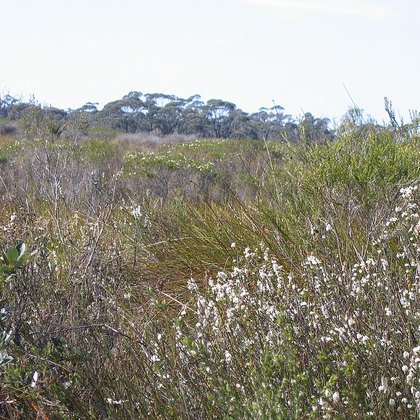
Open sclerophyll forest and woodland in the widest sense, from coastal dune to subalpine altitude, with a preference for spotted gum forest with ironbark and stringybark and a light shrub layer. Also dry forest with Angophora, acacia, banksia or casuarina, high-altitude alpine ash and snow gum, riparian woodland along creeks, coastal heath with flowering banksias and, locally, mangrove. It is a regular in gardens, parks and urban greenery. The diet is about forty per cent nectar and sixty per cent insects — flies, beetles, spiders — with pollen from banksia and grevillea, fruit and seed. The nest is a finely woven cup of moss and plant fibre, low in the understorey or in a garden shrub; the clutch is two or three eggs, and cuckoos parasitise it regularly.
Where the bird is most often found, arranged by main group and formation.


Range and movements
Endemic to Australia, in a broad arc across the east and south-east: from near Cooktown in far northern Queensland, within a line from Charters Towers south to Albury and the coast, west to the Fleurieu Peninsula and the Mount Lofty Ranges in South Australia. It is partly migratory: between March and May hundreds of thousands of birds move north to southern Queensland, returning in July and August to breed in southern New South Wales and Victoria. The passage goes in successive flocks of ten to a hundred birds, sometimes over a thousand; on a single day in May 1965 more than a hundred thousand birds were counted passing Hastings Point in New South Wales. Research indicates the birds orient on the inclination of the earth's magnetic field. The species does not occur in New Zealand.
- Resident
- dark = core range, pale = thinly spread
Where and when to look
In the south-east it is in gardens and parks all year; look for it at a flowering banksia or grevillea and check the yellow stripe running through the eye. The real spectacle is the migration: stand on a coastal headland or a mountain pass in New South Wales or southern Queensland in April or early May and watch north in the first two hours after sunrise. The flocks come over low, calling terric, terric continuously, and follow coastlines, ridges and river valleys as leading lines. Other honeyeaters travel with them on such mornings, so check the head pattern flock by flock.
Conservation
Not threatened (LC), common and widespread, at local densities from 0.01 to nearly eight birds per hectare. The species holds up well in disturbed and urbanised country, provided flowering shrubs and trees remain. In some orchards it is regarded as a pest for pecking ripening fruit. The one structural concern is the migration route: a bird that drifts along the coast in flocks each autumn depends on an unbroken chain of flowering forest over hundreds of kilometres, and fragmentation thins that chain.
Scientific name
Caligavis chrysops | (Latham, 1801)
John Latham described the species in 1801 as Sylvia chrysops; because it has changed genus repeatedly since, author and year stand in parentheses. The epithet chrysops is Greek for 'golden face', from khrysos (gold) and the word for face, and refers directly to the yellow face stripe — the Dutch name geelmaskerhoningeter, the English Yellow-faced Honeyeater and the Spanish mielero carigualdo all say the same thing. The genus Caligavis was introduced in 2011 when molecular work broke up the old catch-all genus Lichenostomus; the name comes from Latin caligo (mist, obscurity) and avis (bird). Genetic study indicates the species split from the other Caligavis species, which live in New Guinea, about seven million years ago.