All species › Passerines › Honeyeaters › Eungella Honeyeater
Eungella Honeyeater | Bolemoreus hindwoodi
Eungellahoningeter | Mielero de Hindwood
The Eungella Honeyeater has the smallest range of any breeding passerine in Australia: a strip of mountain rainforest some twenty by sixty kilometres in the Clarke Range, a little over sixty kilometres west of Mackay in Queensland. It is unobtrusive — dark grey above, mid-grey with faint streaking below — and was described as a separate species only in 1983, having until then been taken for an outlying population of the Bridled Honeyeater. Within its small area it is not rare; outside it, it is nowhere to be found.

Voice
The repertoire has been only partly described, which for an Australian songbird is unusual and shows how little the species has been studied. What is on record are clear, sharp contact calls, usually in short series, and a louder, more nasal calling at flowering trees, where several birds chase one another. In the mountain forest at Eungella that sound carries well, and it is usually what first alerts observers to the species — certainly in the mist that fills this forest on most days.
Recording: Fernando del Valle — CC BY-NC-SA 4.0 · Eungella Plateau, Mackay Regional, Queensland, Australia · xeno-canto
Identification
A medium-sized honeyeater of sixteen to a little over eighteen centimetres, built like a slim Bolemoreus, with a slightly decurved bill. The upperparts are evenly dark grey, the underparts mid-grey with faint paler streaking — a strikingly uninformative plumage. The features are on the head: a narrow white to cream-yellow stripe below the eye, a small white spot just behind it, white ear plumes and a pale gape line. The iris is light grey-blue, the legs dark grey. Decisive is the bill, which is wholly black. Male and female are alike.
Confusion species
The Bridled Honeyeater (Bolemoreus frenatus) is the species of which the Eungella Honeyeater was long considered a form, and the two can hardly be separated on plumage alone. Two things settle it: the bill is wholly black in the Eungella Honeyeater and black with a yellow base in the Bridled, and the ranges lie more than three hundred kilometres apart — the Bridled comes no further south than Mount Spec, the Eungella occurs only in the Clarke Range. On the spot, Lewin's Honeyeater (Meliphaga lewinii) is the real pitfall: it is numerous there and just as dark, but has a crescent-shaped yellow ear patch and a machine-gun rattle of a call. The Yellow-faced Honeyeater (Caligavis chrysops) also occurs but has a sharp yellow face stripe through the eye and is smaller.
Habitat
Plateau rainforest in the eastern Clarke Range and the Sarina Range, normally above nine hundred metres, with a preference for forest edges and the wooded gullies and creeks. In winter birds move down to lower forest to follow flowering trees and are occasionally seen in gardens around Mackay; how regular that movement is remains poorly known. The diet is nectar from flowering rainforest and eucalypt trees, supplemented with insects gleaned from foliage. Little has been published on nest building and breeding biology.
Where the bird is most often found, arranged by main group and formation.
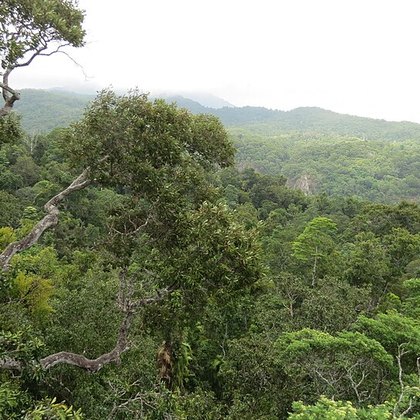
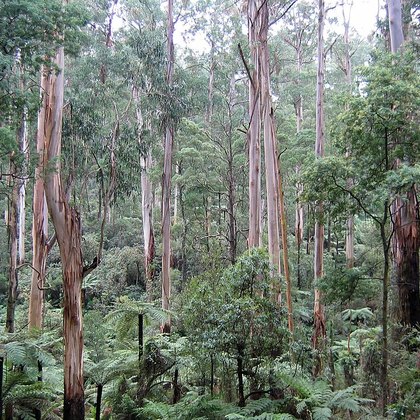
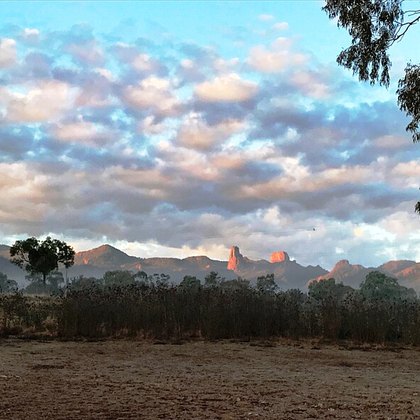
Range and movements
Endemic to Australia, and within Australia confined to an area of roughly twenty by sixty kilometres in the Clarke Range and the adjoining Sarina Range, west and south-west of Mackay in central Queensland. Eungella National Park is the core. This is the smallest range of any breeding passerine on the continent. Within that area the species is common: a research group has colour-banded a hundred and twenty-nine birds at eight sites across twenty-five kilometres of the range. With nearly a thousand records in ten years it is among the less-reported species in the guide, which mainly reflects how remote it is. It does not occur in New Zealand.
- Resident
- dark = core range, pale = thinly spread
Where and when to look
There is only one address: the mountain rainforest at Eungella, about an hour's drive from Mackay. Work the forest edges and small gullies around Broken River and the walking tracks by the visitor centre, preferably early, and look for flowering trees along the forest margin. If you hear or see a grey honeyeater, check the bill first — wholly black — and the face afterwards. Anyone who goes to the ear patch and finds a yellow crescent has Lewin's Honeyeater. The mist that fills this forest on most days makes the first hours after sunrise the best bet.
Conservation
Near Threatened (NT) on the IUCN Red List and listed as Vulnerable in Queensland. The reason is not a demonstrated decline but the size of the area: a species that stands on one mountain range in one small rainforest has no second population to fall back on. The risks named are fire — which in dry years can reach into the rainforest margin — and climate change, which squeezes from below the cool, misty upland zone the bird depends on. There is no national recovery plan; the fieldwork comes largely from a volunteer group that bands and follows the birds.
Scientific name
Bolemoreus hindwoodi | (Longmore & Boles, 1983)
N. Wayne Longmore and Walter Boles described the species in 1983 as Meliphaga hindwoodi; because it has twice changed genus since — first to Lichenostomus, in 2011 to the new genus Bolemoreus — author and year stand in parentheses. The name of that genus is built from those of Boles and Longmore themselves. The epithet hindwoodi honours Keith Alfred Hindwood (1904–1971), an Australian amateur ornithologist who became President of the Royal Australasian Ornithologists Union. The first specimen was collected in the Clarke Range in 1975; Longmore recognised it in the museum collection in 1976 as something new, and expeditions in 1978 and 1980 confirmed the bird in the field. The name Eungella is said to go back to an Aboriginal word for 'mountain of the mist' or 'land of cloud' — a fitting description of the only forest in which this species lives.