All species › Passerines › Spiderhunters and sunbirds › Sahul Sunbird
Sahul Sunbird | Cinnyris frenatus
Sahoelhoningzuiger | Suimanga de Sahul
The Sahul Sunbird is Australia's only true sunbird: a bird of ten centimetres with a long, thinly curved bill, a bright yellow underside and, in the male, a throat shield that flares steel-blue and violet when turned to the sun. It belongs to the mangroves and rainforest edges of north Queensland, but hangs its spindle-shaped nest just as readily from a washing line or a verandah in Cairns.

Voice
The commonest note is a short, high, rising buzz of less than a second, repeated as the bird works from flower to flower; over the rustle of a garden that is usually the first sign. There is also a fast, rattling song that recalls a fairy-wren's, and in chases and border disputes a squeaky, hot-tempered chatter. The bird calls a great deal and rarely sits still while doing so.
No freely licensed recording has been found for this species yet; what to listen for is described below.
Identification
A very small bird of ten to eleven and a half centimetres, with a long, fine and clearly decurved bill and a short white-tipped tail. The upperparts are olive-green, the flight feathers black with green edges, the whole underside clear yellow. From chin to breast the male carries a metallic blue-black to violet shield that only colours in the right light and otherwise reads as plain black; with it go a yellow brow stripe and a yellow moustachial stripe. The female has no shield and is evenly yellow below.
Confusion species
Mistletoebird (Dicaeum hirundinaceum) is just as small but has a short straight bill and, in the male, a red breast stripe and red undertail. Fairy Gerygone (Gerygone palpebrosa) and Large-billed Gerygone (Gerygone magnirostris) are also yellow below, but their bill is straight and fine and they pick insects rather than take nectar. Dusky Myzomela (Myzomela obscura) is dull brown with no yellow and has a shorter, less curved bill.
Habitat
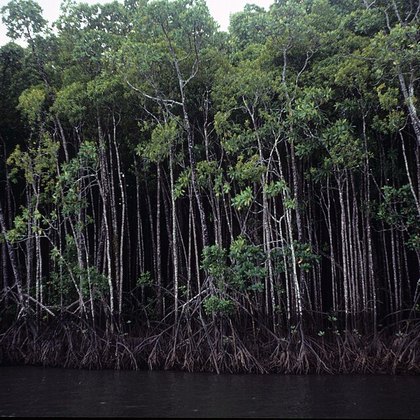
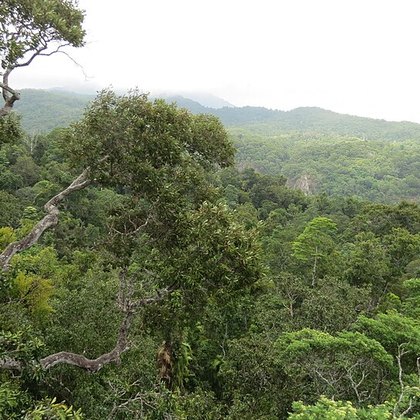
Mangrove, the edges of tropical rainforest, monsoon forest and vine thicket, and beyond that gardens, parks and yards with flowering shrubs. It wants nectar-bearing flowers and cover at eye level, and the town supplies that better than closed forest does: in Cairns, Townsville and Port Douglas it works the hibiscus in the front garden. Where it enters forest it stays along the edge and in the gaps.
Where the bird is most often found, arranged by main group and formation.


Range and movements
The islands of Torres Strait and Cape York, and from there south along the wet east coast of Queensland to about the latitude of Gladstone; it does not run far inland. In Australia this is the subspecies frenatus; outside Australia the species covers New Guinea and the surrounding islands — Sahul, from which its name comes. It does not migrate and holds the same ground all year.
- Resident
- dark = core range, pale = thinly spread
Where and when to look
Search not in the canopy but at eye level, at a flowering hibiscus, heliconia or banana flower, and listen for the rising buzz. Then work the buildings: a spindle-shaped nest of thirty to sixty centimetres, woven from grass, bark and spider web and slung half a metre to a metre and a half up from a wire, a lamp or a roof edge, is unmistakable and gives the pair away at once. It breeds mainly from August to March.
Conservation
Least Concern (LC). The species holds up well and has gained more from people than it has lost: gardens, parks and planted flowering shrubs have made it a common town bird in north Queensland, and its range along the Queensland coast looks to be growing rather than shrinking. What does weigh is the loss of mangrove to coastal building and of rainforest edge to clearing; storms and cyclones knock local numbers back.
Scientific name
Cinnyris frenatus | (Müller, 1843)
Salomon Müller described the bird in 1843 as Nectarinia frenata; because it later moved to another genus, author and year stand in parentheses. The genus Cinnyris was introduced by Cuvier in 1816. frenatus is Latin for 'bridled', after the yellow stripes that run across the face like a harness. Until recently this bird stood under Cinnyris jugularis; since the split on plumage and DNA that name belongs to the Philippine Garden Sunbird, and AviList v2025b carries the Sahul birds as a species of their own.