All species › Passerines › Munias, parrotfinches, waxbills and allies › Gouldian Finch
Gouldian Finch | Chloebia gouldiae
Gouldamadine | Diamante de Gould
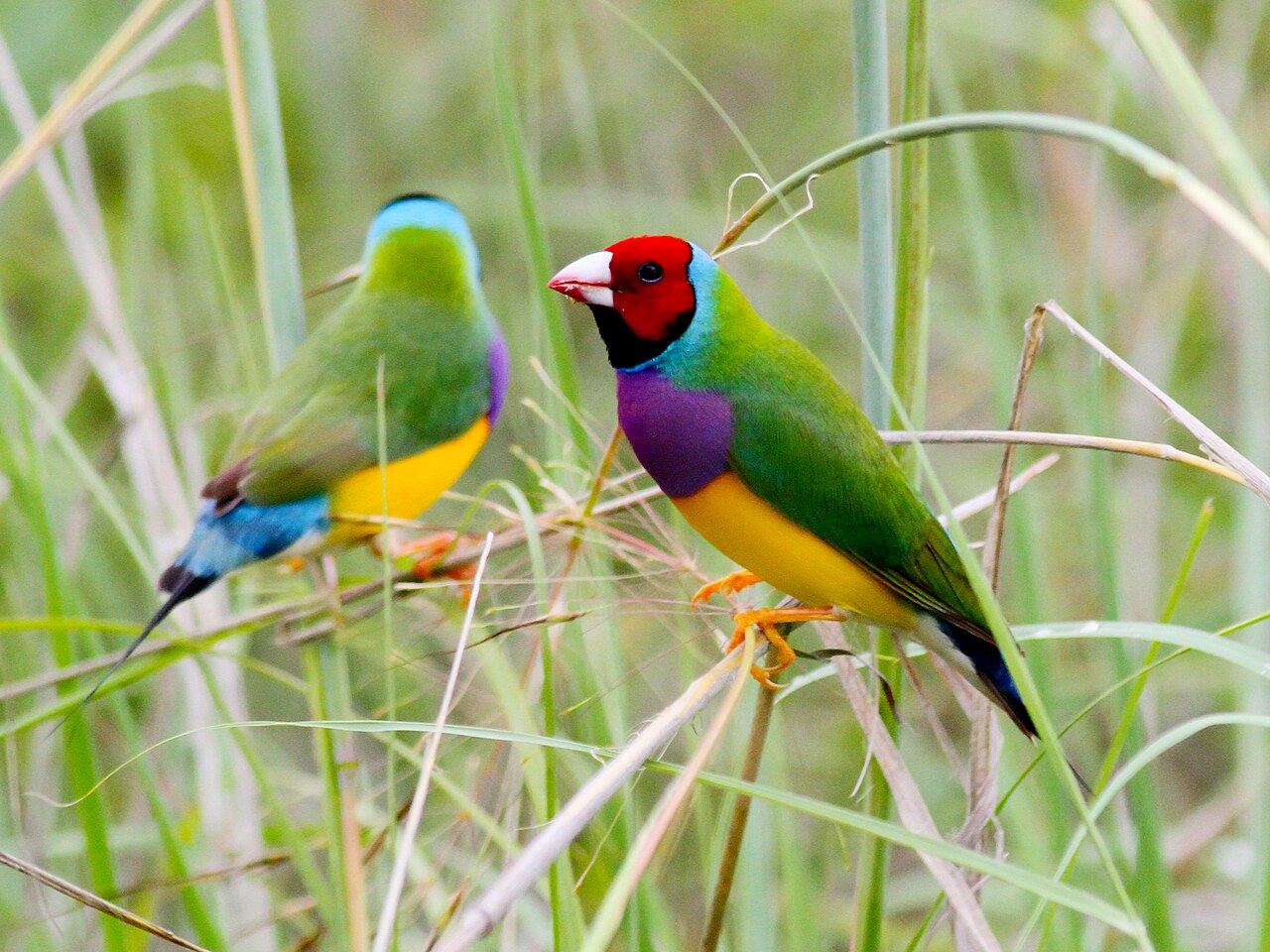
The Gouldian Finch is the most brightly coloured bird of the Australian savanna: grass-green on the back, purple on the breast, butter-yellow on the belly, with a pale blue band round a black, red or yellow face. In the field it is usually met at a waterhole late in the dry season, when a small party comes in fast and straight, drinks briefly and is gone again.
Voice
A quiet bird with a conspicuous plumage. The contact call is a high, short, thin ssit or sit-sit, given constantly by parties in flight and while drinking; it does not carry far. The male's song is quieter still: a mumbled, hissing and rattling sequence barely audible from a few metres, ending in a run of dry clicks. Displaying males sing with the crown feathers raised and the body bobbing, but almost inaudibly to human ears. Nestlings beg with a fine high peeping.
Recording: Louis Masarei — CC BY-NC-SA 4.0 · Lake Argyle, Shire of Wyndham-East Kimberley, Western Australia, Australia · xeno-canto
Identification
A small, compact finch of twelve to fourteen centimetres with pointed, projecting central tail feathers. Back and wings are bright grass-green, the breast deep violet-purple, belly and undertail butter-yellow, the rump pale blue. The head is either black, or scarlet, or rarely yellow-orange, and in every case is edged by a narrow pale blue band. The bill is ivory white with a coloured tip. The female has the same pattern but duller, with a paler purple breast and shorter tail pins. Take care with those three head colours: they are not three species and not subspecies, but three colour forms of one and the same population, which interbreed freely. About three quarters of wild birds are black-headed, about a quarter red-headed, and yellow-headed birds are a great rarity — a few in a thousand at most. The red-black difference rests on a single place in the genetic material and is inherited with the sex; the yellow form arises because a second, separate inherited factor prevents the red pigment being made. Black and red heads can therefore sit side by side in one flock. The juvenile differs markedly: grey-green above, dull grey on the head and off-white to pale brown below, without any of the adult colours, and with a dark bill.
Confusion species
Adults cannot be mistaken. The problem lies with the juveniles, which are colourless grey-green and join the same flocks and the same waterholes as the other northern finches. Long-tailed Finch (Poephila acuticauda) is larger and sandy brown with a black throat patch, a long pointed black tail and a yellow or red bill. Masked Finch (Poephila personata) has a black mask round a yellow bill and is likewise sandy brown, never green. Crimson Finch (Neochmia phaeton) is red-faced with a long red tail and clings to permanent water with pandanus. Double-barred Finch (Stizoptera bichenovii) is small, brown-grey and barred black and white across the breast. To settle a juvenile Gouldian, look for the green wash on the back and at the company it keeps: juveniles almost always travel with adults. Finally beware escaped cage birds: aviculture has blue, white-breasted and pale green forms that do not occur in the wild.
Habitat
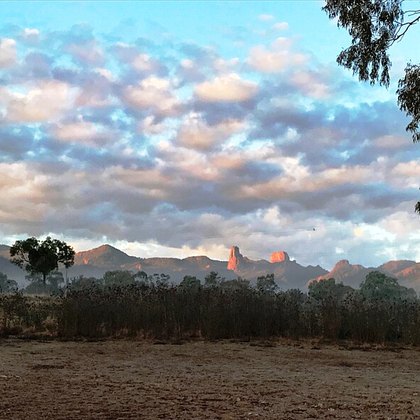
Tropical savanna and open eucalypt woodland on stony hills and slopes, with smooth-barked eucalypts in which the species finds its nest hollows, and a layer of annual grasses beneath. On the seed of those grasses — especially wild sorghum — it lives for most of the year. The Gouldian Finch is one of the few estrildid finches that does not build its own grass nest but breeds in tree hollows, which ties it to older trees. It must also drink daily, so the birds are never far from a pool or creek. In the dry season the parties move down to the lowlands and watercourses, in the wet season back up into the hills.
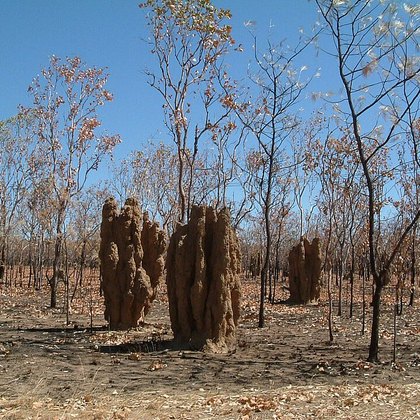
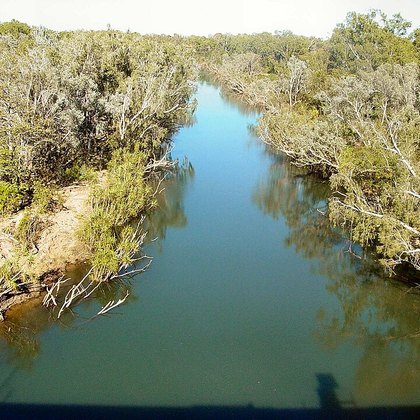
Where the bird is most often found, arranged by main group and formation.

Range and movements
Northern Australia, but badly fragmented and far smaller than a century ago. The largest numbers are in the Kimberley of northern Western Australia and in the Top End of the Northern Territory, with the country round the Yinberrie Hills near Katherine as the best known stronghold. Further east, in the Gulf country and on Cape York Peninsula, the species is now rare to gone; from the wet tropics of Queensland it has disappeared entirely. Within that range it is nomadic: parties move between dry-season and wet-season areas and may be absent from a site for years.
- Resident
- dark = core range, pale = thinly spread
Where and when to look
Late in the dry season, between August and October, sit early in the morning by a pool or a stock trough in savanna woodland and wait. The birds arrive in small parties, fly in low and fast, drink briefly and are away within a minute — listen for the high thin ssit that announces their approach. Check the head colour of every bird as they come in: seeing black and red together in one party is exactly what makes this species remarkable.
Conservation
Since the reassessment of 2018 the species has been rated Least Concern (LC) on the world list — before that it stood for a long time as Endangered and then as Near Threatened. That downlisting came not because the habitat improved but because better survey work showed the population to be larger than had been thought. In Australia itself the Gouldian Finch remains on the national list of threatened species. The causes of the earlier collapse still operate: altered fire regimes, in which late, hot dry-season fires remove the grass seed supply exactly when the birds need it, and cattle grazing that keeps the same grasses short. Old hollow-bearing eucalypts are also being lost. Mass trapping for the bird trade, a heavy pressure until the 1970s, ended with the Australian trapping and export ban of 1981; the air-sac mite then blamed for the decline turns out to be mainly a problem of captive birds. Management with cool fires early in the season is the key measure.
Scientific name
Chloebia gouldiae | (Gould, 1844)
John Gould described the species in 1844 as Amadina gouldiae and named it for his wife Elizabeth Gould, who drew the plates for his books on Australian birds and had died shortly before; the English name Gouldian Finch and the Dutch name gouldamadine both go back to her. Because the species has since moved to another genus, author and year stand in parentheses. The genus Chloebia was erected by Reichenbach in 1862 and refers to the young green of grass. The species was long placed with the parrotfinches in Erythrura; the separate genus is again followed today. The type locality is the Victoria River in the Northern Territory.