All species › Passerines › Munias, parrotfinches, waxbills and allies › Plum-headed Finch
Plum-headed Finch | Emblema modestum
Ceresamadine | Diamante modesto
The Plum-headed Finch is the least conspicuous of the Australian finches: brown above, white with fine waving below, and only in good light a deep plum crown and chin spot. It is nomadic by nature and turns up suddenly in large flocks after a good rainfall year where it had been absent for years.

Voice
A soft, short tlip or tset as contact call, often repeated from a flock moving through tall grass; on flushing, a fine tinkling of dozens of voices at once. The song is a soft, restrained twitter and squeak without clear structure, barely audible at a few metres; the male sings upright with a grass stem in his bill.
No freely licensed recording has been found for this species yet; what to listen for is described below.
Identification
Eleven to twelve centimetres, compact, with a short black bill. Upperparts plain grey-brown, underparts white with fine dark barring over breast and flanks that looks like lacework at close range. The male has a deep plum to wine-red crown and forehead, and an equally plum chin spot below the bill; against the light that simply reads as dark. The female has less plum on the crown and a white chin, so the chin spot is missing. Young birds are plain brown, unbarred below and without plum; they are then hard to separate from young mannikins.
Confusion species
Chestnut-breasted Mannikin (Lonchura castaneothorax) shares the same reed fringes but has a heavy blue-grey bill, a chestnut breast and an orange-yellow rump. Scaly-breasted Munia (Lonchura punctulata) also has scaled underparts, but the scaling is coarser and rounded, the head plain chocolate-brown and the bill heavy and blue-grey — never a plum crown. Double-barred Finch (Stizoptera bichenovii) has sharp black arcs across a white face, not fine waving. Young birds without markings are recognised almost only by the slim black bill and by their company.
Habitat
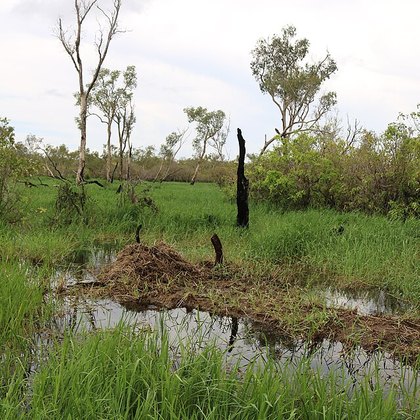
Tall grass, reeds and rushes along creeks, billabongs and dams in the open eucalypt country of the east, and adjoining grassy woodland. It takes half-ripe grass seed, climbing the stems and riding them down under its weight. Crop edges, sorghum and cereal fields and weedy ditch banks are used as long as the grass stays tall; nearby drinking water is a condition.
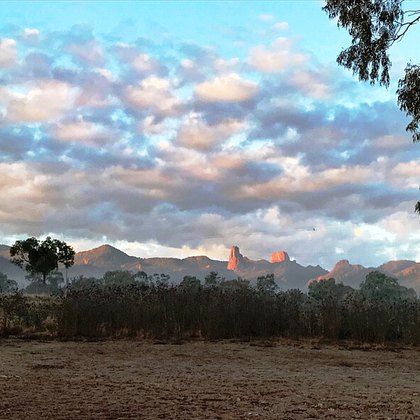
Where the bird is most often found, arranged by main group and formation.


Range and movements
Eastern Australia, from northern Queensland south into central New South Wales, mainly on the inland side of the Great Dividing Range and in the Murray-Darling basin. Not a true migrant but a pronounced nomad: numbers swing strongly with rainfall, and after wet years flocks of hundreds appear far outside the usual places, only to vanish again in dry ones. The mapped range is therefore always wider than what one meets in a single season.
- Resident
- dark = core range, pale = thinly spread
Where and when to look
Look for it not in the tree but in the grass: walk slowly along an overgrown creek bank and watch for grass stems swaying without wind. When disturbed the whole flock rises low and compact and drops in again twenty metres on. Take time over the crown — plum is the one thing that settles this species at a glance, and it wants side light.
Conservation
Not globally threatened and still met regularly over much of eastern Australia, though nowhere numerous. In the south of the range numbers have fallen with the loss of tall native grass along watercourses, grazing to the water's edge and the straightening of creeks. Because the species wanders so much, a real trend is hard to establish: local absence need mean no more than a dry year.
Scientific name
Emblema modestum | (Gould, 1837)
Gould described the bird in 1837 as Amadina modesta, from a specimen out of inland New South Wales on the upper Hunter; because the species later moved to another genus, author and year stand in parentheses. modestus is Latin for 'modest, unassuming', after the inconspicuous plumage. For a long time the species stood in the books as Aidemosyne modesta, in a genus of its own; in the current arrangement it belongs to Emblema, a genus name Gould introduced in 1842 from Greek-Latin emblema, 'inlaid ornament'.