All species › Passerines › Munias, parrotfinches, waxbills and allies › Painted Finch
Painted Finch | Emblema pictum
Geschilderde astrild | Diamante pintado
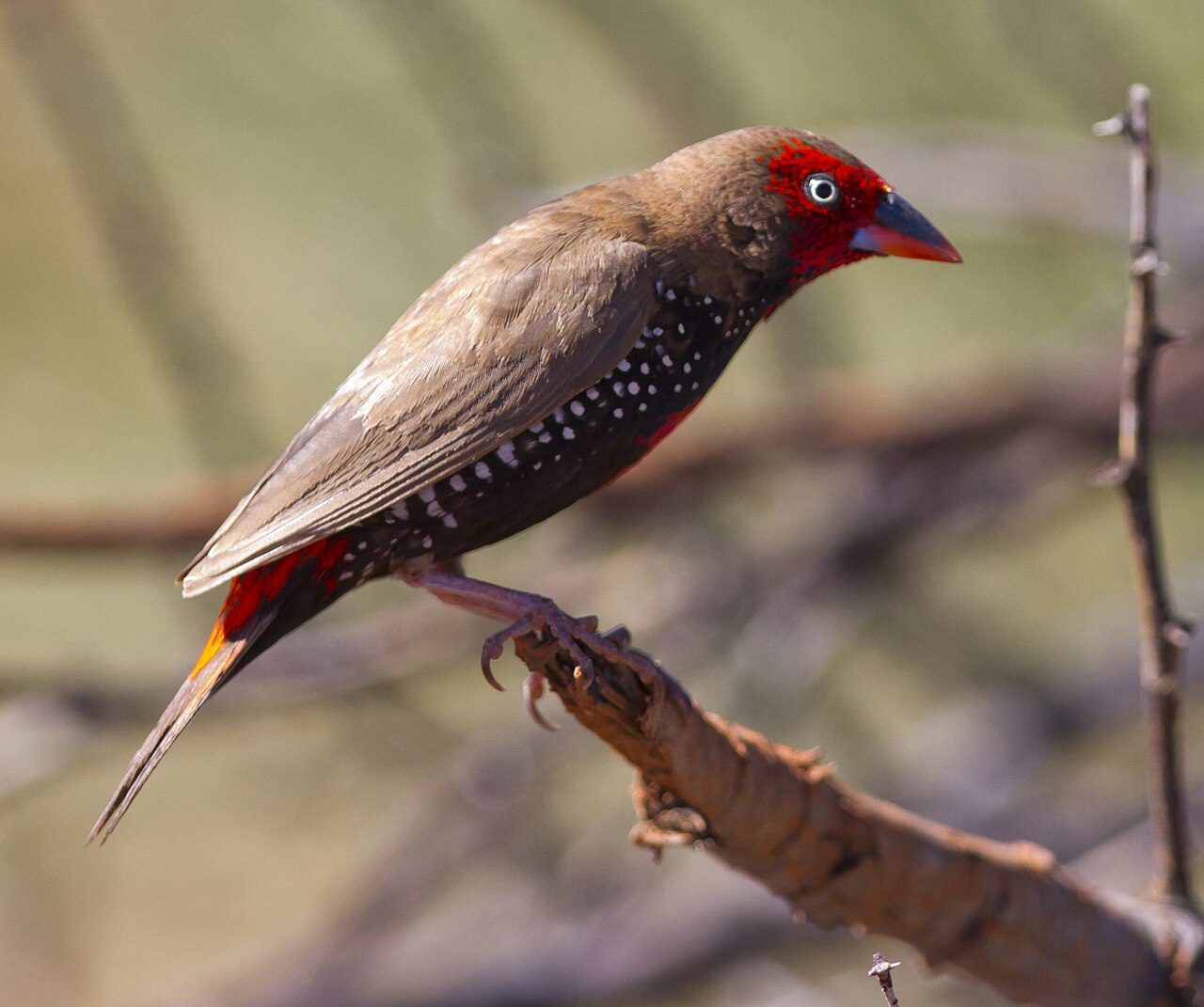
The Painted Finch is the most vividly coloured bird of Australian spinifex country: scarlet on the face and down the centre of the belly, otherwise black with rows of round white spots. It belongs to rocky hills with prickly spinifex, never far from a water-holding gorge, and is usually scarce and scattered there.
Voice
The commonest sound is a sharp, high, clicking chek or trrt, often repeated as a pair walks between the spinifex hummocks; it sounds more insect-like than bird-like. In flight comes a nasal, slightly tinny chehh that carries well over rocky slopes. The song is soft and disorderly, a string of creaks, clicks and squeaks without fixed build, given at close range from a stone or a low shrub.
Recording: Louis Masarei — CC BY-NC-SA 4.0 · Marble Bar, Shire of East Pilbara, Western Australia, Australia · xeno-canto
Identification
Eleven to twelve centimetres, compact, with a strikingly long and pointed bill, dark with red on the lower side — that bill profile alone sets it apart from every other Australian finch. The male is brown-black above, with scarlet forehead, face and throat, a scarlet rump and a scarlet band down the centre of the belly. Flanks and lower belly are black with regular rows of round white spots. The female has far less red — usually only a small red patch above the bill and in the throat — and is more heavily white-spotted below. Young birds are dull brown, unspotted, with a dark bill.
Confusion species
Star Finch (Emblema ruficauda) also has a red face and red bill, but is olive-green above, finely white-spotted and tied to reeds and damp grassland in the north. Crimson Finch (Neochmia phaeton) is crimson over the whole underside with white flecks on the flanks and keeps strictly to permanent water. Double-barred Finch (Stizoptera bichenovii) has black arcs and black-and-white spotted wings but no trace of red. In the dry interior the Painted Finch is in practice unmistakable: no other finch there combines scarlet with black-and-white spotted flanks and that long pointed bill.
Habitat
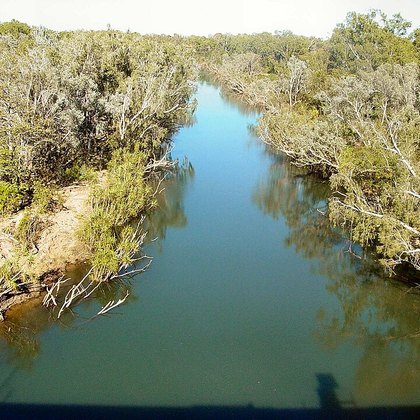
Spinifex (Triodia) hummock grassland on rocky hills, ridges, scree slopes and gorge walls in the arid interior, and gibber (stony desert with a pavement of polished stones) plains and stony ground where spinifex (spiny, hummock-forming desert grass of the interior) comes through. It forages on foot between and under the prickly hummocks, picking the seed of spinifex and other drought grasses off the ground, and when disturbed runs into a hummock rather than away. Daily drinking is a condition: water-holding pools in rock gorges, stock dams and springs decide where it can stay.
Where the bird is most often found, arranged by main group and formation.


Range and movements
The arid north and interior of Australia: from the Pilbara and Barrow Island in Western Australia through the central deserts and the ranges of the Northern Territory east into north-western Queensland. Resident on a fine scale, but shifting to places where rain has fallen recently and grass has seeded; after fire in spinifex it takes years for the birds to return. During the twentieth century the range expanded somewhat at its southern and eastern edge, probably thanks to new stock watering points.
- Resident
- dark = core range, pale = thinly spread
Where and when to look
Go early in the morning to a rock gorge with a permanent pool and sit still. Drinking happens in short, nervous visits by two to ten birds that come in low over the rocks. Otherwise look for movement on the ground between the hummocks: the species walks more than it flies, and the clicking contact call always comes from there first.
Conservation
Least Concern (LC) and spread over a very large range, but everywhere at low density. The main risk is the fire regime: extensive hot fires in spinifex leave whole ridges unsuitable for years, while a mosaic of old and young spinifex suits it. The drying of natural rock pools in long dry runs restricts it locally; artificial stock watering points work in its favour.
Scientific name
Emblema pictum | Gould, 1842
Gould described the species in 1842 as Emblema picta, from a specimen from Depuch Island off the Western Australian coast; because it still stands in the same genus, author and year go without parentheses (only the ending changed with the gender of the name). pictus is Latin for 'painted', after the vividly marked plumage. Emblema goes back to Greek-Latin emblema, 'inlaid ornament' or 'mosaic inlay' — the rows of white spots in black are exactly that. This species was for a long time the only one in the genus; only in the recent arrangement did Star Finch (Emblema ruficauda) and Plum-headed Finch (Emblema modestum) join it, two species that resemble it in nothing.