All species › Passerines › Munias, parrotfinches, waxbills and allies › Star Finch
Star Finch | Emblema ruficauda
Binsenastrild | Diamante colirrojo
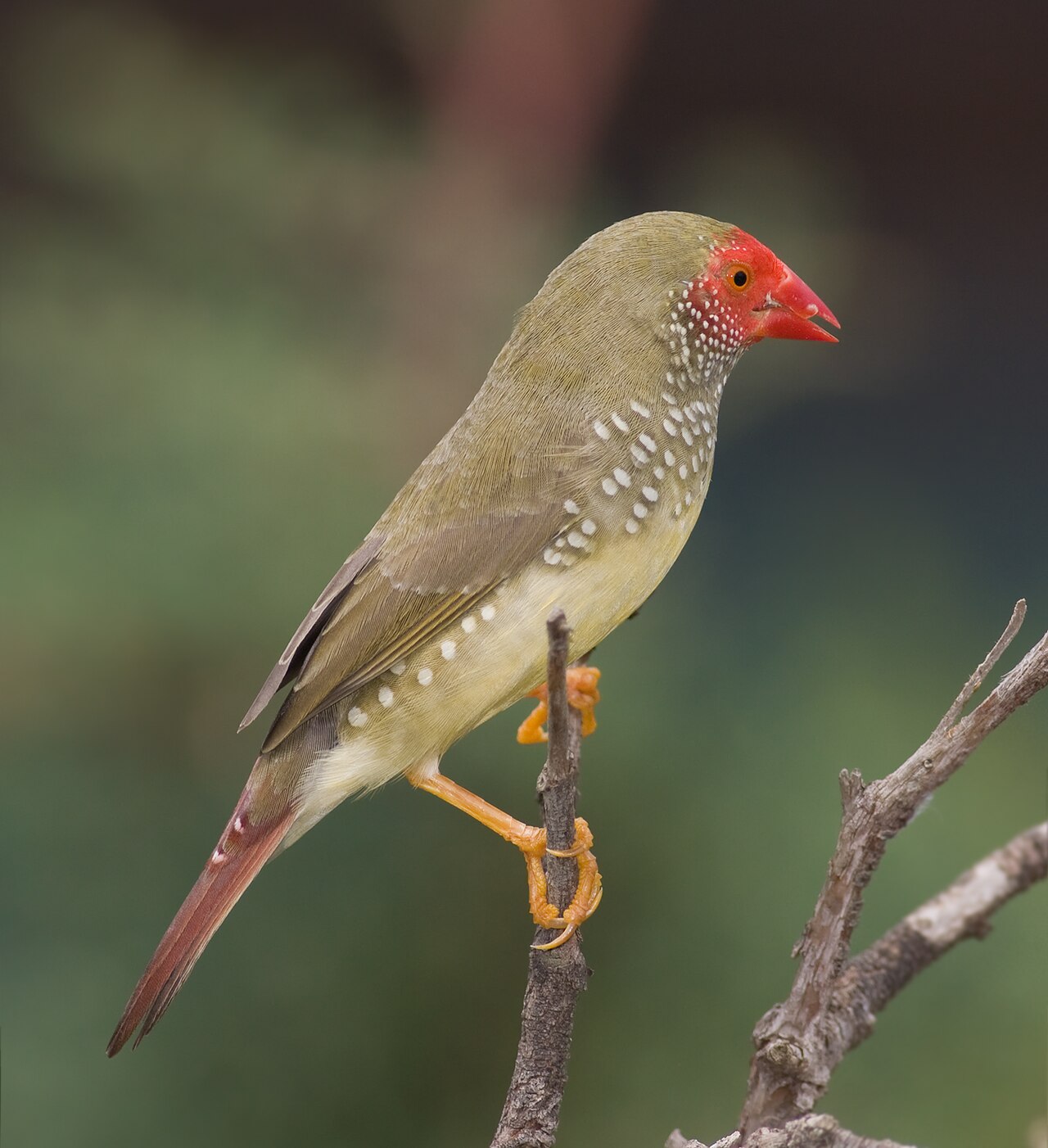
The Star Finch is the red face among the reed stems: a small, olive-brown finch of damp grassland in tropical Australia, with a crimson mask, a red bill and fine white spotting over cheek, breast and flank. Where it still occurs, it stays close to water.
Voice
The contact call is a high, thin and slightly plaintive tseet, often repeated while a small party shuffles through the grass; it carries further than the bird is visible. In flight comes a sharper, short tzep. The male's song is soft and barely audible at ten metres: a strung-together, lightly rattling trill that rises and then falls away, usually given from a grass stem or a low branch above the drinking place.
No recording with a suitable Creative Commons licence has been found for this species yet; what to listen for is described below.
Identification
A small finch of ten to twelve centimetres, olive-brown to olive-green above, with a bright red rump and red-brown tail. The adult wears a crimson mask covering forehead, lores, chin and throat, with a red bill that merges into it. Over the cheek, breast sides and flanks lies a fine white spotting, as if stars had been scattered on it — hence the English name. The underparts are yellowish to olive-yellow, paler in the centre. Females show less red on the mask and are duller; young birds lack red altogether, have a dark bill and are plain grey-brown with a dull red-brown rump.
Confusion species
Crimson Finch (Neochmia phaeton) shares the reed fringes of the north and also has red on the face, but there the red runs over the entire underside and the spotting stands as white specks in a crimson breast, not in olive green. Red-browed Finch (Neochmia temporalis) has only a red brow-stripe on a grey head and is not spotted. Painted Finch (Emblema pictum) is much more heavily black-and-white spotted on the flanks and belongs in spinifex country (spiny, hummock-forming desert grass of the interior), not in reeds. Young Star Finches without red are the hardest: look for the red-brown rump and tail and for the company of adults.
Habitat
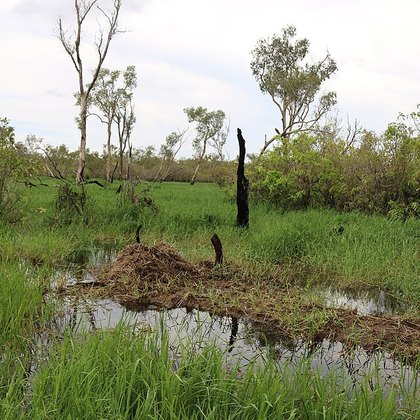
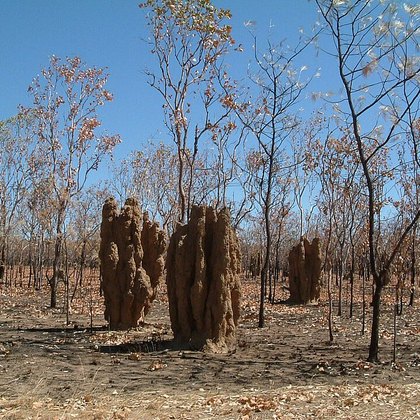
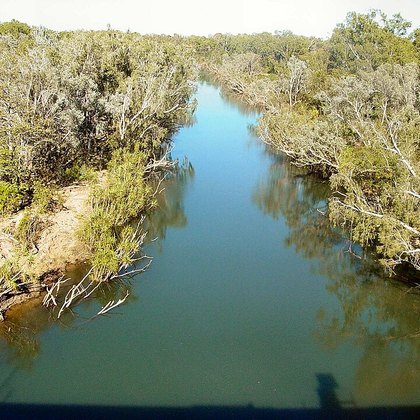
Rank grass, rushes and reeds at the edge of swamps, lagoons, creeks and stock dams in tropical savanna, and the adjoining grassland as long as water is within reach. It rarely leaves the immediate surroundings of water, drinks several times a day and takes the seed of half-ripe grasses on or just above the ground. Cane edges, wet stock paddocks and sown grassland are accepted as long as the grass stays tall and dense.
Where the bird is most often found, arranged by main group and formation.
Range and movements
Tropical northern Australia: from the Kimberley in Western Australia through the Northern Territory into northern Queensland, with its core along the major river systems and coastal plains. Resident with local shifts between wet and dry season: in the dry, parties gather at the last water-holding pools; in the wet they spread over fresh grassland. The historical range reached far further south-east, into inland New South Wales, where the species has gone.
- Resident
- Winter
- dark = core range, pale = thinly spread
Where and when to look
In the dry season, sit in the late afternoon at a stock dam or remnant pool with the reeds away from the sun. Parties come to drink in waves, stay briefly and fly low over the grass again; the red rump lights up then. Listen first for the thin tseet over the grass: it gives the birds away almost always before the eye finds them.
Conservation
Assessed globally as Least Concern (LC), but that verdict conceals a heavy loss at the eastern edge of the range. The eastern form of the interior and of southern Queensland and New South Wales — the form on which Gould based the species — has all but or entirely vanished there; in Australian legislation that eastern subspecies counts as endangered and possibly extinct. Overgrazing of damp grassy hollows, the loss of tall grass around drinking places and the spread of introduced grasses are named as the main causes. In the tropical north the species holds on where grazing leaves the reed fringes intact.
Scientific name
Emblema ruficauda | (Gould, 1837)
Gould described the bird in 1837 as Amadina ruficauda, from a specimen out of inland New South Wales (the Liverpool Plains); because the species later moved to another genus, author and year stand in parentheses. ruficauda is Latin: rufus 'red-brown' and cauda 'tail'. Gould introduced the genus Emblema in 1842, from Greek-Latin emblema, 'inlaid ornament' or 'mosaic inlay', after the spotted pattern. This species long stood in the books as Neochmia ruficauda, and for some authors as Bathilda ruficauda; the merger into Emblema is recent. The Dutch name follows the German Binsenastrild, after the rushes and reeds it lives in.