All species › Passerines › Munias, parrotfinches, waxbills and allies › Blue-faced Parrotfinch
Blue-faced Parrotfinch | Erythrura trichroa
Blauwmaskerpapegaaiamadine | Diamante cariazul
The Blue-faced Parrotfinch is grass-green with a cobalt-blue face and a red rump — and despite those colours one of the hardest songbirds to find in Australia. In the Australian part of the range it is a small population in the rainforest of the far north-east of Queensland.

Voice
A high, thin, slightly metallic tseet-tseet as contact and flight call, regularly repeated and often the only sign of the species while it sits invisible in the grass. The song is soft and quick: a lightly rattling twitter with high squeaks between, given from cover and barely audible at a distance. Anyone waiting at the known sites learns above all to watch for that thin tseet over the forest edge.
No freely licensed recording has been found for this species yet; what to listen for is described below.
Identification
A compact finch of about twelve centimetres, with a short conical black bill and a short pointed tail. The body is bright grass-green, the underparts a slightly yellower green. Forehead, lores, cheek and chin are cobalt-blue; on the male that blue runs more widely over crown and ear-coverts, on the female it is more limited and duller. Rump and uppertail-coverts are crimson and form a vivid signal against the green in flight. Young birds are dull green with little or no blue, a duller red rump and a paler bill base.
Confusion species
In Australia there is no other green finch, so confusion arises mainly with green birds of other families: young and female honeyeaters, figbirds and white-eyes. The distinction lies in the heavy conical bill of a seed-eater and in the red rump. Outside Australia the species belongs to a wider group of parrotfinches of the genus Erythrura, of which for instance Erythrura psittacea of New Caledonia and Erythrura prasina of South-East Asia are well known; none of those occurs in the guide's area. Some authors also place Gouldian Finch (Chloebia gouldiae) in Erythrura, but that bird is separated at once in the field by colour and pattern.
Habitat
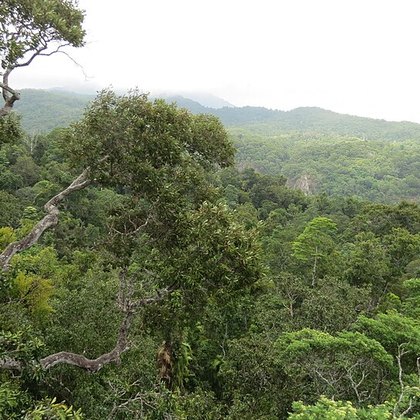
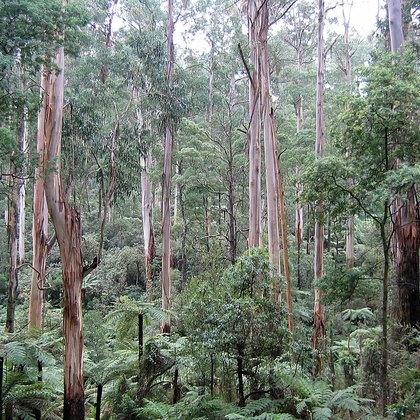
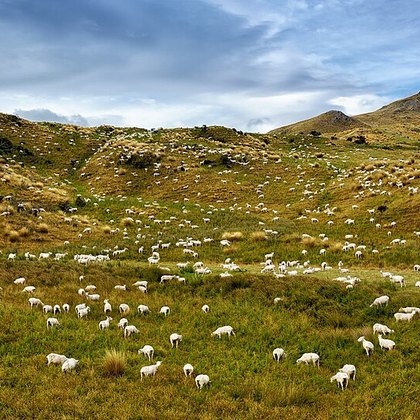
Rainforest and wet forest edges, particularly clearings, young regrowth, logged patches, roadside verges and pasture margins where tall grass seeds. The food is almost entirely half-ripe grass seed, taken by climbing the stems; bamboo and introduced grasses are readily used. The species moves through the year between higher and lower forest: in summer mainly in upland rainforest, in the cooler months more at lower clearings and grasslands.
Where the bird is most often found, arranged by main group and formation.

Range and movements
In the guide's area confined to north-eastern Queensland, in and around the Wet Tropics between roughly Cooktown and the ranges north of Townsville, with the Atherton Tableland as its core. Beyond that the species is far more widespread: New Guinea, parts of Indonesia, the Carolines — where the type specimen came from — the Solomon Islands, Vanuatu and New Caledonia. The Australian share of the world population is small and numbers fluctuate with the seed supply, so the species can be absent from a fixed site for years.
- Resident
- dark = core range, pale = thinly spread
Where and when to look
Look not in the forest but at its edge: a grassy roadside or clearing against tall rainforest, at altitude, with seeding grass. Stand there early in the morning and watch for small green birds dropping low out of the forest and then hanging motionless on a stem. The red rump is often the only field mark one really sees as they fly off.
Conservation
Assessed globally as not threatened: the range is enormous and on many islands the species is common. In Australia it is a small, local population whose size is poorly known, partly because the birds are so inconspicuous and so nomadic. Keeping open, grassy edges alongside intact rainforest — exactly the transitions lost to thickening or to intensive mowing — is the point to watch here.
Scientific name
Erythrura trichroa | (Kittlitz, 1833)
Kittlitz described the species in 1833 as Fringilla trichroa, from a specimen from Kosrae (then Ualan) in the Carolines; because it later moved to another genus, author and year stand in parentheses. trichroa is Greek for 'three-coloured', after the combination of blue, green and red. Swainson introduced the genus Erythrura in 1837, from Greek eruthros 'red' and oura 'tail', after the red rump and tail all parrotfinches share.