All species › Passerines › Munias, parrotfinches, waxbills and allies › Pictorella Mannikin
Pictorella Mannikin | Heteromunia pectoralis
Witborstrietvink | Diamante pectoral
The Pictorella Mannikin is the scarcest of the Australian mannikins and the only one at home in the dry tropical interior: a bird of eleven centimetres with a black face mask and a breast of white, black-rimmed feathers that reads as scaling or mother-of-pearl. It takes grass seed off bare, freshly burnt ground and must come to water every day. Where it stands in dozens one year it can be gone the next.

Voice
The contact note is a soft, thin and slightly plaintive tyew, repeated in flight and barely catchable at ten metres. A drinking party keeps up a low, continuous babble that carries across the water. The male sings a long, quiet and rambling warble, delivered with the breast puffed and the neck stretched; you have to be close to hear it at all. More often than a call you hear the dry rustle of wings as the flock lifts.
Recording: Nigel Jackett — CC BY-NC-SA 4.0 · Track to Marglu Billabong, Parrys Lagoon Nature Reserve, Australia · xeno-canto
Identification
A compact finch of eleven to twelve centimetres, sandy brown above, with a heavy lead-grey conical bill, grey legs and a short, blunt tail. The face is black and sharply bounded; the breast carries a field of white feathers with black margins that at range reads as scaling, and small white spots stand on the wing coverts. In the male that breast field is largely white and the mask deep black; in the female the mask is dark brown and the breast more clearly barred black and white. Young birds are plain grey-brown, without mask or scaling.
Confusion species
Chestnut-breasted Mannikin (Lonchura castaneothorax) shares the same drinking places but has a chestnut breast with a black band below it and an orange-yellow rump that lights up on every departing bird. Yellow-rumped Mannikin (Lonchura flaviprymna) is plain cream below and has no mask. Long-tailed Finch (Poephila acuticauda) and Masked Finch (Poephila personata) carry a yellow or red bill and a long, pointed tail. Only the Pictorella sets a black mask against a scaled white breast.
Habitat
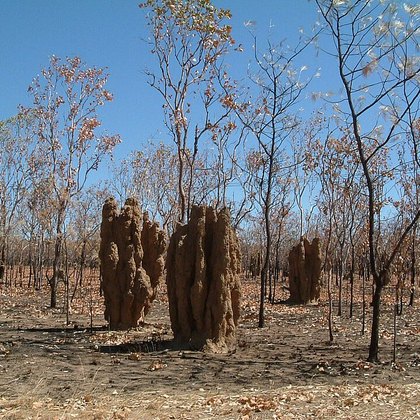
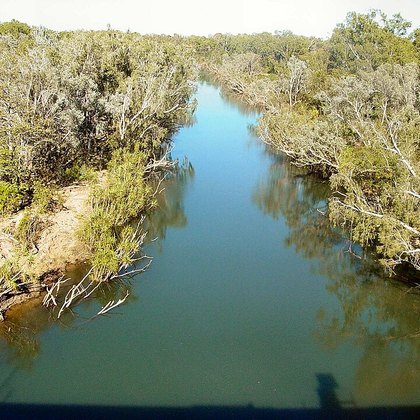
Eucalypt savanna, Mitchell grassland on black soil and the edges of spinifex (spiny, hummock-forming desert grass of the interior) country, always where the grass seeds and the ground between the tussocks stays open. Recently burnt ground is its best feeding place: there the seed lies exposed. It is tied to creeks, stock dams and waterholes, because it cannot go a day without drinking, and it avoids closed forest and the wet coastal belt.
Where the bird is most often found, arranged by main group and formation.


Range and movements
Tropical northern Australia, roughly north of a line from Exmouth in Western Australia to Mackay in Queensland: the Kimberley, the Northern Territory, the Gulf country and northwestern Queensland. It is absent from Cape York and from eastern Arnhem Land. It does not migrate, but it moves with the seed and with the fire, so numbers at any one place swing hard from year to year.
- Resident
- Winter
- dark = core range, pale = thinly spread
Where and when to look
In the dry season, June to September, sit late in the afternoon at a stock dam or waterhole in open savanna and watch for small parties dropping in low and fast. They drink briefly and go. Search burnt ground as well: against black ash the white breast scaling shows from a long way off.
Conservation
Least Concern (LC), but it is the scarcest of the northern seed-eaters and the picture has not improved. Heavy grazing by cattle and feral horses removes the grass seed, and the shift to late, hot dry-season fires leaves too little seed standing for a bird that lives on it. On the black-soil plains of Queensland it has gone from some districts; in the Kimberley it holds up better.
Scientific name
Heteromunia pectoralis | (Gould, 1841)
Gould described the bird in 1841 as Amadina pectoralis; because it later moved to another genus, author and year stand in parentheses. The genus Heteromunia was introduced by Mathews in 1913 and sets Greek heteros, 'other' or 'different', before the genus name Munia given by Hodgson in 1836: it belonged there, and yet it did not. pectoralis is Latin for 'of the breast', after the scaled breast field. The species stood for a long time as Lonchura pectoralis.