All species › Passerines › Munias, parrotfinches, waxbills and allies › Chestnut-breasted Mannikin
Chestnut-breasted Mannikin | Lonchura castaneothorax
Bruinborstrietvink | Capuchino pechicastaño
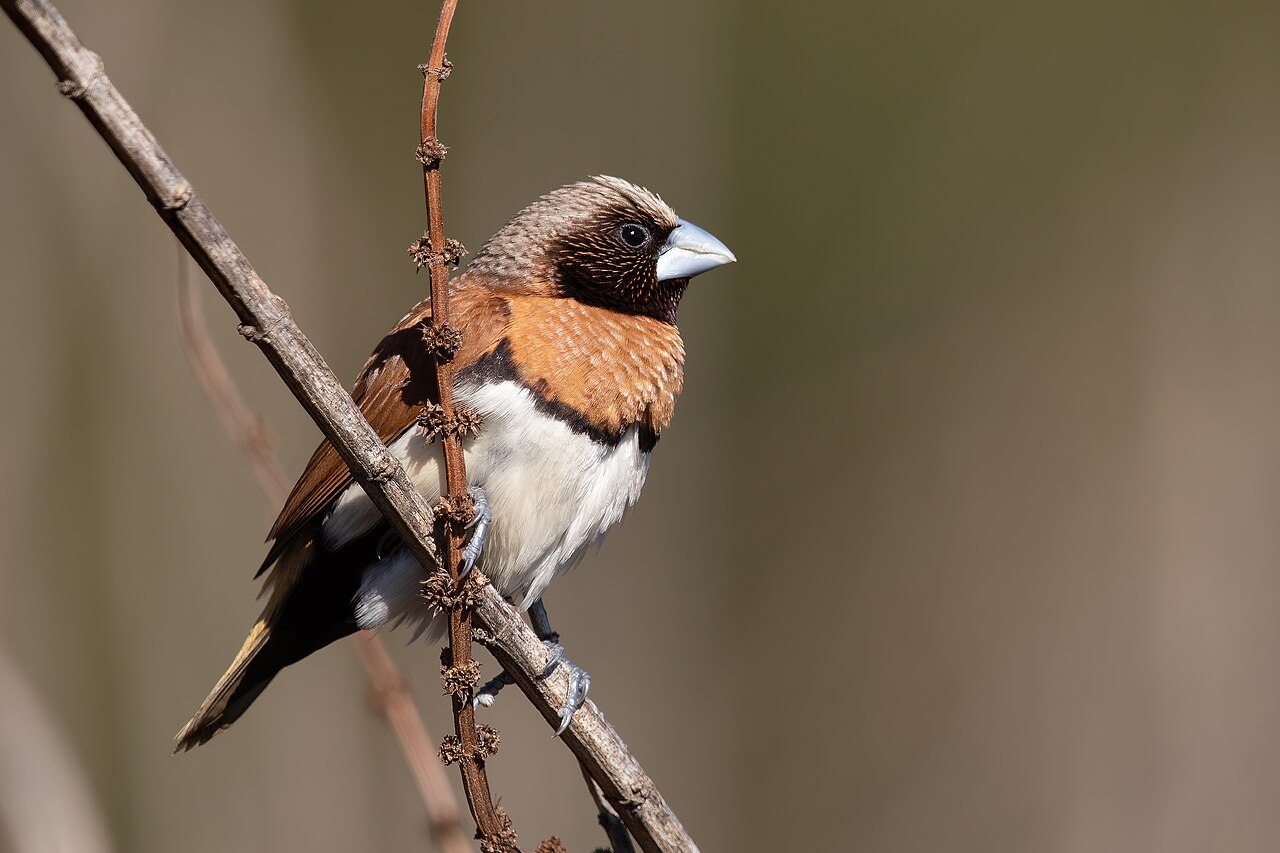
The Chestnut-breasted Mannikin is the commonest mannikin of northern and eastern Australia: a compact seed-eater with a heavy blue-grey bill, a black face, a chestnut breast and an orange-yellow rump that lights up on every departing bird. It is a native species, unlike the Scaly-breasted Munia with which it often shares a flock at the edge of towns.
Voice
A high, thin teet or tyip as contact call, adding up in a flock to a sustained fine tinkling; it is the sound that betrays an invisible flock in the reeds. On flushing, a drier and faster version of the same. The male's song is very soft — a series of muffled clicks, squeaks and a low buzzing part — and inaudible beyond a few metres; he sings with head raised and throat feathers spread.
No freely licensed recording has been found for this species yet; what to listen for is described below.
Identification
Ten to twelve centimetres, compact, with a heavy blue-grey conical bill. Crown and nape are grey, face and throat black and sharply bounded. The breast is warm chestnut, closed off below by a narrow black band; below that the belly is white and the flanks black with white markings. Back and wings are plain warm brown, rump and uppertail-coverts golden to yellow-orange — the best mark at range. Young birds are plain brown-grey above and dirty white to buff below, without mask or breast band, with a dark bill; they are almost always in the company of adults.
Confusion species
Yellow-rumped Mannikin (Lonchura flaviprymna) has a plain pale grey head without a black mask, no chestnut breast and no black breast band; where the two meet in the Top End, hybrids occur with an incomplete mask or half a breast band, and those cannot be named with certainty. Scaly-breasted Munia (Lonchura punctulata) has a plain chocolate-brown head and a scaled white breast, and in Australia is an introduced species. Pictorella Mannikin (Heteromunia pectoralis) has a black mask beside a scaled white breast and lacks any coloured rump. Plum-headed Finch (Emblema modestum) is finely waved below and has a slim black bill.
Habitat
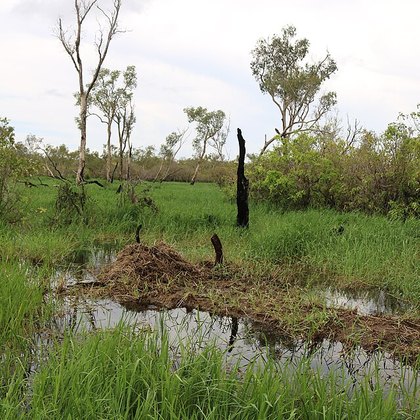
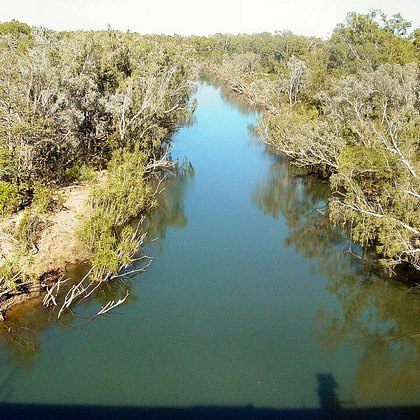
Reeds, rushes and tall grass along swamps, billabongs, creeks, coastal lagoons and rice and cane fields, and adjoining savanna as long as water is within reach. It forages in flocks, climbing the stems and riding the seed heads down with its weight. Mangrove edges, wet pastures and weedy crop margins are used too; in farmland it can do local damage in rice.
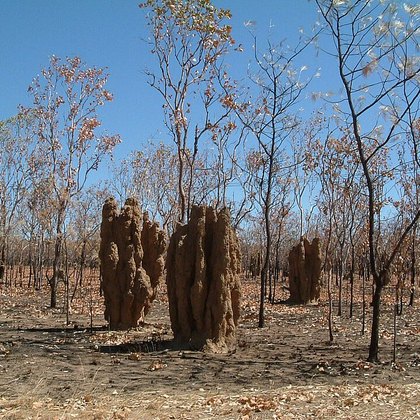
Where the bird is most often found, arranged by main group and formation.

Range and movements
Northern and eastern Australia: from the Kimberley through the Top End and down the Queensland coast into eastern New South Wales, reaching the Sydney region. Also native to New Guinea. Resident with local movement to whatever is ripe: clumping at water in the dry, spreading over fresh grassland in the wet. Outside the natural range, escaped cage birds have founded established populations, among others on Pacific islands and in south-western Australia.
- Resident
- dark = core range, pale = thinly spread
Where and when to look
Walk slowly along a reed fringe and watch for stems swaying without wind. When the flock lifts, look at the rump: the golden-orange patch above the tail is the first and often only thing one sees in a low, fast flight. Drinking places in late afternoon give the best views.
Conservation
Not threatened and common to very common over most of its range; locally it has even increased where rice growing and irrigated grassland supplied new food. At the south-eastern edge it has fallen back locally with the loss of reedland and the hardening of banks. Where the species forages together with Scaly-breasted Munias, it is useful to keep the native and the introduced bird apart in counts.
Scientific name
Lonchura castaneothorax | (Gould, 1837)
Gould described the bird in 1837 as Amadina castaneothorax, from a specimen out of inland New South Wales; because it later moved to another genus, author and year stand in parentheses. The specific name puts Latin castaneus 'chestnut' before Greek thorax 'breast': chestnut-breast, exactly what one sees. Sykes introduced the genus Lonchura in 1832, from Greek lonkhe 'spearhead' and oura 'tail', after the pointed tail of this group.