All species › Passerines › Munias, parrotfinches, waxbills and allies › Yellow-rumped Mannikin
Yellow-rumped Mannikin | Lonchura flaviprymna
Gele rietvink | Capuchino culiamarillo
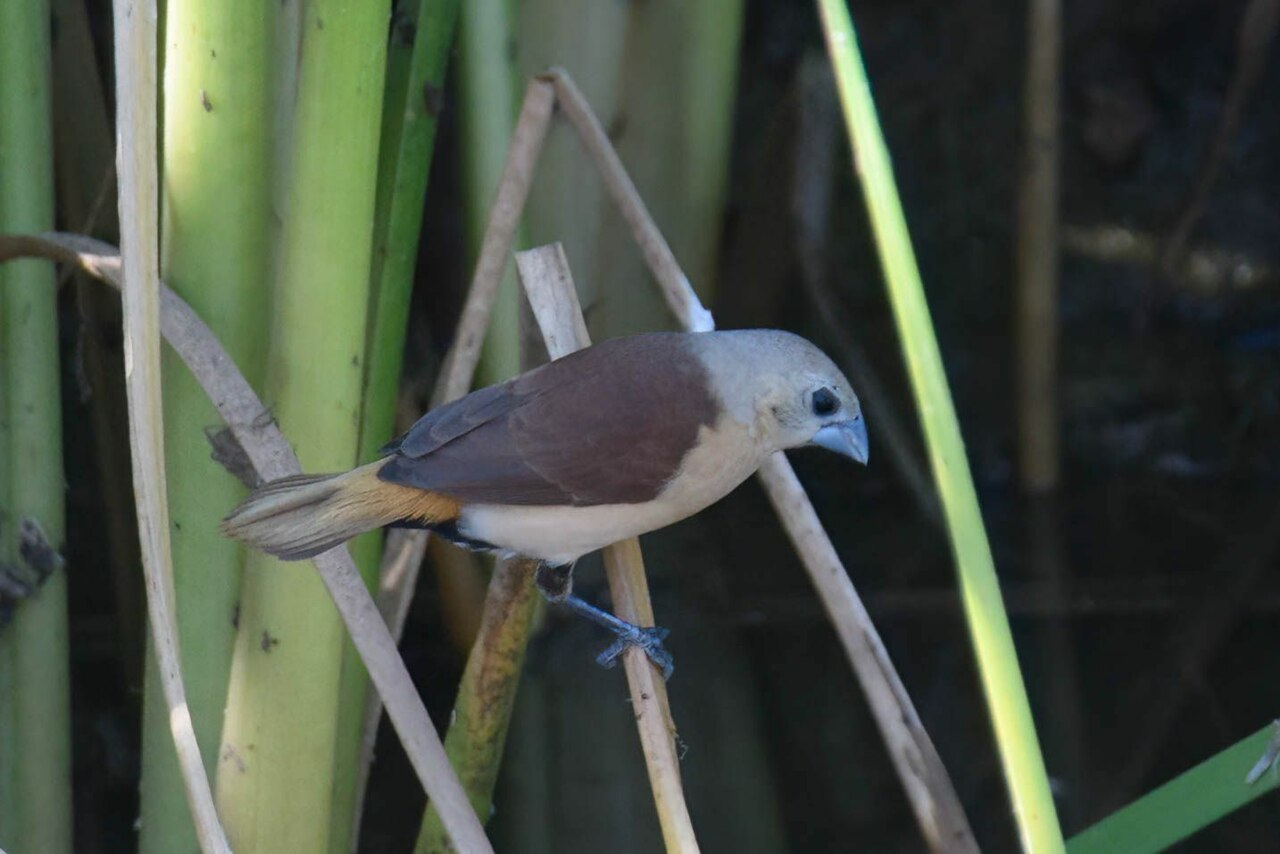
The Yellow-rumped Mannikin is Australia's rarest and most narrowly distributed mannikin: a pale, softly coloured bird of the Top End, with a light grey head, creamy underparts and a warm yellow-orange rump. It lives almost always in the company of the far commoner Chestnut-breasted Mannikin, and hybridises with it as well.
Voice
The contact call is a high, thin teet, in practice not reliably separable from that of the Chestnut-breasted Mannikin; in mixed flocks, voice is therefore no means of identification. On flushing, a rapid series of the same, like a fine tinkling. The male's song is very soft and consists of muffled clicks and a low buzz, audible only at close range and almost always directed at one female.
No freely licensed recording has been found for this species yet; what to listen for is described below.
Identification
Eleven to twelve centimetres, compact, with a heavy blue-grey conical bill. The head is plain light to silver grey, without black mask or black throat. The upperparts are warm light brown to cinnamon, plain and unmarked. The underparts are creamy to dirty white and lack both a chestnut breast and a black breast band. Rump and uppertail-coverts are bright yellow-orange, the undertail-coverts dark. Females look like males. Young birds are plain grey-brown and then hardly separable from young Chestnut-breasted Mannikins.
Confusion species
Chestnut-breasted Mannikin (Lonchura castaneothorax) is the critical species: it has a black face and throat, a chestnut breast and a black breast band, all three absent in the Yellow-rumped. Where the ranges overlap in the Top End the flocks mix and hybrids regularly occur with half a throat patch or an incomplete breast band; such birds cannot be named and should be recorded as hybrids. The two were once treated as one species; they are now regarded as two. Pictorella Mannikin (Heteromunia pectoralis) has a black mask and a scaled breast and lacks the yellow rump entirely.
Habitat
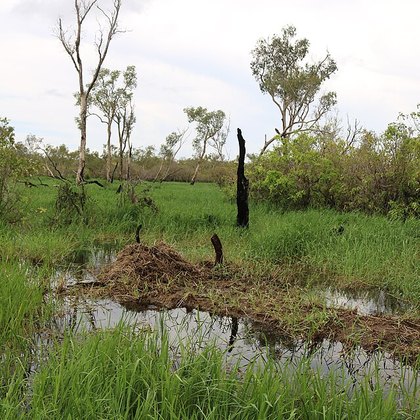
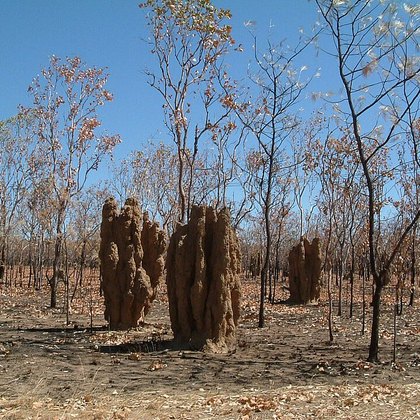
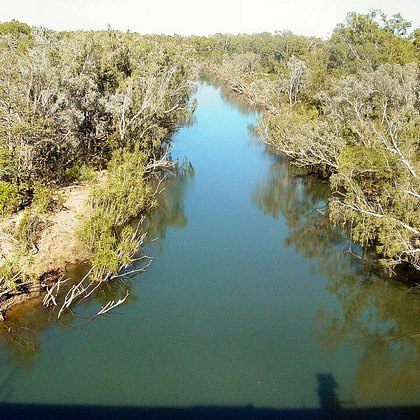
Tall grass, reeds and rushes along rivers, billabongs, swamp edges and stock dams in tropical savanna, and the adjoining floodplain grassland. The diet is that of all mannikins: half-ripe grass seed, taken by climbing the stems. Water within flying distance is a fixed condition, and in the dry season the birds concentrate at the remaining pools.
Where the bird is most often found, arranged by main group and formation.
Range and movements
A small range in northern Australia: from the north-eastern Kimberley in Western Australia east into the north-west of the Northern Territory, with the valleys of the Victoria, Daly and Roper rivers as the best-known areas. Nowhere else in the world does the species occur. Resident with small-scale movements between wet and dry season; numbers are poorly known, partly because the birds sit in mixed flocks and are easily overlooked in counts.
- Resident
- dark = core range, pale = thinly spread
Where and when to look
Scan mixed mannikin flocks stem by stem at a Top End drinking place — almost every record of this species comes out of such a flock. Look for the pale, plain head without black: among the black-masked Chestnut-breasted Mannikins it stands out as a light patch. Watch at the same time for intermediates with half a throat patch and note them separately.
Conservation
Assessed globally as not threatened, but that verdict rests on a small range and on poorly known numbers. Changes in the fire regime, grazing of floodplain grassland to the water's edge and the spread of introduced grasses such as gamba grass are named as the main concerns, because they replace the tall native grass the species lives on. Hybridisation with the Chestnut-breasted Mannikin makes monitoring harder as well: mixed flocks demand careful separation in counts.
Scientific name
Lonchura flaviprymna | (Gould, 1845)
Gould described the bird in 1845 as Donacola flaviprymna, from a specimen from the north coast of Australia attributed to the Victoria River in the Northern Territory; because it later moved to another genus, author and year stand in parentheses. The specific name puts Latin flavus 'yellow' before Greek prumna 'stern, hindmost part': yellow rump. Sykes introduced the genus Lonchura in 1832, from Greek lonkhe 'spearhead' and oura 'tail'.