All species › Passerines › Munias, parrotfinches, waxbills and allies › Scaly-breasted Munia
Scaly-breasted Munia | Lonchura punctulata
Muskaatvink | Capuchino nutmeg
In Australia the Scaly-breasted Munia is not a native bird but an established exotic: an Asian mannikin that has built up flocks from escaped and released cage birds at the edges of the east-coast cities and elsewhere. It is recognised by its plain chocolate-brown head and finely scaled white breast.

Voice
A soft, somewhat plaintive kee-tee or pee-eet as contact call, higher and more whistled than in the native mannikins and often the best mark of a flock in thick grass. On flushing, a rapid series of fine tyip notes. The male's song is very soft: a string of squeaks, clicks and a low buzzing part, with a single higher, upslurred closing note; it is audible only at a few metres.
No freely licensed recording has been found for this species yet; what to listen for is described below.
Identification
Eleven to twelve centimetres, compact, with a heavy blue-grey to lead-coloured conical bill. Head, face and throat are plain dark chocolate-brown, without a sharply bounded mask. Back and wings are warm olive-brown; rump and tail carry an olive-yellow to buff wash that flashes briefly in flight. Breast and flanks are white with coarse, crescent-shaped dark scaling — the mark that gave the species its English name. The belly is plain white. Young birds are plain light brown above and even buff below, entirely unscaled and with a dark bill; they are often taken for another species and are in practice the main identification problem.
Confusion species
Chestnut-breasted Mannikin (Lonchura castaneothorax) has a black face with a grey crown, a chestnut breast with a black band below it and a vivid golden-orange rump — none of which the Scaly-breasted Munia has. Pictorella Mannikin (Heteromunia pectoralis) also has a scaled white breast, but above it a black mask and a coarser, more spotted pattern, and it lives in dry savanna rather than at the edge of town. Plum-headed Finch (Emblema modestum) is finely waved rather than scaled, with a slim black bill and a plum crown. For young birds, call and company help most.
Habitat
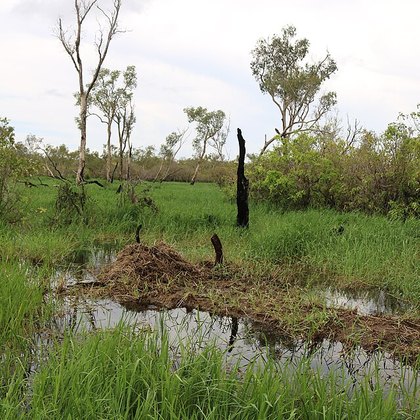
Rank grass, weedy margins, reed fringes, parks, gardens, playing fields, railway embankments and crop edges, almost always in or at the edge of settled country. It forages in flocks on the ground and by climbing seeding grasses and weeds, and comes in gardens to seed tables and to grass run to head. Cane and cereal are used; in the Asian part of the range it counts locally as a pest in rice.
Where the bird is most often found, arranged by main group and formation.


Range and movements
Native to South and South-East Asia, from India and Sri Lanka through southern China into Indonesia and the Philippines. In Australia the species is introduced: escaped and released cage birds founded populations during the twentieth century around the eastern cities — with Brisbane and Sydney as the core — and later elsewhere, among others in the south-west and the tropical north. Beyond the guide's area it is established on a large scale too, from Hawaii to the Caribbean. The Australian populations are resident, moving within an urban setting to whatever is in seed.
- Resident
- dark = core range, pale = thinly spread
Where and when to look
Walk along weedy verges and vacant lots at the edge of town and watch for parties of small brown birds rising out of the grass onto a wire or a shrub. There, sitting still, the scaled breast is seen at once. Look straight away at the plain brown young in the same flock: that is the honest picture of what one actually meets in the field.
Conservation
Not globally threatened and one of the most numerous seed-eating songbirds in Asia, partly because it is among the most widely kept cage birds in the world. In Australia the species is not a conservation target but an established exotic; the point of interest is keeping counts clean, since it occurs in mixed flocks with native mannikins and is mistaken for them. Demonstrated harm to native birds is limited; competition for seed-rich patches at the urban edge is mentioned but not well quantified.
Scientific name
Lonchura punctulata | (Linnaeus, 1758)
Linnaeus described the bird in 1758 as Loxia punctulata, among the crossbills and hawfinches; because it later moved to another genus, author and year stand in parentheses. The type locality reads simply 'Asia' and was later restricted to Calcutta. punctulata is Latin, a diminutive of punctum 'spot': finely spotted, after the scaling on the breast. Sykes introduced the genus Lonchura in 1832, from Greek lonkhe 'spearhead' and oura 'tail'. The cage-bird trade names Nutmeg Mannikin and Spice Finch refer to the nutmeg-brown head.