All species › Passerines › Bowerbirds › Satin Bowerbird
Satin Bowerbird | Ptilonorhynchus violaceus
Satijnblauwe prieelvogel | Pergolero satinado
The Satin Bowerbird is Australia's best-known builder: the male sets up a bower of two upright walls of sticks on the forest floor and lays out everything blue he can find in front of it. It is not a nest: the female builds hers separately, high in a tree fork.
Voice
At the bower a broad and strange repertoire: blowing hisses, mechanical rattles, a swelling electrical buzz and loud mimicry of other forest birds, all in quick, jerky succession. The contact call is a loud, rising weeoo from the canopy, usually the first sign of the species. In winter, when green birds forage together in flocks, what is mostly heard is a soft churring chatter.
Recording: James Ray — CC BY-SA 4.0 · Faulconbridge, Blue Mountains City Council, New South Wales, Australia · xeno-canto
Identification
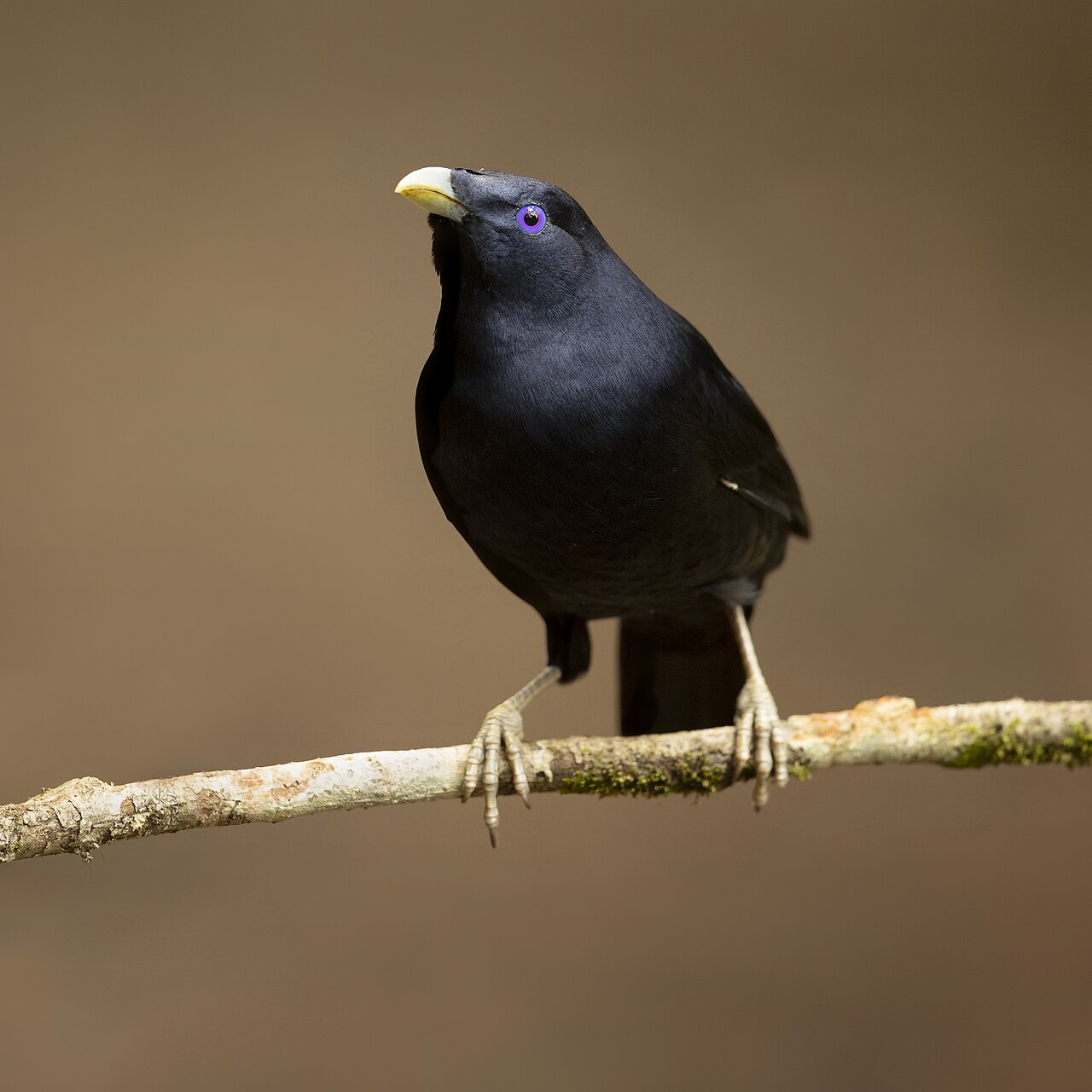
The adult male is entirely glossy blue-black with a pale blue-white bill and a violet-blue iris; in full light the black turns deep purple. Females and young — the 'green birds' — are olive green above and cream below with dark scalloping, with brown wings and the same violet-blue iris. A male needs seven years to gain the black plumage, so by far the most birds one sees are green. The build is compact: 27 to 33 cm, heavy bill, short rounded wings.
Confusion species
Regent Bowerbird (Sericulus chrysocephalus) is smaller and the male black and vivid yellow; the green females resemble each other, but Regent Bowerbird has a dark iris and a blacker crown. Great Bowerbird (Chlamydera nuchalis) is grey-brown and spotted and keeps to drier woodland in the north. A black male is taken at dusk for a starling; the pale bill, the violet-blue iris and the rounded silhouette separate them.
Habitat
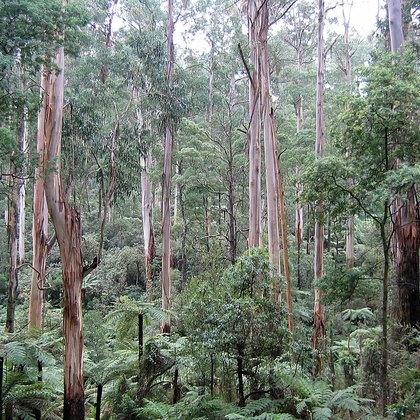
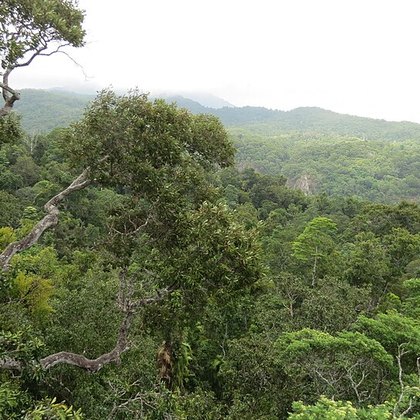
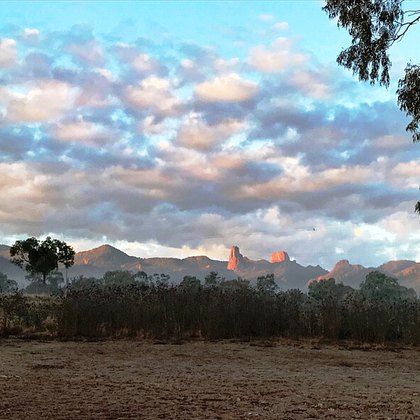
Wet sclerophyll forest and rainforest with a dense shrub layer, where the bower sites are; in winter groups wander to drier woodland edges, orchards, parks and gardens. Around Sydney and Brisbane it reaches suburbs with old gardens, where discarded blue plastic supplies its decoration. The bower stands on a flat, shaded spot with an open view to one side, the same site for years.
Where the bird is most often found, arranged by main group and formation.


Range and movements
Along the east coast of Australia, from south-eastern Victoria north into south-eastern Queensland, with a separate population in the rainforest of the Atherton Tableland in the north. Resident, but with clear seasonal movement: in winter, in June and July, flocks of tens of green birds move to lower and more open country, and in summer they spread out again over the bower sites. The range has hardly changed in the past century, though it is pushing further into urban edges.
- Resident
- dark = core range, pale = thinly spread
Where and when to look
Look not for the bird but for the bower: a two-walled structure of upright sticks on the forest floor, with a pale litter platform and a collection of blue in front of it. It can be found all year and the male returns daily to maintain and rearrange it. The display itself belongs to the warm half of the year, from September to February; go early in the morning, sit down ten metres away and do not move.
Conservation
Not threatened and common throughout its range, including in built-up country. Collected blue plastic sometimes reaches the young; how much harm that does has not been properly studied. The main concern is the loss of moist forest with a dense shrub layer at the edge of the cities.
Scientific name
Ptilonorhynchus violaceus | (Vieillot, 1816)
Vieillot described the species in 1816 as Pyrrhocorax violaceus, among the choughs; because it was later moved to another genus, author and year stand in parentheses. Kuhl introduced the genus Ptilonorhynchus in 1820, from Greek ptilon (feather) and rhynchos (bill), after the small feathers covering the base of the bill. violaceus is Latin for 'violet-coloured', after the purple sheen of the male. The type locality reads 'Nouvelle Hollande' and is understood as Sydney, New South Wales.