All species › Passerines › Bowerbirds › Tooth-billed Bowerbird
Tooth-billed Bowerbird | Scenopoeetes dentirostris
Bruine katvogel | Pergolero dentado
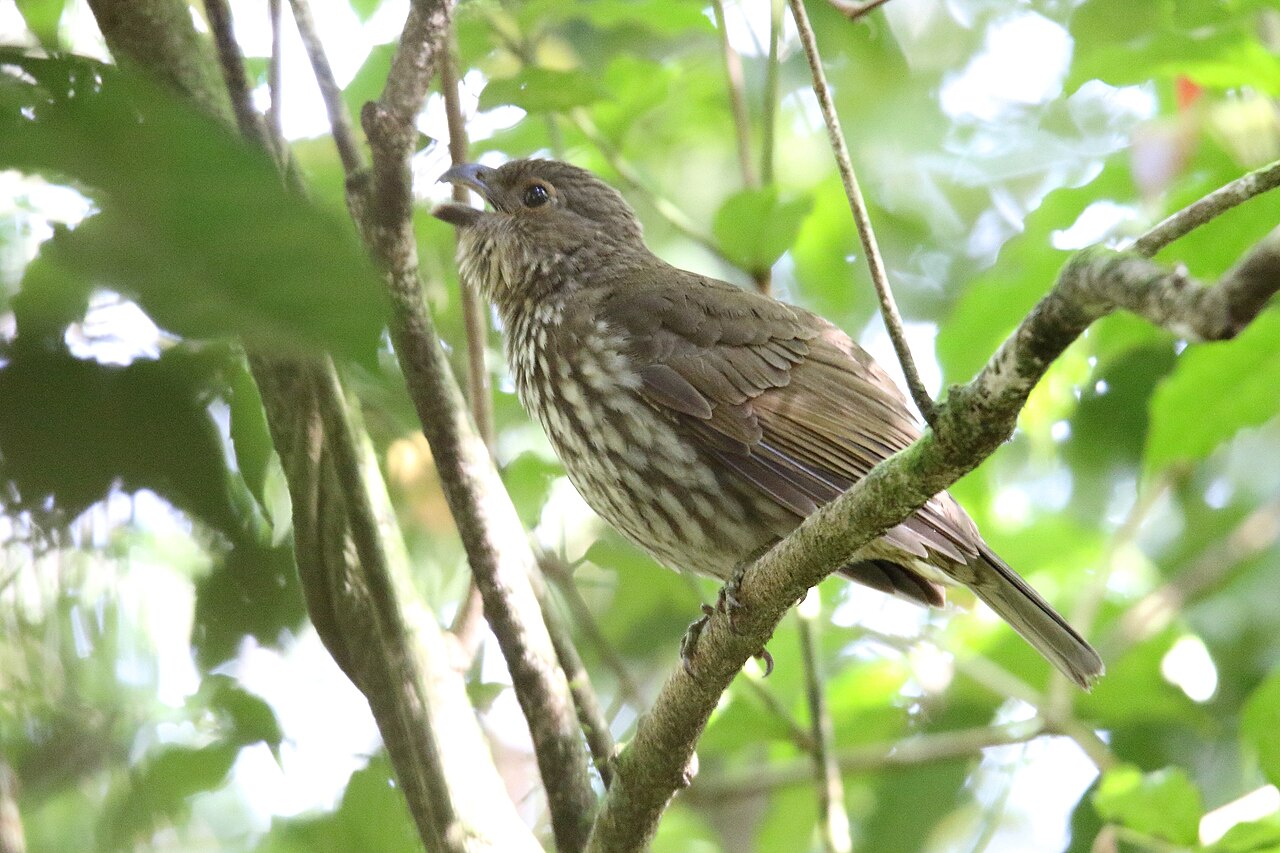
Despite its Dutch name this is not a catbird of the genus Ailuroedus but a bowerbird in its own right, and it builds no bower at all. The male sweeps a court clear on the forest floor, lays fresh cut leaves on it pale side up, and sings above it from a sapling. He carries the tool for it on his face: a heavy bill with two notches with which he snips through leaf stalks.
Voice
From October to January the sound is inescapable: a loud, far-carrying, rasping and explosive song from a sapling above the court, built out of harsh rattles, squalling calls and much mimicry of other rainforest birds. Several males sing within earshot of each other, so that in spring the forest rattles from every side. Outside the song season the species is notably silent and then mostly a sound of rustling leaves.
Recording: Andrew McCafferty — CC BY-NC-SA 4.0 · Lake Eacham, Tablelands Regional, Queensland, Australia · xeno-canto
Identification
A stout, compact forest bird, olive-brown on head, back and wings and cream to dirty yellow below, there closely and sharply streaked dark brown from throat to flank. Male and female look alike. The bill is heavy and dark and carries a clear notch on each side of the upper mandible, the tooth that gives the bird its name. The behaviour is the strongest character and departs from every other bowerbird: no avenue of sticks and no tower, but a cleared court of one to two square metres of forest floor, on which forty to a hundred large, freshly cut leaves are laid pale side up. Wilted leaves are replaced daily; decoration with fruit, shells or coloured objects is entirely absent.
Confusion species
The shared name with the catbirds deceives: the Spotted Catbird (Ailuroedus maculosus) and the Green Catbird (Ailuroedus crassirostris) are bright grass-green above and finely spotted, not olive-brown and streaked, and they have a pale bill and a mewing call. A female or young Victoria's Riflebird (Ptiloris victoriae) lives in the same forest but has a long decurved bill and crosswise arrowhead marks instead of lengthwise streaks. The female Golden Bowerbird (Prionodura newtoniana) is much smaller and plain ash-grey below.
Habitat
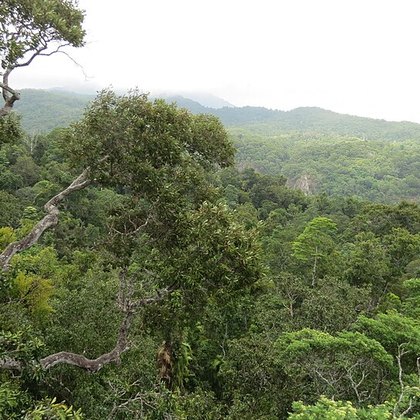
Tropical rainforest with a closed canopy and a shaded, open floor layer on which a court can be made, chiefly above six hundred metres on the tablelands and to a lesser degree lower down along the coastal escarpments. Outside the song season the birds wander to lower forest and to fruiting edges. The species eats mainly fruit and leaves and is thus, unusually for a passerine, partly a leaf eater.
Where the bird is most often found, arranged by main group and formation.
Range and movements
Endemic to the Wet Tropics of north-eastern Queensland, from the hinterland of Cooktown south to about the Paluma area, centred on the Atherton Tableland and the surrounding mountain blocks. Resident with limited altitudinal movement: in the cold months birds drop to lower forest, and in spring the males return to the same court, which is swept clean on the same spot for years on end.
- Resident
- dark = core range, pale = thinly spread
Where and when to look
In the southern spring look for a patch of forest floor that looks too tidy: a round area stripped of twigs with pale leaves laid on it, always under a sapling. Sit down rather than stand, and wait: the male sings there almost without pause in daylight. Wilted leaves on the court show the male has been away a while, fresh leaves that he will be back within minutes.
Conservation
Near Threatened (NT) and locally numerous within its small range. The whole habitat lies almost entirely within the Wet Tropics World Heritage Area, where logging has ended, but the status weighs heavily on the narrowness of that range: the species occurs nowhere else, and severe cyclones can tear open the canopy over large areas in a single season.
Scientific name
Scenopoeetes dentirostris | (Ramsay, 1876)
Ramsay described the species in 1876; because it was later moved to another genus, author and year stand in parentheses. Scenopoeetes goes back to Greek skenopoios (tent-maker, booth-builder), after the court the male lays out. dentirostris is Latin for 'toothed-billed', from dens (tooth) and rostrum (bill), after the notches with which it snips through leaf stalks. The Dutch name bruine katvogel is misleading, for the bird is no Ailuroedus and does not mew; the name tandsnavelprieelvogel, 'tooth-billed bowerbird', also occurs in the literature.