All species › Passerines › Bowerbirds › Regent Bowerbird
Regent Bowerbird | Sericulus chrysocephalus
Geelnekprieelvogel | Pergolero regente
No Australian bird keeps male and female so far apart as this one. The male is velvet black with a broad golden-yellow hood and large yellow wing panels, the female an inconspicuous olive-brown bird with a dark crown. Seen separately they are taken for two species; usually they sit in the same fig tree.

Voice
Soft and unobtrusive, certainly beside the noisy Satin Bowerbird. The usual sound is a nasal, rattling rasp of two or three syllables, besides a high, rising contact whistle between birds in a fruiting tree. At the bower a soft hiss and a little mimicry are added, but it stays private; the bird is almost always seen before it is heard.
No freely licensed recording has been found for this species yet; what to listen for is described below.
Identification
The difference between the sexes is so great that it needs explaining on its own. The adult male is deep velvet black with a golden-yellow crown and nape running as a hood over head and mantle, and with large golden-yellow panels in the wings that flare as a yellow flash in flight; the bill is pale yellow and the eye yellow. The female lacks all of that: grey-brown to olive-brown above, paler and scalloped below, with a dark, almost black crown and a dark bill. Young males resemble the female for years and only gradually show yellow feathers among the brown, so most birds seen are female-coloured. The bower is a simple avenue of two short stick walls, sparsely decorated — a few snail shells, leaves or berries — and the male paints the inner walls with saliva mixed with chewed plant matter.
Confusion species
The brown female is the difficult bird: it resembles the female and young of the Satin Bowerbird (Ptilonorhynchus violaceus), which lives in the same forest. That bird is however larger, clearly olive-green above with coarse dark scalloping below, and has a violet-blue iris and a pale bill; the Regent Bowerbird is browner, smaller and has a blackish crown. The Green Catbird (Ailuroedus crassirostris) of the same forests is bright grass-green, far more heavily built and spotted on throat and head. The black and yellow male can be confused with nothing.
Habitat
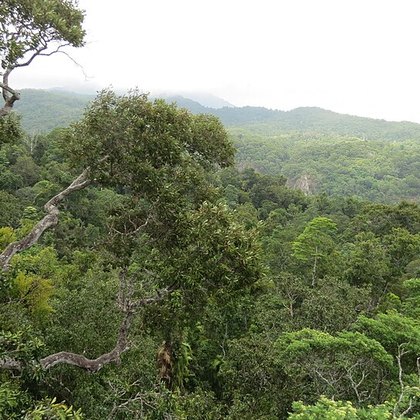
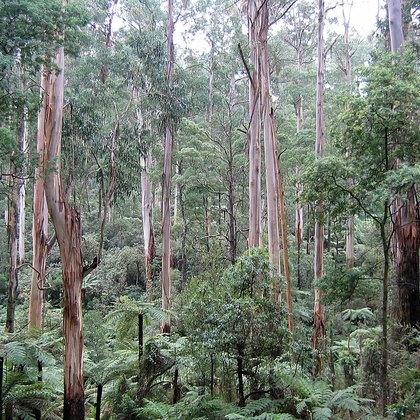
Subtropical rainforest and its moist margins, wet sclerophyll forest with a dense understorey, and in winter also lower fruiting edges, roadsides, orchards, parks and gardens. Around mountain guesthouses in the Lamington area the species comes to feeding tables and can be watched at a few metres. Figs, camphor laurel, lantana and other berry bearers draw groups; the bower stands in deep shade beneath the canopy.
Where the bird is most often found, arranged by main group and formation.

Range and movements
A narrow strip along the east coast of Australia, from about central-eastern Queensland south through the border ranges into north-eastern and central New South Wales, roughly to the Hunter region. Resident with clear altitudinal movement: in winter the birds drop from mountain rainforest to lower and more open country, and in spring they return to the bower sites. The range is fragmented by the historical clearing of coastal rainforest.
- Resident
- dark = core range, pale = thinly spread
Where and when to look
Look for the fruiting tree, not for the bird: a ripe fig or a lantana thicket at the forest edge yields more in half an hour than an hour of scanning the canopy. Watch for the yellow flash in the wing when a dark bird dives into the forest — with this species that is often all one sees. The bower is small and unobtrusive and is overlooked more easily than that of the Satin Bowerbird.
Conservation
Not threatened, although the range is narrow and in many places fragmented by the clearing of coastal rainforest in the nineteenth and twentieth centuries. The core areas now lie within protected World Heritage rainforest reserves. Locally the species actually benefits from introduced berry bearers in gardens and along roads, which bridge the winter.
Scientific name
Sericulus chrysocephalus | (Lewin, 1808)
Lewin described the species in 1808; because it was later placed in another genus, author and year stand in parentheses. Sericulus is a diminutive of Latin sericus (silken), after the silky sheen of the male's plumage. chrysocephalus comes from Greek khrusos (gold) and kephale (head), after the golden hood. In English the bird is the Regent Bowerbird, after the colours of the household of the Prince Regent.