All species › Waders, gulls and terns › Plovers and lapwings › Semipalmated Plover
Semipalmated Plover | Charadrius semipalmatus
Amerikaanse bontbekplevier | Chorlitejo semipalmado
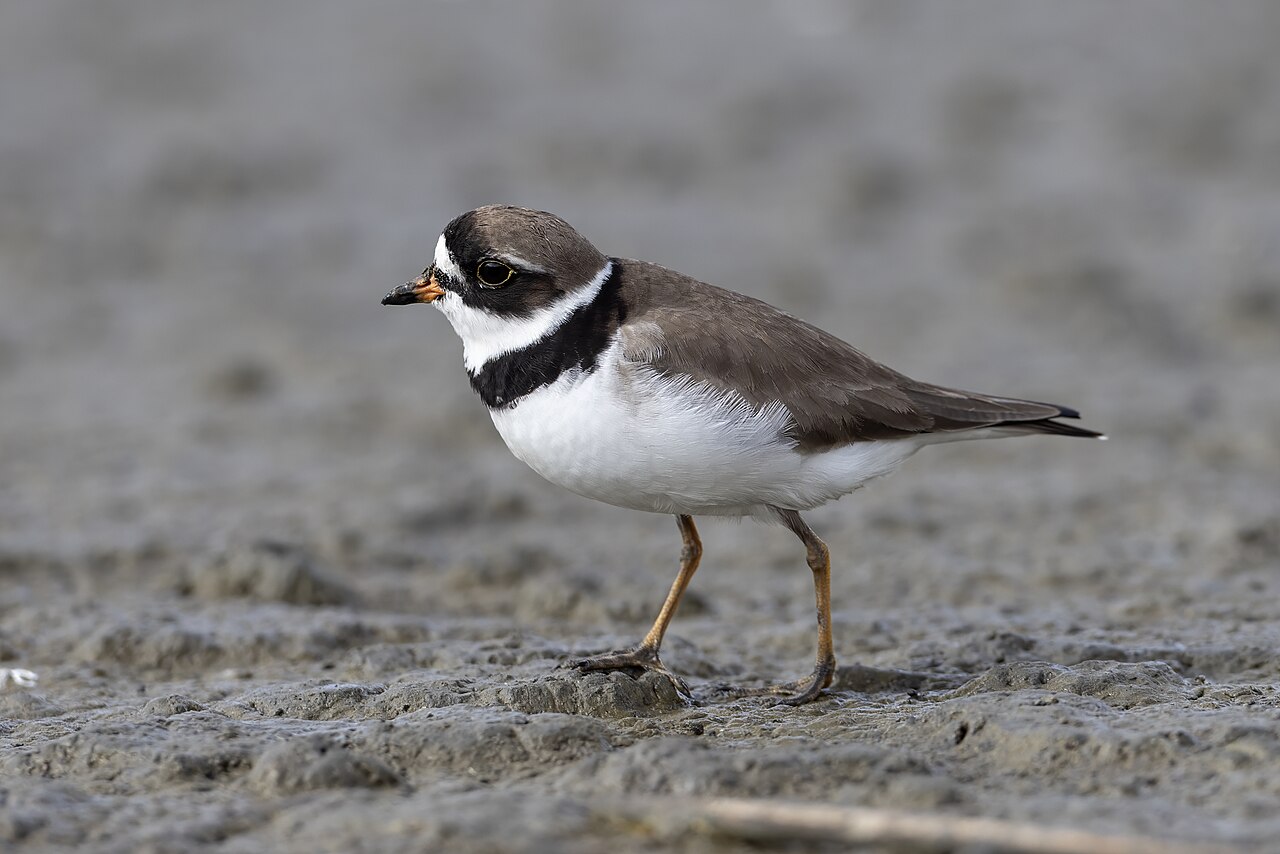
The Semipalmated Plover is the New World counterpart of the Common Ringed Plover: a small, rounded plover with a single dark breast band, a short blunt bill with an orange base and dull yellow legs, and with a striking yellow orbital ring. It breeds in northern Canada and Alaska and normally winters along American coasts; a bird seen here has crossed half the Pacific in the wrong direction.
Voice
The call is a clear, sharp and distinctly rising two-note whistle, chu-weet or chi-wee, shorter and more emphatic than the plaintive too-lee of the Common Ringed Plover. In alarm it becomes a fast repeated chip-chip. On the breeding grounds the male gives a sustained rattling song in a fluttering display flight, never to be heard in this part of the world.
No freely licensed recording has been found for this species yet; what to listen for is described below.
Identification
A small, compact plover of eighteen centimetres and just under fifty grams, grey-brown above and white below, with one dark band across the breast that is often a shade narrower than on Common Ringed Plover. The forehead is white, with a black bar above it and a dark mask through the eye; a small white supercilium shows behind the eye. The bill is short and blunt, orange with a black tip in breeding plumage and almost wholly dark in winter; the legs are dull yellow. Diagnostic is the complete, bright yellow orbital ring, obvious at close range. As the name says there is webbing between all three front toes, but that is almost never visible in the field.
Confusion species
Common Ringed Plover (Charadrius hiaticula) is the only real confusion and the differences are fine: it is slightly larger and longer-billed, has orange rather than dull yellow legs, a broader white forehead, a broader black breast band, no clear white supercilium and at most an incomplete, dark orange orbital ring. The call settles it: rising and sharp here, soft and falling in Common Ringed Plover. Red-capped Plover (Anarhynchus ruficapillus) and Kentish Plover (Anarhynchus alexandrinus) never show a complete breast band and are paler and longer-legged. Double-banded Plover (Anarhynchus bicinctus) is larger, longer-winged and has greenish-yellow legs in every plumage. Siberian Sand Plover (Anarhynchus mongolus) is bulkier, lacks the white forehead-and-collar pattern and has a longer, all-black bill.
Habitat
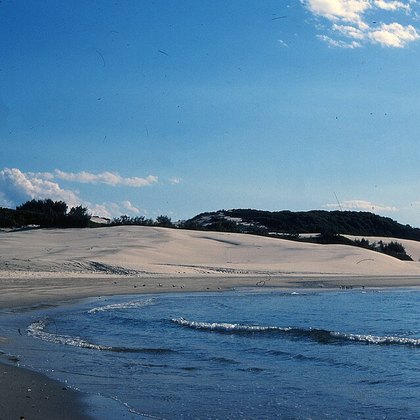
Tidal flats, mud margins and sandbars in estuaries and harbours, where it feeds among the common shorebirds. Also sandy beaches with stranded weed, shallow coastal lagoons and the muddy edges of sewage farms and saltpans. Like its Old World counterpart it wants open, flat ground with a clear view.
Where the bird is most often found, arranged by main group and formation.

Range and movements
A very rare vagrant within the map window. New Zealand has four accepted records: a bird from 1983 to 1985, one seen at several sites from December 2009 to October 2010, and one at Kaipara Harbour in June and July 2024. Australia likewise has a handful of records, among them the first for South Australia in 2021, and there is a single record from Norfolk Island. Birds sometimes stay for months at one high-tide roost, so a record is usually looked over by many observers.
- Resident
- Breeding (summer)
- dark = core range, pale = thinly spread
Where and when to look
Do not look for it, listen for it: in a flock of plovers at a roost the rising chu-weet stands out against the flat notes of Red-capped Plovers. Then work on the orbital ring at close range — no other plover here shows so obvious a complete bright yellow ring around the eye. Come back: these vagrants often stay faithful to the same flat and the same state of tide for weeks.
Conservation
Least Concern (LC), with a large breeding range across northern Canada and Alaska and a population put at well over half a million birds, stable or slightly increasing. The species benefits from not depending on one narrow chain of staging sites, as so many migrant shorebirds do. For Australia and New Zealand it is too rare to raise a conservation question of its own.
Scientific name
Charadrius semipalmatus | Bonaparte, 1825
Bonaparte described the species in 1825 in the Journal of the Academy of Natural Sciences of Philadelphia as Charadrius semipalmatus, and it has stayed in that genus, so author and year carry no parentheses. The type locality is the sea coast of New Jersey. Charadrius goes back to Greek kharadrios, a bird of ravines. semipalmatus is Latin for 'half-webbed', from semi, 'half', and palma, 'palm': the front toes are joined at the base by small webs, a character carried in both the scientific and the Spanish name.