All species › Waders, gulls and terns › Plovers and lapwings › Red-kneed Dotterel
Red-kneed Dotterel | Erythrogonys cinctus
Roodknieplevier | Chorlito pechinegro
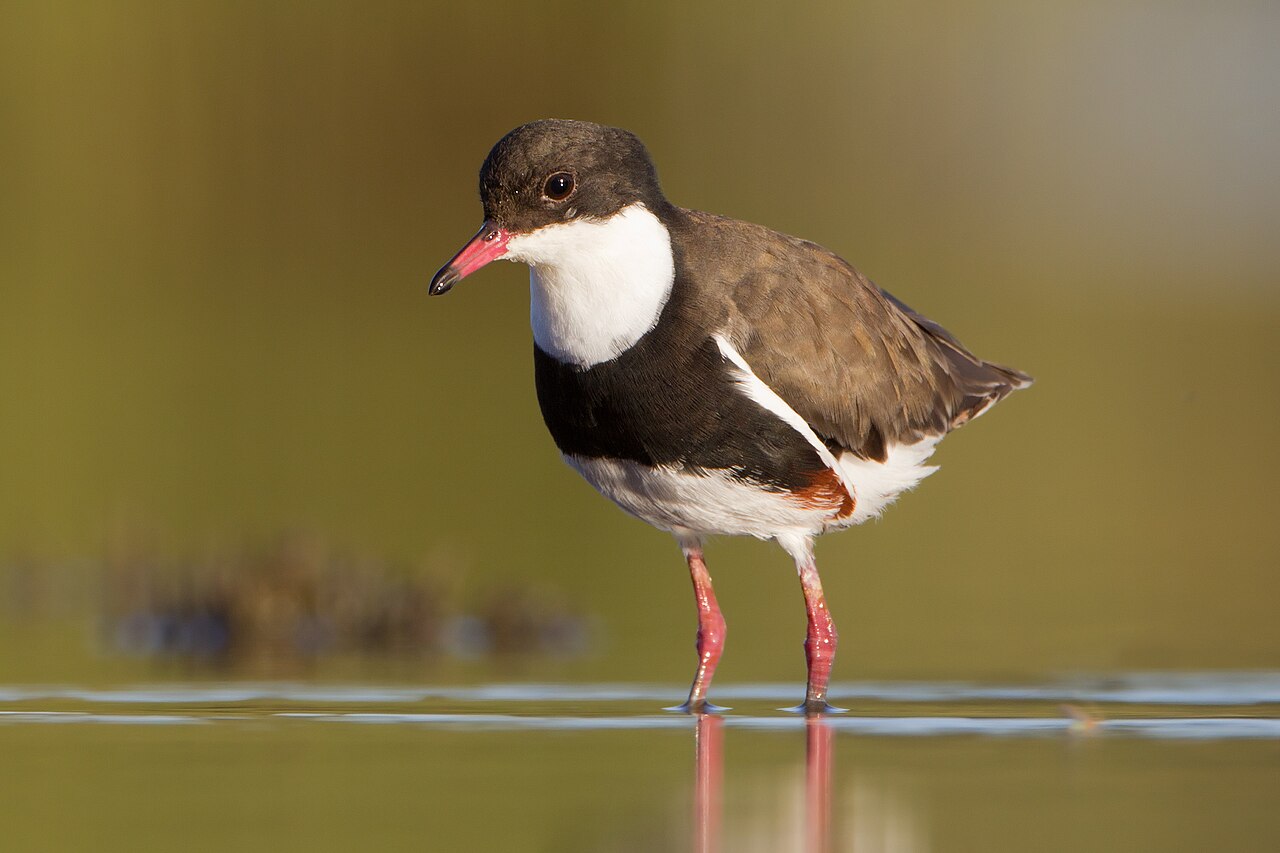
The Red-kneed Dotterel is the most strongly marked plover of the Australian interior: a black cap that encloses the whole eye, a white throat, a black breast band and chestnut flanks, and below all that a pair of legs that are bright red above the joint. It belongs to fresh water, is nomadic, and turns up wherever a swamp fills somewhere inland.
Voice
The alarm call is a quick, high, sharp wit-wit, two notes close together, usually as the bird lifts off the bank. While feeding, a softer, short yapping note passes between the birds of a party. It has no true song.
No freely licensed recording has been found for this species yet; what to listen for is described below.
Identification
A small, plump plover of seventeen to nineteen centimetres. The black cap runs from the upper mandible over the crown down below the eye and low into the hindneck, cutting sharply against the white throat; across the breast is a black band that passes at the sides into warm chestnut flanks. The bill is short and red with a black tip. The legs are the species' signature: bright pinkish-red above the joint — the 'knee' of the name — and green-grey below it. Young birds are brown where adults are black.
Confusion species
Along the same freshwater edge walks Black-fronted Dotterel (Thinornis melanops), but that bird has no cap: only a black forehead and a black mask through the eye, a V-shaped band on the breast and a chestnut shoulder stripe, and it lacks the red on the legs. Double-banded Plover (Anarhynchus bicinctus) carries two straight bands and a dark bill. Hooded Plover (Thinornis cucullatus) also has a black cap, but a wholly black one with no white throat, and it stands in ocean surf rather than an inland swamp. No other plover in this region combines the black cap with chestnut flanks and red thighs.
Habitat
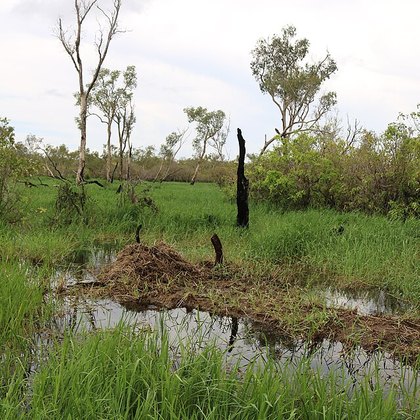
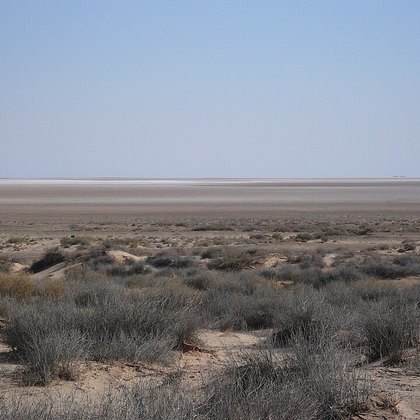
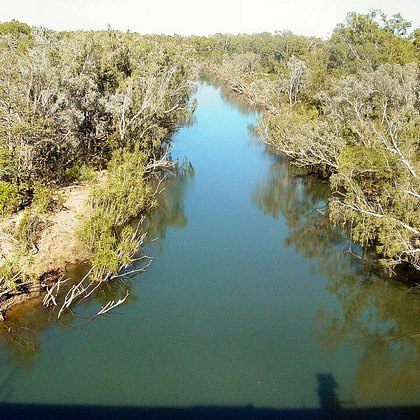
Shallow freshwater marshes, lagoons, stock dams, flooded plains and claypans with a muddy edge and some reed or low herbage along it; it rarely uses saline water. Unlike most plovers it wades well out and will even swim briefly while feeding. Its food is aquatic insects and their larvae, small molluscs, worms and seeds, taken from the bottom and from the mud edge.
Where the bird is most often found, arranged by main group and formation.

Range and movements
Across the whole Australian mainland, from the Murray-Darling plains to the Kimberley and the Top End, and on north into southern New Guinea; in Tasmania it is an irregular visitor and in New Zealand a vagrant. Within Australia it moves strongly with the water: it leaves an area as the swamps dry and appears in flocks as soon as a flood puts a new plain under water, sometimes hundreds of kilometres from where it was the year before.
- Resident
- dark = core range, pale = thinly spread
Where and when to look
After a wet spell, drive past inland dams, floodplains and drying lakes and walk the muddy edge; the bird stands out the moment it moves, because the black cap and white throat give far more contrast than the other small plovers. In doubt, look at the legs rather than the head: the red above the joint is shown by no other species in this region.
Conservation
Least Concern (LC), with no sign of any appreciable decline. The species is tied to the erratic water years of the interior and can absorb large swings simply by moving to the next flooded marsh; artificial waters such as stock dams and reservoirs help in that. Its greatest vulnerability lies in the water management of the large river systems, where extraction can flatten the natural flooding rhythm.
Scientific name
Erythrogonys cinctus | Gould, 1838
Gould described the species in 1838 as Erythrogonys cinctus, in his Synopsis of the Birds of Australia, placing it at once in a new genus he erected for it; since it still stands there as the only species, author and year carry no parentheses. Erythrogonys is Greek for 'red-knee', from eruthros, 'red', and gonu, 'knee'. cinctus is Latin for 'girdled' or 'banded', after the black breast band. The type locality is New South Wales.