All species › Waders, gulls and terns › Plovers and lapwings › Inland Dotterel
Inland Dotterel | Peltohyas australis
Australische renplevier | Chorlito australiano
The Inland Dotterel is the only wader in the world that lives in the desert year-round, far from any water. It walks the gibber plains and claypans of Australia's dry heart, eats leaf tips by day and insects by night, and carries a black Y across a white breast that no other bird of this region shows.

Voice
It is usually silent. Anyone who hears it hears the flight call: a short, guttural trill, krroot or krrr, low and rolling, often in the dark as a party lifts off the road. Around the nest comes a soft, short moaning note. There is no song.
No freely licensed recording has been found for this species yet; what to listen for is described below.
Identification
A plover of nineteen to twenty-three centimetres with a small, well-rounded head, a short fine bill and relatively long legs. The upperparts are sandy buff streaked dark brown, exactly the colour of the gibber it walks on. A black band runs across the crown and through the eye, and on the white breast stands a striking black Y-shaped or anchor-shaped band running down from the hindneck; the belly carries a rufous patch. Young birds are duller and show almost no black. In danger it prefers running to flying, and above forty degrees it seeks the shade of a bush.
Confusion species
On the dry plain it shares ground with Banded Lapwing (Vanellus tricolor), but that is far larger, with a yellow bill and a red wattle and a straight black breast band rather than a Y. Australian Pratincole (Glareola isabella) walks the same gibber and claypans and also has a dark belly patch, but is slimmer, with long pointed wings, a forked tail and a floating, swallow-like flight. Oriental Plover (Anarhynchus veredus) uses dry grassland in summer too, but is slimmer and longer-legged with pale yellow legs and shows no trace of the Y. Red-kneed Dotterel (Erythrogonys cinctus) has a black cap and red legs and belongs to fresh water, not to the desert.
Habitat
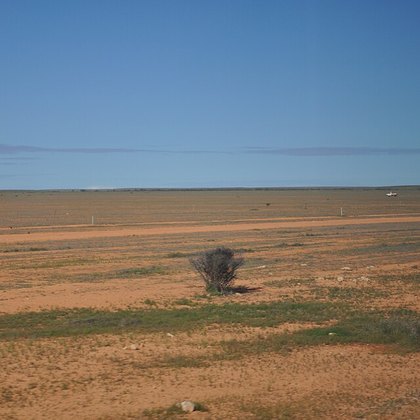
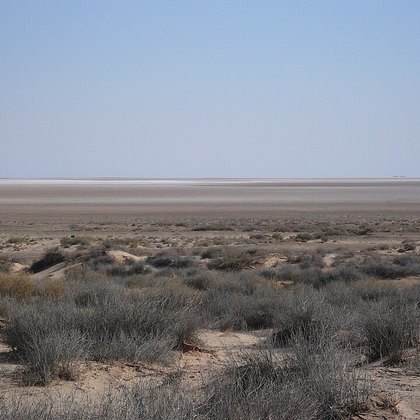
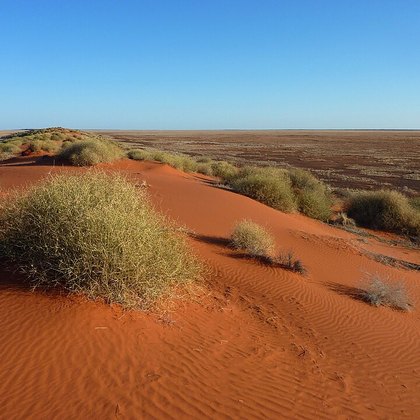
Flat, all but bare gibber plains, gravel flats, claypans and gilgai country with scattered saltbush, bluebush or samphire twenty to forty centimetres high. By day it eats the tips of desert shrubs, and by night it hunts spiders, grasshoppers, beetles, ants and earwigs, often along the edge of an outback road. Salt glands let it process saline plant matter and draw its water from it, so that it can go year-round without a drinking place.
Where the bird is most often found, arranged by main group and formation.

Range and movements
The dry interior of mainland Australia only, mainly south of the Tropic of Capricorn and confined to country receiving less than a hundred millimetres of summer rain; that produces a range map which very nearly matches the map of summer drought. Within that area it occurs in every mainland state, but always at low density and with strong shifts between years, according to where the rain has fallen.
- Resident
- Winter
- dark = core range, pale = thinly spread
Where and when to look
Do not look for it in the heat of the day but early in the morning or late in the afternoon, when the loose parties of ten to twenty birds work across the gibber; occasionally hundreds stand together. Drive a gravel road at walking pace and watch for movement, because the pattern makes it vanish completely when it is still. At night it is easiest: in the headlights it runs the roadside after insects.
Conservation
Least Concern (LC), with a population described as relatively large and stable, though no reliable figures exist; in Victoria it does stand as vulnerable on the state list. Its range is largely too dry to develop, which protects it, but grazing by sheep and rabbits can remove the low saltbush it needs for shade and food, and foxes and feral cats now reach the gibber plains as well.
Scientific name
Peltohyas australis | (Gould, 1841)
Gould described the species in 1841 as Eudromias australis in the Proceedings of the Zoological Society of London; because of the later move, author and year stand in parentheses. australis is Latin for 'southern'. The type locality is simply the interior of Australia. The genus Peltohyas was introduced by Sharpe in 1896: the name combines Greek pelte, 'small shield', with the old genus name Hyas for the dotterels, where Gould at first took this bird to belong. Its affinities were long disputed; molecular work now places it within the plovers.